Think about the last political argument you saw online. Someone was relentless. They posted inflammatory takes, attacked anyone who disagreed, and seemed to feed off the chaos. You probably assumed they just cared deeply about politics.
They might not care about politics at all. They might just have dark personality traits.
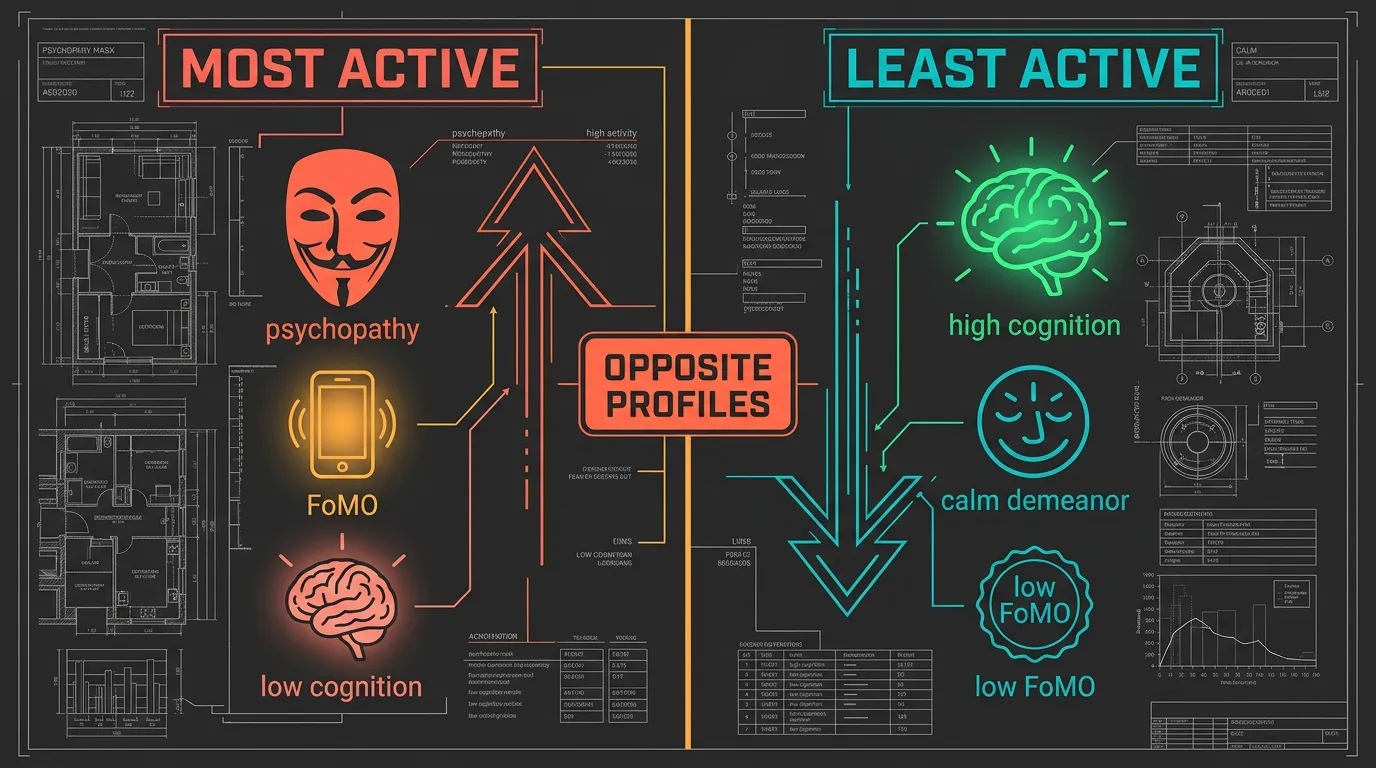
A massive study published in Nature’s Humanities and Social Sciences Communications surveyed over 8,000 people across eight countries. It found something disturbing. The people most active in online political spaces are disproportionately high in psychopathy and fear of missing out.[1] And those with both high psychopathy and low cognitive ability are the most politically active of all.
What the Nature Study Actually Found
The study was led by Saifuddin Ahmed at Nanyang Technological University. His team used quota sampling to survey participants in the United States, China, Singapore, Indonesia, Malaysia, the Philippines, Thailand, and Vietnam.[1] They measured dark personality traits using the Short Dark Triad scale, cognitive ability using the Wordsum vocabulary test, FoMO levels, and six types of online political activity like commenting, sharing, and posting political content.
The findings were consistent across cultures.
- Psychopathy predicted higher online political participation in all eight countries
- FoMO was a universal driver of online political engagement across every country studied
- Narcissism predicted participation in only three countries: the United States, the Philippines, and Thailand
- Higher cognitive ability was linked to lower online political participation in every single country
That last finding stings. People with stronger critical thinking skills were consistently less likely to jump into online political debates.[2]
The interaction between psychopathy and cognitive ability was even more alarming. In five of the eight countries, the link between psychopathy and political engagement was strongest among people with low cognitive ability.[1] The people dominating online political conversations often combine impulsive, emotionally detached traits with weaker reasoning skills.
“Those most active in online political spaces are often motivated less by civic-minded intentions and more by psychological and cognitive factors.” - Saifuddin Ahmed, Nanyang Technological University
This does not mean smart people never engage politically online. It means the loudest and most frequent voices are statistically more likely to be driven by personality traits rather than genuine civic interest.
| Finding | Scope | Consistency |
|---|---|---|
| Psychopathy predicts participation | All 8 countries | Universal |
| FoMO predicts participation | All 8 countries | Universal |
| Higher cognition = less participation | All 8 countries | Universal |
| Narcissism predicts participation | US, Philippines, Thailand only | Cultural variation |
| Low cognition + psychopathy = most active | 5 of 8 countries | Strong pattern |
Recommended read: The Chaos Machine by Max Fisher — how social media algorithms amplify the most extreme and emotionally charged voices in political spaces.
Inside the Dark Triad, Psychopathy, Narcissism, and Machiavellianism
To understand why these personality types dominate online politics, you need to understand what the Dark Triad actually is. It is a cluster of three personality traits that psychologists have studied for decades.[3]
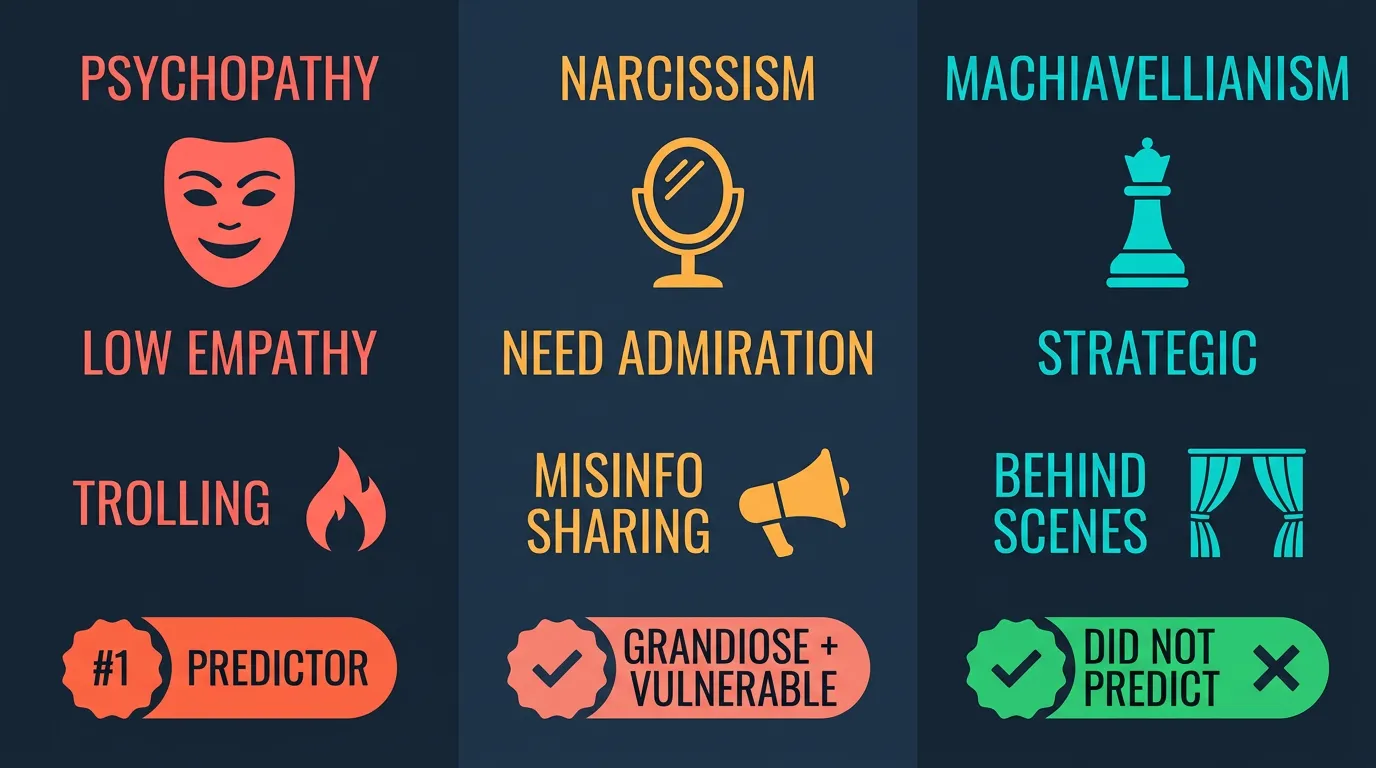
Psychopathy
People high in psychopathy show reduced empathy, high impulsivity, and a willingness to manipulate others without guilt. They are drawn to conflict the way most people are drawn away from it. Online political fights give them exactly what they want. Confrontation without real consequences.
Research shows psychopathy is the strongest predictor of internet trolling behavior, outperforming both narcissism and Machiavellianism.[4] A 2024 study confirmed that psychopathy predicts both active trolling and bystander toleration of trolling, especially when combined with low agreeableness.[5]
Narcissism
Narcissism involves grandiosity, a constant need for admiration, and a fragile sense of self-worth that depends on external validation. Political debates online are a perfect stage. Every like, share, and reply is a dose of the attention narcissists crave.
There are two types that show up differently online. Grandiose narcissists use political arguments to assert dominance and display their superiority. Vulnerable narcissists lash out when they feel slighted or ignored.[6] Both types make political discussions more toxic. If you have ever noticed the signs of a covert narcissist in your personal life, you will recognize similar patterns in online political spaces.
A 2024 study found that narcissists are also more likely to spread political misinformation. They are less skeptical of conspiracy theories, and sharing controversial content gets them the attention they seek.[7]
Machiavellianism
Machiavellianism is the strategic, calculating side of the triad. People high in this trait view others as tools to be used. Interestingly, the Nature study found that Machiavellianism did not predict online political participation the way psychopathy and narcissism did.[1]
This makes sense. Machiavellians prefer to work behind the scenes. They are the ones running disinformation campaigns and pulling strings, not the ones arguing in comment sections. You can learn more about their manipulation tactics in everyday life.
| Dark Triad Trait | Core Feature | Online Political Behavior |
|---|---|---|
| Psychopathy | Low empathy, high impulsivity | Aggressive commenting, trolling, provoking |
| Narcissism | Need for admiration | Posting hot takes, seeking likes and shares |
| Machiavellianism | Strategic manipulation | Behind-the-scenes influence, not public debate |
Recommended read: It’s Not You by Ramani Durvasula — a clinical guide to identifying and protecting yourself from narcissistic behavior patterns in relationships and online.
Why Dark Personalities Thrive in Online Politics
Online political spaces are not designed for thoughtful debate. They are designed for engagement. And dark personality traits map perfectly onto the features that drive engagement.
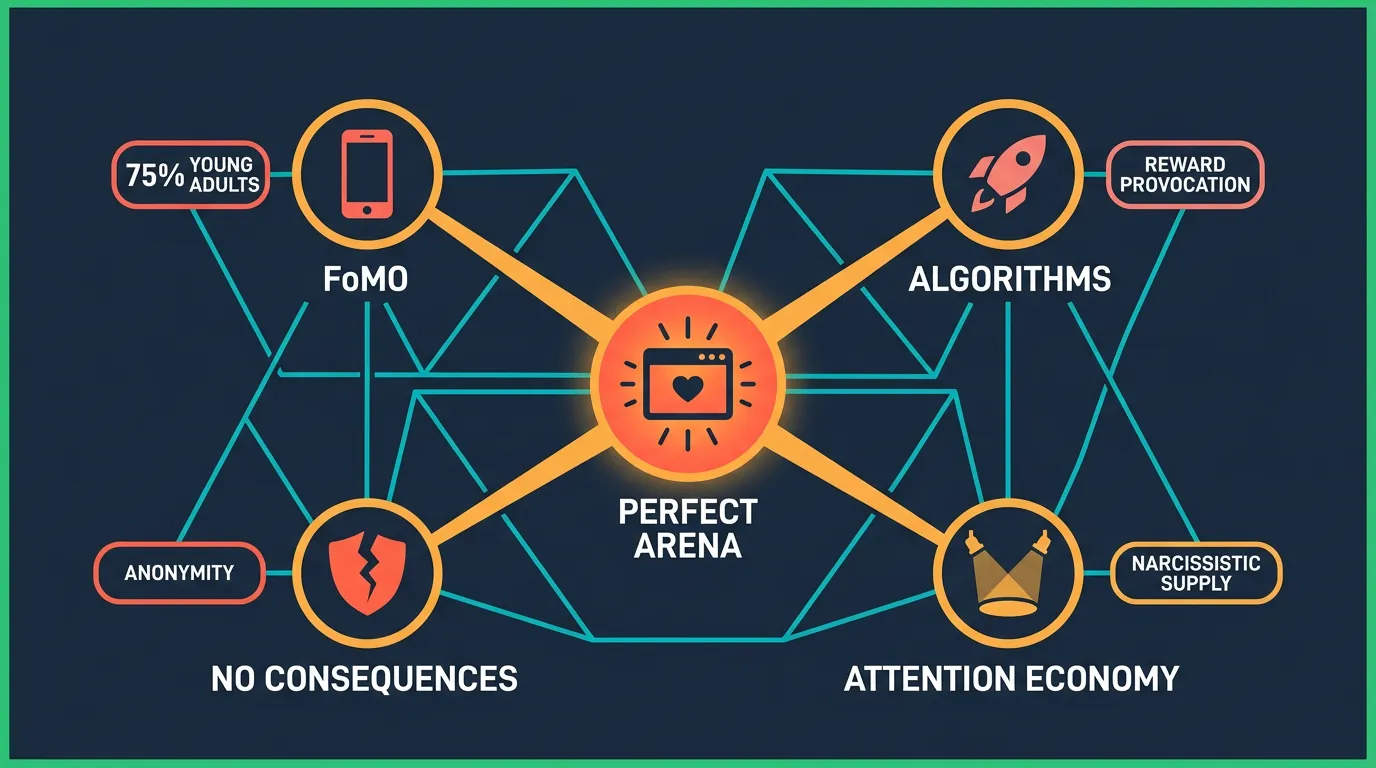
FoMO Keeps Them Plugged In
Fear of missing out was a universal predictor of online political participation across all eight countries in the Nature study.[1] FoMO creates a compulsive need to stay connected to what others are doing and saying.
About 75% of young adults report experiencing FoMO regularly.[8] When combined with dark personality traits, FoMO turns casual political interest into obsessive engagement. People feel anxious about missing the latest controversy, the newest outrage, the biggest argument.
This is not civic engagement. It is compulsive behavior driven by the fear of social exclusion.
Algorithms Reward Provocation
Social media platforms amplify emotional, provocative content because it drives the most engagement. A post that makes people angry gets more shares than one that makes them think. This creates a system that rewards exactly the behaviors psychopathic and narcissistic individuals naturally display.
- Inflammatory posts get pushed by algorithms designed for maximum engagement
- Personal attacks generate more replies than policy analysis
- Extreme positions get amplified over nuanced ones
- Outrage cycles create the perfect environment for people who feed on conflict
No Real Consequences
In a face-to-face political discussion, aggressive behavior carries social costs. People avoid you. Relationships break down. But online, there is almost no penalty for being hostile. You can attack strangers, make outrageous claims, and move on to the next target.
This lack of consequences is especially attractive to people high in psychopathy. Research on the online disinhibition effect shows that anonymity and physical distance lower people’s behavioral inhibitions.[9] For someone already low in empathy and high in impulsivity, the internet removes the last remaining guardrails.
The Attention Economy
Every political post is a bid for attention. For narcissists, this is intoxicating. The metrics of social media, likes, shares, follower counts, are basically narcissistic supply delivered in real time.
A 2024 study in Frontiers in Communication found that narcissistic tendencies strongly predict misinformation sharing because the act of sharing controversial content attracts the attention and validation narcissists need.[7] A separate 2025 study found that malicious envy mediates the link between narcissism and trolling behavior, meaning narcissists troll because they resent others getting attention they feel they deserve.[10]
Recommended read: Foolproof by Sander van der Linden — the science of why misinformation spreads and how to build psychological immunity against manipulation.
How This Warps Political Reality for Everyone
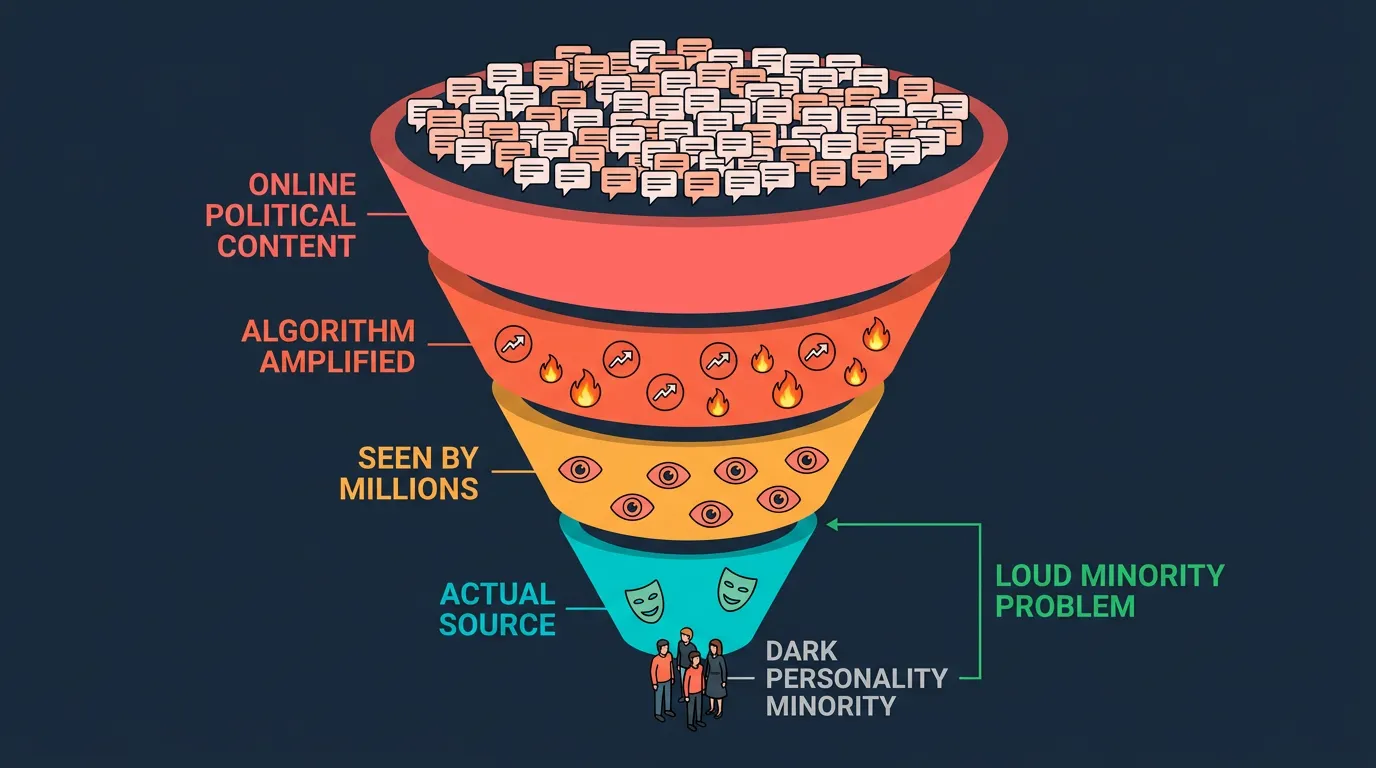
Here is why this matters far beyond psychology research. If the most active voices in online political spaces are disproportionately shaped by psychopathy, narcissism, and FoMO, then what you see online is not a representative sample of public opinion. It is a distorted picture painted by people with extreme personality profiles.
The Loud Minority Problem
Most people do not post about politics online. They scroll, read, and form opinions in silence. But the algorithms show them content from the most active posters. Those active posters are statistically more likely to have dark personality traits.[1]
This creates a feedback loop.
- Dark personality individuals post the most extreme content
- Algorithms amplify extreme content because it generates engagement
- The silent majority sees extreme content and assumes it reflects public opinion
- Political discourse shifts toward hostility and polarization
It Fuels Polarization
A 2024 study from Northwestern’s Kellogg School of Management found that psychopathy specifically predicts “ideological poking.” That is the public display of political content designed to insult opponents.[11] This was true regardless of political ideology. Psychopathy predicted provocative political behavior among both liberals and conservatives.
This matters because people already resist changing their political beliefs. When the loudest voices in political spaces are those motivated by personality traits rather than genuine conviction, it pushes everyone further into their corners.
It Spreads Misinformation
People high in dark personality traits are more likely to share misinformation online. A cross-national study of social media fatigue and misinformation found that narcissistic tendencies were one of the strongest predictors of sharing false information.[12]
The reason is straightforward. Narcissists share content that gets attention. Misinformation is often more sensational, more emotionally charged, and more shareable than accurate information. They do not fact-check because accuracy is not the point. Attention is the point.
| What You See Online | What Is Actually Happening |
|---|---|
| Passionate political arguments | Often driven by personality traits, not conviction |
| “Most people” agree with extreme views | A loud minority shaped by dark traits |
| Viral political content | Amplified by algorithms rewarding provocation |
| Confident, aggressive commenters | Potentially high in psychopathy and low in cognitive ability |
Recommended read: Tribal by Michael Morris — how cultural instincts shape group identity and political tribalism in ways we rarely notice.
How to Spot Dark Personality Tactics in Online Debates
You cannot diagnose someone through a screen. But you can recognize patterns. Researchers have identified specific behaviors linked to dark personality traits in online spaces that serve as reliable red flags.[13]
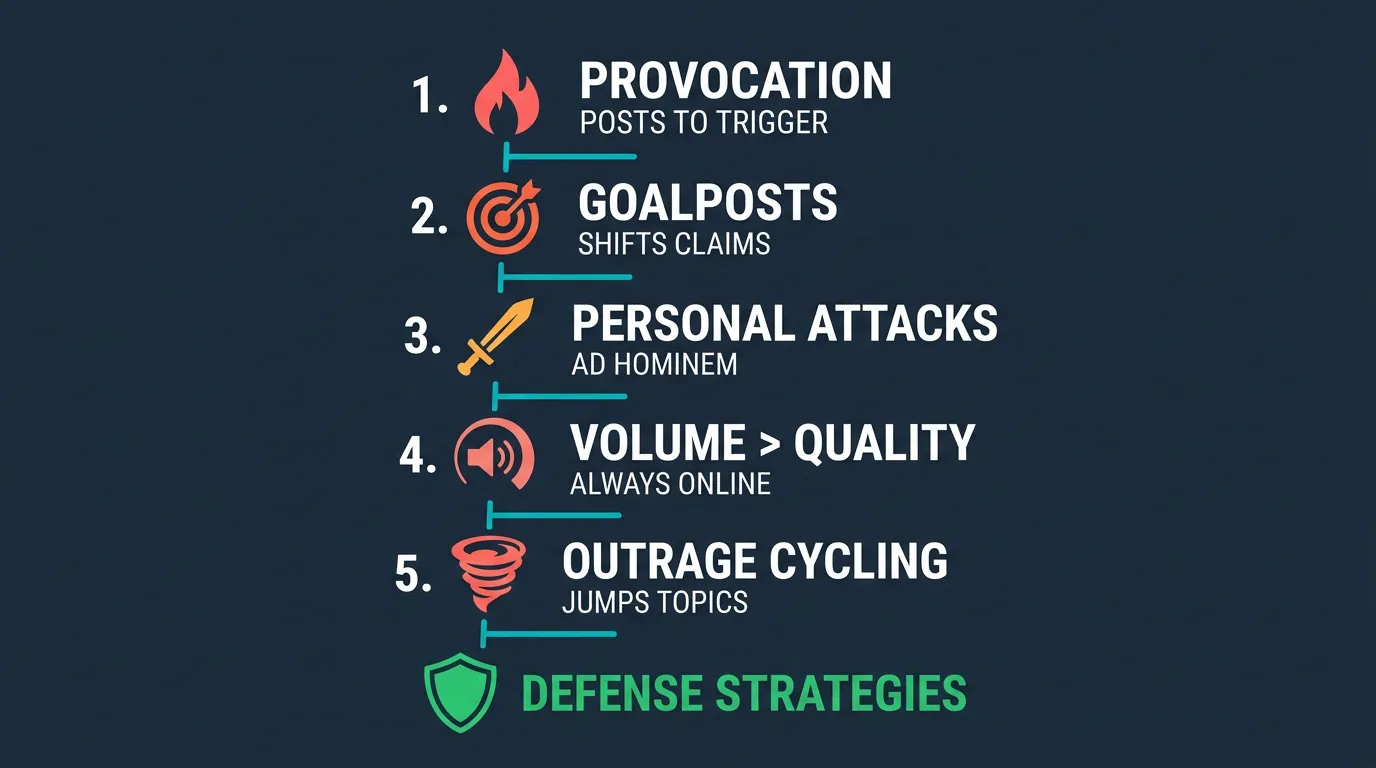
Watch for These Patterns
- Relentless provocation. They post to get reactions, not to exchange ideas. If every comment is designed to trigger anger, the person may be high in psychopathy.
- Moving the goalposts. When you counter their argument, they shift to a completely different claim. This is a manipulation tactic, not genuine debate.
- Personal attacks over substance. They attack you rather than your argument. Ad hominem attacks are a hallmark of low-empathy, high-impulsivity online behavior.
- Volume over quality. They post constantly, respond to everything, and seem to be online at all hours. High FoMO and dark personality traits drive this compulsive activity.
- Outrage cycling. They jump from controversy to controversy, always at the center of the storm. Each new outrage gives them a fresh audience.
How to Protect Yourself
Understanding this research changes how you should interact with political content online. Here are evidence-based strategies.
- Recognize the distortion. The most active political voices online do not represent most people. They represent a specific personality profile.
- Do not engage with provocation. Responding to someone high in psychopathy gives them exactly what they want. Your outrage is their fuel.
- Check your FoMO. If you feel anxious about missing a political argument, that is FoMO talking, not civic duty. Step away.
- Seek out quiet voices. The most thoughtful political perspectives often come from people who post less frequently. Seek them out deliberately.
- Limit exposure time. Research consistently shows that more time on political social media correlates with more polarization and more negative emotions.[8]
The biggest takeaway from this research is not that politics attracts bad people. It is that online platforms have accidentally created the perfect arena for dark personality traits to dominate public discourse. The people screaming the loudest in your feed are not necessarily the most informed, the most passionate, or the most representative. They may simply be the ones whose personality traits are best suited to thrive in an environment built on conflict and attention.
Once you see it, you cannot unsee it. And that awareness is your best defense.
Sources
What the Nature Study Actually Found
Inside the Dark Triad
3. The Dark Side of Politics: Participation and the Dark Triad (Political Studies, 2021)
Why Dark Personalities Thrive in Online Politics
How This Warps Political Reality for Everyone
How to Spot Dark Personality Tactics in Online Debates
13. FoMO and Dark Personalities Drive Online Political Engagement (Neuroscience News, 2025)