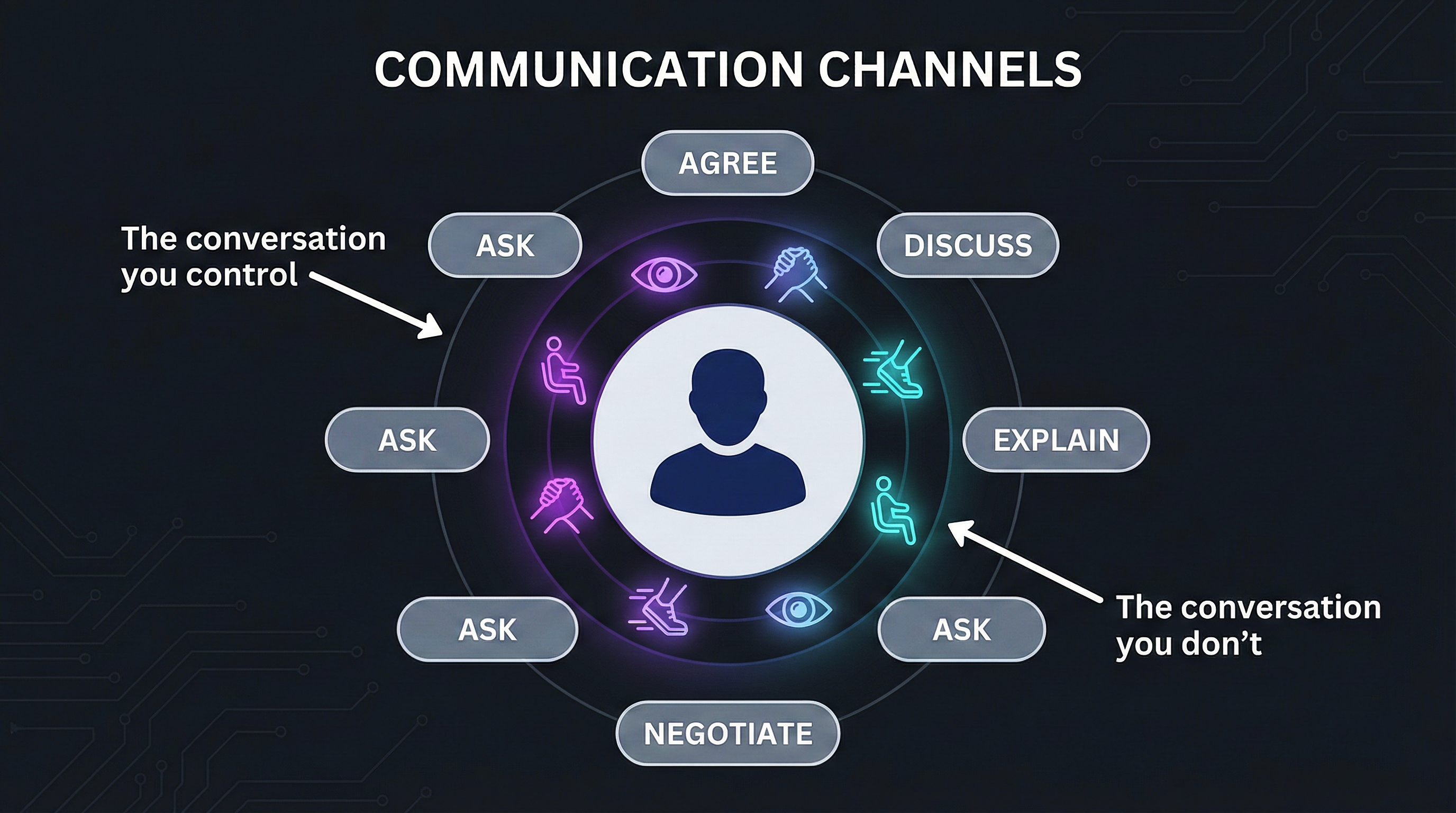

A former FBI counterintelligence agent named Joe Navarro once shared a trick he uses every time he meets someone new. He leans in, gives a firm handshake, makes eye contact. Then he takes one step back and waits.
What happens next tells him everything.
If the person stays put, they’re comfortable. If they step back or angle away, they need space. And if they step closer? That person already likes him. No words needed. Just feet.
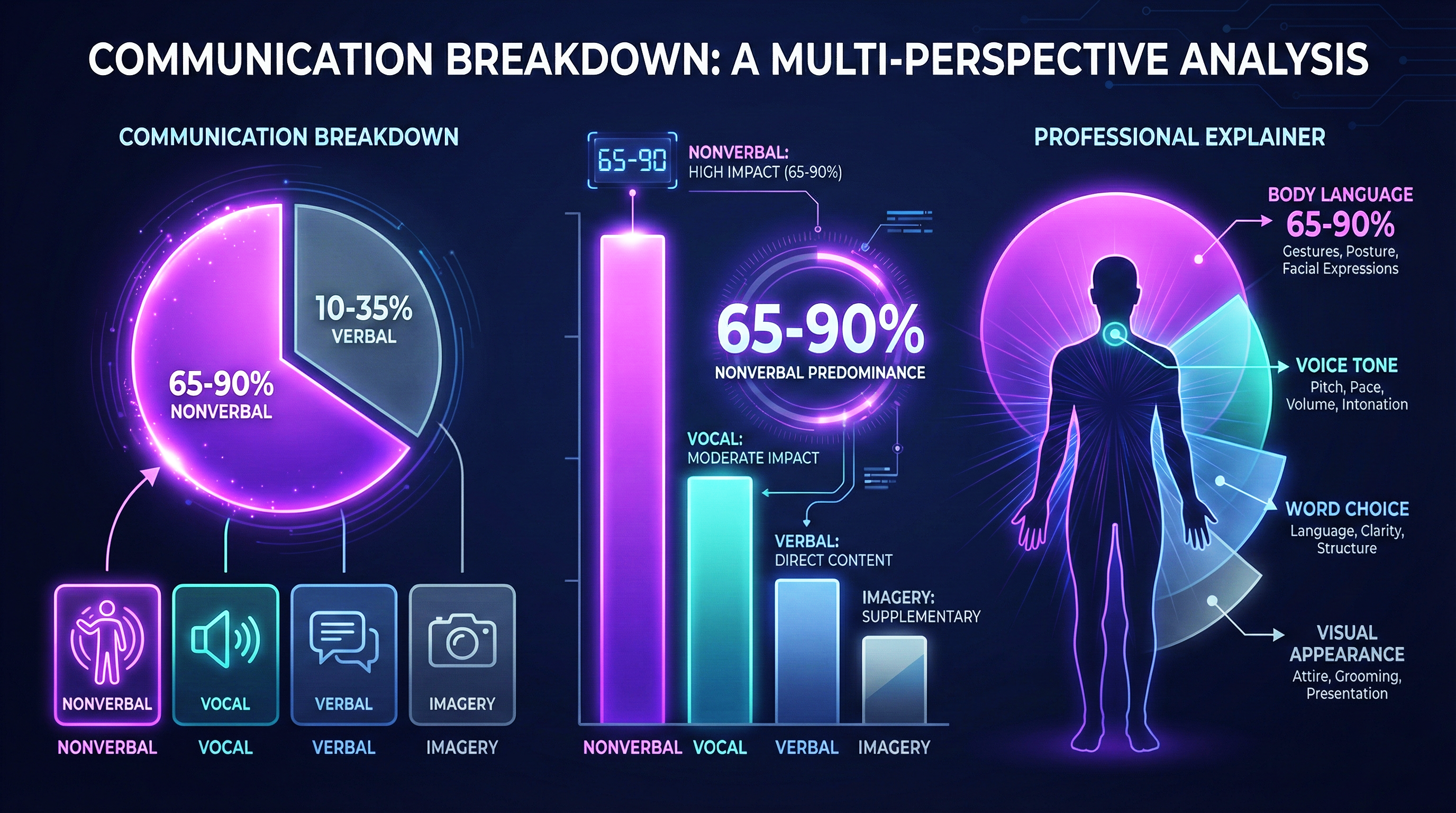
Most of us spend hours preparing what we’re going to say in job interviews, first dates, and big meetings. But we spend almost zero time thinking about what our bodies are saying. That’s a problem. Because research shows nonverbal cues account for 65 to 90 percent of all communication. Your words are only a fraction of the message.
Your Body Never Stops Talking
Every second you’re around other people, you’re broadcasting signals. Your posture, your hand movements, where your feet point, how wide your eyes get. These tiny cues are being picked up by everyone around you, whether they realize it or not.
Vanessa Van Edwards, a behavioral researcher who has led workshops at companies like Google and Amazon, calls these signals “cues.” She breaks them into four channels:
- Nonverbal cues: gestures, posture, facial expressions, body movements
- Vocal cues: tone, pitch, pace, volume
- Verbal cues: word choice, phrasing, what you say in emails and texts
- Imagery cues: clothing, colors, desk setup, visual presentation
The nonverbal channel is by far the biggest. It’s the largest section in Van Edwards’ book because it carries the most weight in how people judge you.
Why This Skill Pays Off
Being good at reading body language isn’t just a party trick. It has real consequences.
- People who are strong at nonverbal cue recognition earn more money in their jobs
- They are rated as “more socially and politically skilled” by their colleagues
- Students who struggle to decode facial expressions and voice tones report significantly less relationship well-being
- In one study, judges watching job interviews with the sound off could accurately predict which candidate would get hired. Just from body language.
“How you say something is just as important as what you say. Nonverbal cues are either supporting your message or detracting from it.” - Vanessa Van Edwards
Think about that. You could have the best resume in the room. The best answers. The best ideas. But if your body is sending the wrong signals, none of it lands.
Recommended read: Cues by Vanessa Van Edwards. The science of nonverbal, vocal, and visual signals that shape how people perceive you in every interaction.
The Most Honest Part of Your Body (It’s Not Your Face)
Here’s something most people get wrong. They focus on faces when trying to read someone. But faces are actually the least reliable body part. People have been practicing their facial expressions since childhood. They know how to fake a smile.
Your feet, on the other hand? Nobody thinks about those.
Why Feet Don’t Lie
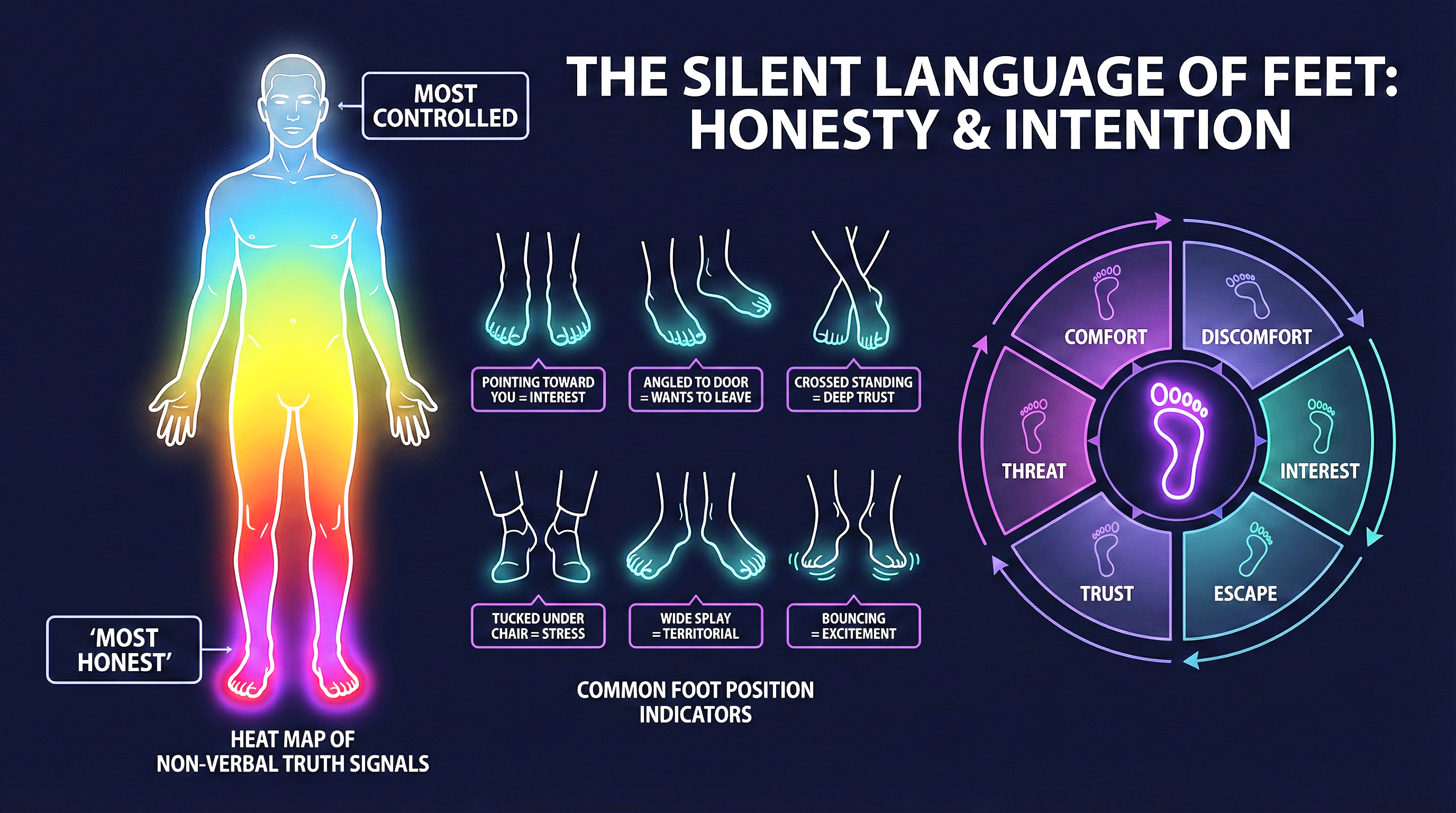
Former FBI Special Agent Joe Navarro spent 25 years reading people’s body language during interrogations. His conclusion? The feet are the most honest part of the body. Here’s why:
- Your limbic brain (the emotional, survival part) controls your feet automatically
- You can’t consciously fake foot behavior the way you can control your smile
- Feet respond instantly to comfort and discomfort without any conscious thought
Here are the foot signals Navarro says to watch for:
| Foot/Leg Signal | What It Means |
|---|---|
| Feet pointing toward you | Interest and engagement |
| Feet angled toward the door | They want to leave |
| Legs crossed while standing | Deep comfort and trust |
| Sudden uncrossing of legs | A threat or discomfort just registered |
| Bouncing or wiggling feet | Excitement or happiness |
| Feet tucked under the chair | Stress or desire to hide |
| Wide leg splay | Territorial. Something is wrong. |
The Crossed-Legs Test
When you cross one leg over the other while standing, you give up most of your balance. You literally can’t run or freeze quickly. Your limbic brain only allows this when it feels completely safe.
Navarro once met two women at a party. During the introduction, one of them immediately crossed her legs and leaned toward her friend. He told them, “You two must have known each other for a long time.” They were stunned. They’d been friends since grade school in Cuba in the 1940s.
Their feet gave it away.
Here’s the other detail that most people miss. We usually cross our legs in the direction of the person we like most. At a family dinner, a parent might unconsciously cross their legs tilting toward their favorite child. In a meeting, your legs will angle toward the person you trust most.
Recommended read: What Every BODY Is Saying by Joe Navarro. An ex-FBI agent’s field guide to speed-reading people through their body language.
Reading the Upper Body: Eyes, Arms, and Lean
Feet tell you the foundation. But the upper body fills in the details. Here’s how to decode what’s happening from the waist up.
The Eyes Have It
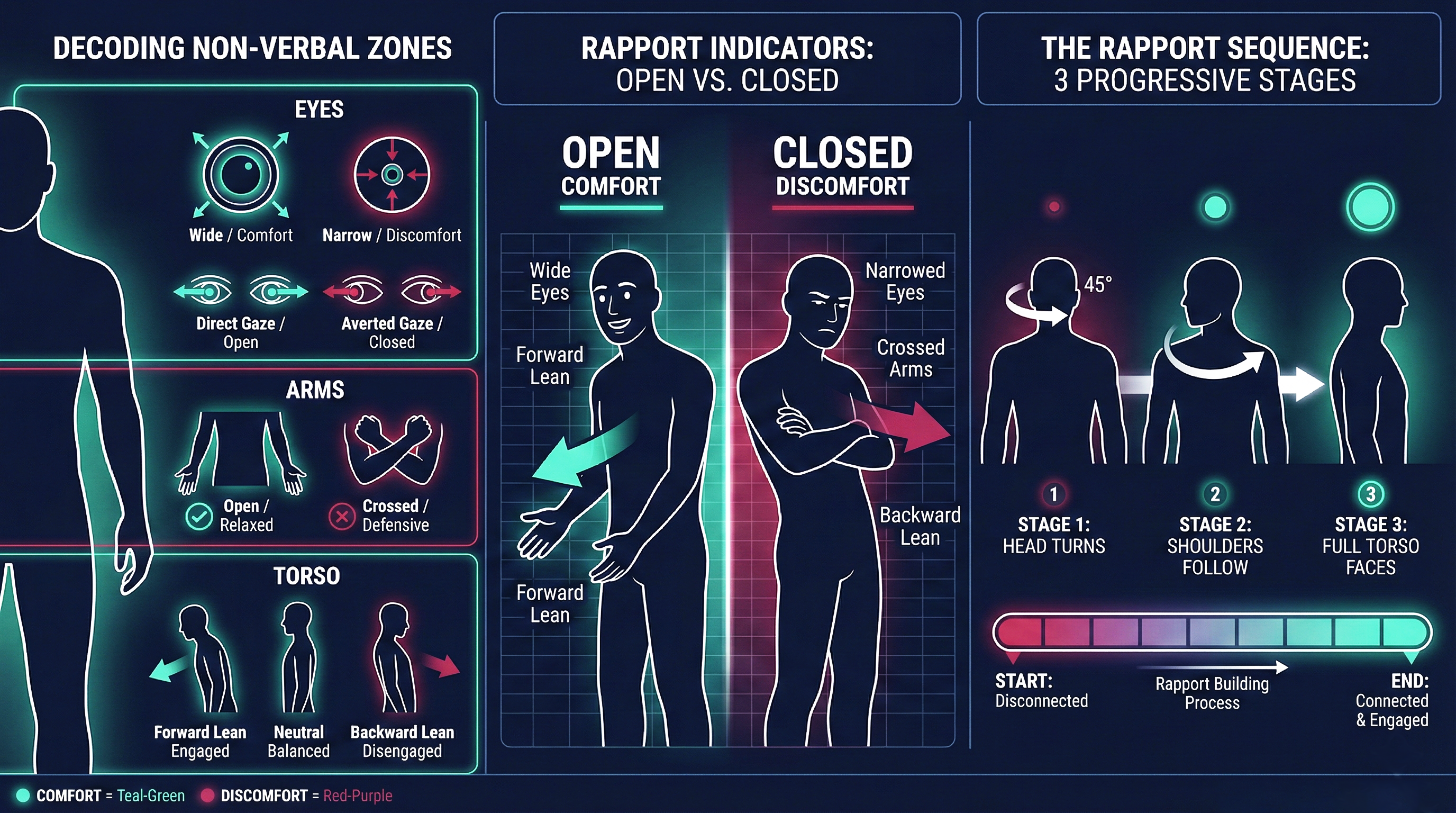
Eye behavior is one of the most powerful nonverbal channels. But it’s also one of the most misunderstood. Looking away during a conversation doesn’t mean someone is lying. It actually means they’re thinking more clearly.
Key eye cues to watch:
- Wide open eyes (the “flashbulb” effect): The person is excited or genuinely pleased to see you
- Squinting or narrowing eyes: Discomfort, disagreement, or suspicion
- Pupil dilation: Attraction or intense interest (though lighting can cause this too)
- Looking away while talking: A comfort display. They feel safe enough to think freely.
- Avoiding eye contact with a superior: In many cultures, this signals respect, not deception
Van Edwards recommends what she calls “gazing with purpose.” Don’t just stare. Search the other person’s face for emotions. Look for eye locks. Those brief moments when your eyes meet and hold. That’s when your brain releases oxytocin, the bonding chemical.
“Gaze with intent. Don’t just gaze, search. Looking for emotions gives your eye contact direction and purpose.” - Vanessa Van Edwards
Arms and Torso: The Barrier System
Your torso houses your vital organs. Heart, lungs, liver. So your brain is very protective of it. When you feel uncomfortable, your body creates barriers. When you feel safe, it opens up.
Signs of comfort:
- Open posture: Arms relaxed at sides, body facing the other person directly
- Leaning in: Tilting your torso toward someone signals interest and trust
- Mirroring: When two people unconsciously copy each other’s posture, rapport is strong
Signs of discomfort:
- Arm crossing: Creates a psychological shield across the chest
- Torso turning away: Even a slight angle means they want to disengage
- Picking up objects (purse, pillow, coffee cup) and placing them between you: Barrier building
- Leaning backward: Increasing distance without moving their feet
These signals are also part of what makes the hidden rules of persuasion so effective. People who master body language can influence you without saying a word.
Jack Schafer, a former FBI behavioral analyst, describes a predictable sequence when someone builds rapport with you. First, their head turns toward you. Then their shoulders follow. Finally, their entire torso repositions to face you directly. When all three happen, rapport is solid.
Recommended read: The Like Switch by Jack Schafer. FBI-tested techniques for building instant rapport and reading friend-or-foe signals.
What Body Language Can’t Tell You
Now for the part most “body language experts” on the internet skip. There are real limits to what you can read from someone’s nonverbal signals.
There Is No Pinocchio Effect
Navarro is blunt about this. After decades of studying deception, he says:
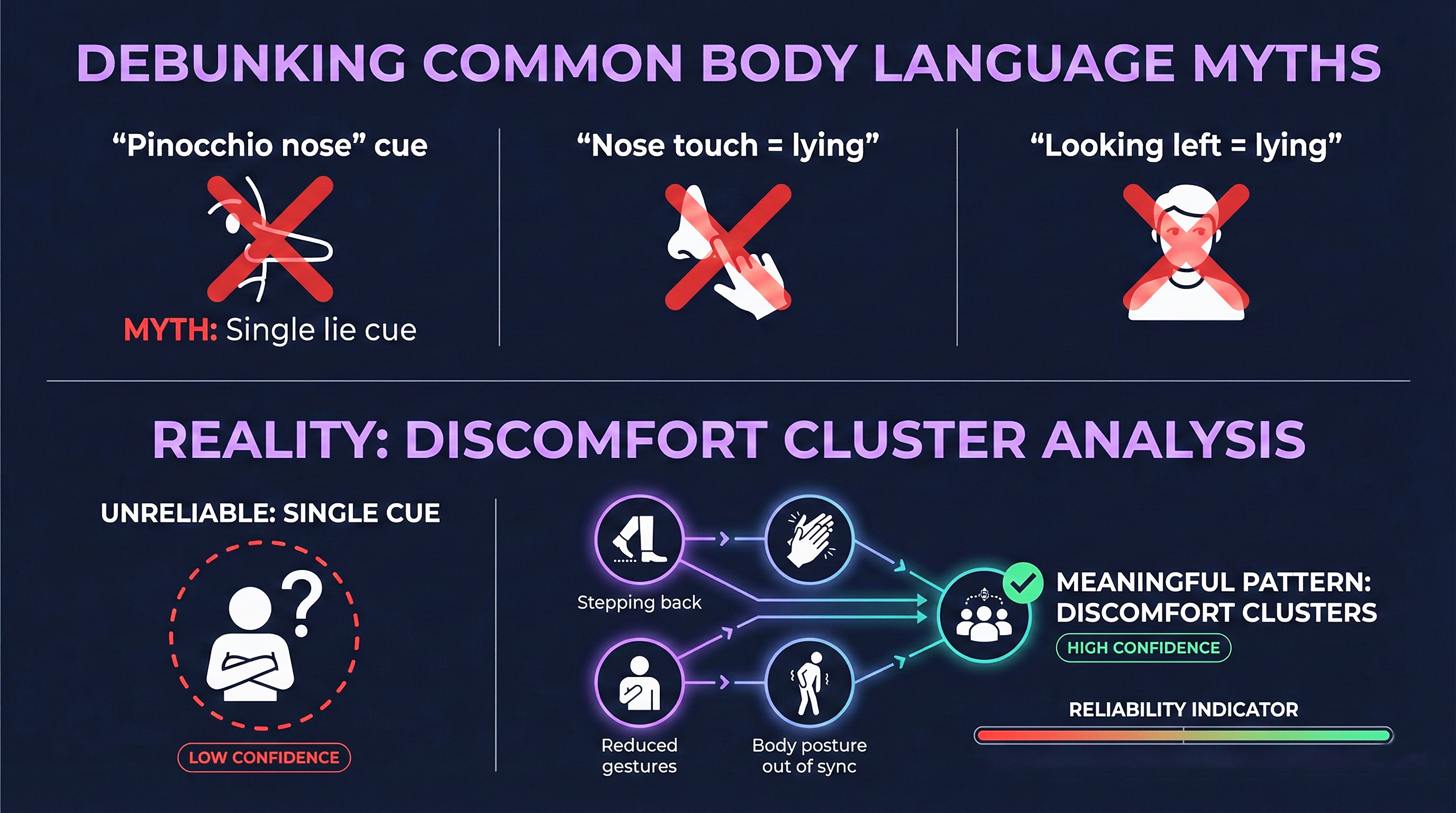
“There are no nonverbal behaviors that, in and of themselves, are clearly indicative of deception.” - Joe Navarro
No single gesture means someone is lying. Not touching the nose. Not looking left. Not crossing arms. Those are myths that refuse to die. What you can look for instead are clusters of discomfort:
- Feet suddenly withdrawing under the chair (freeze response)
- Hands rubbing on pants legs (self-soothing)
- Loss of hand gestures or eyebrow movement (reduced emphasis)
- Body going out of sync with words (saying “yes” while subtly shaking head)
Even then, discomfort might come from the topic, the room, or nervousness. Not from lying. Context is everything. That said, understanding these cues can help you recognize when someone is trying to exploit your trust through deliberate deception.
Culture Changes the Rules
While many nonverbal cues are universal, some vary by culture:
- In some Asian and Middle Eastern cultures, direct eye contact with a superior is rude
- Italians tend to use far more hand gestures than Americans
- Nodding means different things in different parts of India and Pakistan
- Personal space expectations vary dramatically from country to country
Researchers found that emotions are recognized across cultures at better-than-chance levels. But people are most accurate when reading others from their own cultural group. You have a built-in advantage reading people who are similar to you. And a disadvantage when they’re not.
How to Use This Starting Today
You don’t need to become an FBI agent to use body language. Here are practical steps you can start with right now.
-
Watch the feet first. In your next conversation, glance at the other person’s feet. Are they pointing toward you or the exit? This one check gives you more honest information than anything they say.
-
Do the “lean and wait” test. When you meet someone new, lean in for the greeting, then step back. Watch whether they stay, step back, or move closer. Now you know where you stand.
-
Open your own body. Uncross your arms. Turn your torso to fully face the person you’re talking to. Lean slightly forward. These signals tell the other person’s brain that you’re safe and engaged.
-
Search, don’t stare. During conversation, look for emotions on the other person’s face instead of just “making eye contact.” This shifts your gaze from awkward to purposeful and helps you actually read the room.
-
Look for clusters, not single cues. One crossed arm means nothing. Crossed arms plus feet angled away plus torso leaning back? That’s a pattern worth paying attention to. This is especially important when dealing with people who use dark psychology tactics to control others.
-
Touch the arm. A brief, appropriate touch between the elbow and shoulder is one of the most powerful rapport-building gestures. It works across most Western cultures. Navarro calls it a simple way of saying, “We are OK.”
Recommended read: Influence by Robert Cialdini. The classic guide to the psychology of persuasion, including how nonverbal warmth and authority cues drive compliance.
The Invisible Conversation
Every interaction you have is actually two conversations happening at once. There’s the one with words. And there’s the one your body is having without your permission.
The good news? Once you know what to look for, you can’t unsee it. Navarro’s friend said it best after learning to spot the hidden street signs in Coral Gables, Florida: “Once I knew what to look for and where to look, the signs were obvious and unmistakable.”
Your body has been talking your entire life. Now it’s time to start listening.