In 2002, a Stanford student named Tristan Harris walked into a class that would change his life. It was held in something called the Persuasive Technologies Lab. The rumors on campus said it was a place where scientists figured out how to change your behavior. Without you ever knowing.
The professor, B.J. Fogg, handed out stacks of books on psychological manipulation. Old research. Proven tricks. Techniques that could make people do almost anything. Harris was hooked.
“It felt like somebody’s showing me the code,” Harris later said. “The code of how you can influence people.”
That class produced the co-founders of Instagram. It also laid the groundwork for an entire industry built on exploiting human trust. But here’s the thing. The tricks those students learned weren’t new. Con artists, spies, and emotional manipulators had been using them for centuries.
Your Brain Has a Trust Problem
You were born to trust. It’s not a flaw. It’s a feature. Your ancestors survived because they cooperated with others. Your brain evolved to assume that most people are telling the truth most of the time.
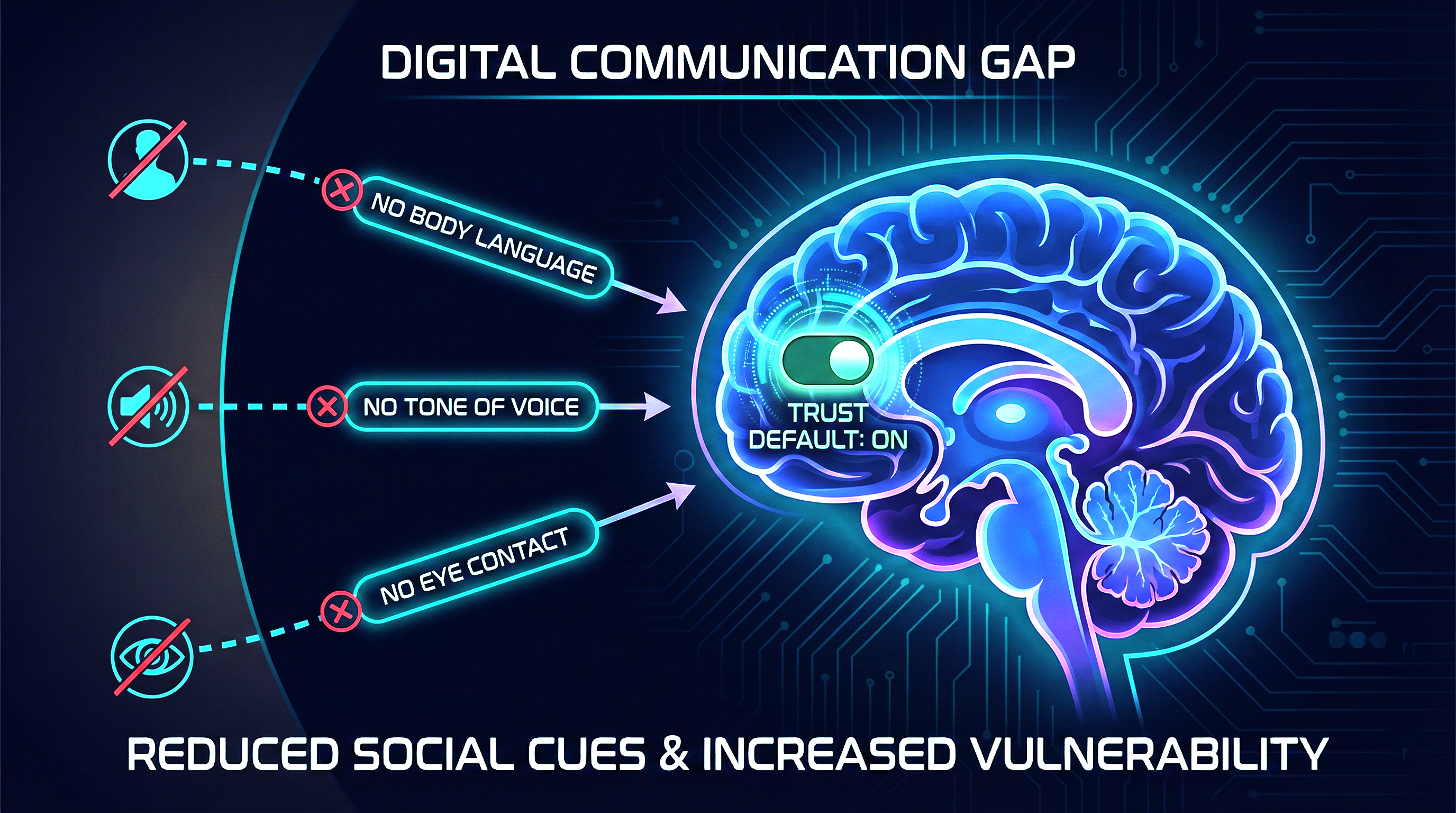
Psychologists call this truth bias. Former FBI agent Jack Schafer explains it simply. When someone tells you something, your default reaction is to believe them. You need a reason not to believe. And that reason has to be strong enough to override your brain’s built-in setting.
Why Truth Bias Is Dangerous Online
In person, you have tools to catch liars. You can read facial expressions, body language, and tone of voice. Online, you lose all of that. It’s one reason your brain may actually trust AI more than real people in certain situations. Schafer points out that without verbal and nonverbal cues, you’re “at a disadvantage when judging written correspondence on the Internet.”
Here’s what happens:
- Your brain defaults to believing what someone writes
- You have no body language to cross-check their words
- You start comparing the person to your idealized version of who they might be
- Over time, you fill in the gaps with qualities you want them to have
- The truth bias creates a primacy filter that colors everything they say going forward
This is exactly how catphishing works. The person doesn’t have to be a brilliant liar. They just have to let your brain do the lying for you.
“Absent verbal and nonverbal cues, individuals are at a disadvantage when judging written correspondence on the Internet.” . Jack Schafer, The Like Switch
Recommended read: The Like Switch by Jack Schafer. An ex-FBI agent’s guide to the psychology of trust, attraction, and detecting deception.
The Manipulator’s Playbook: 6 Tactics They All Use
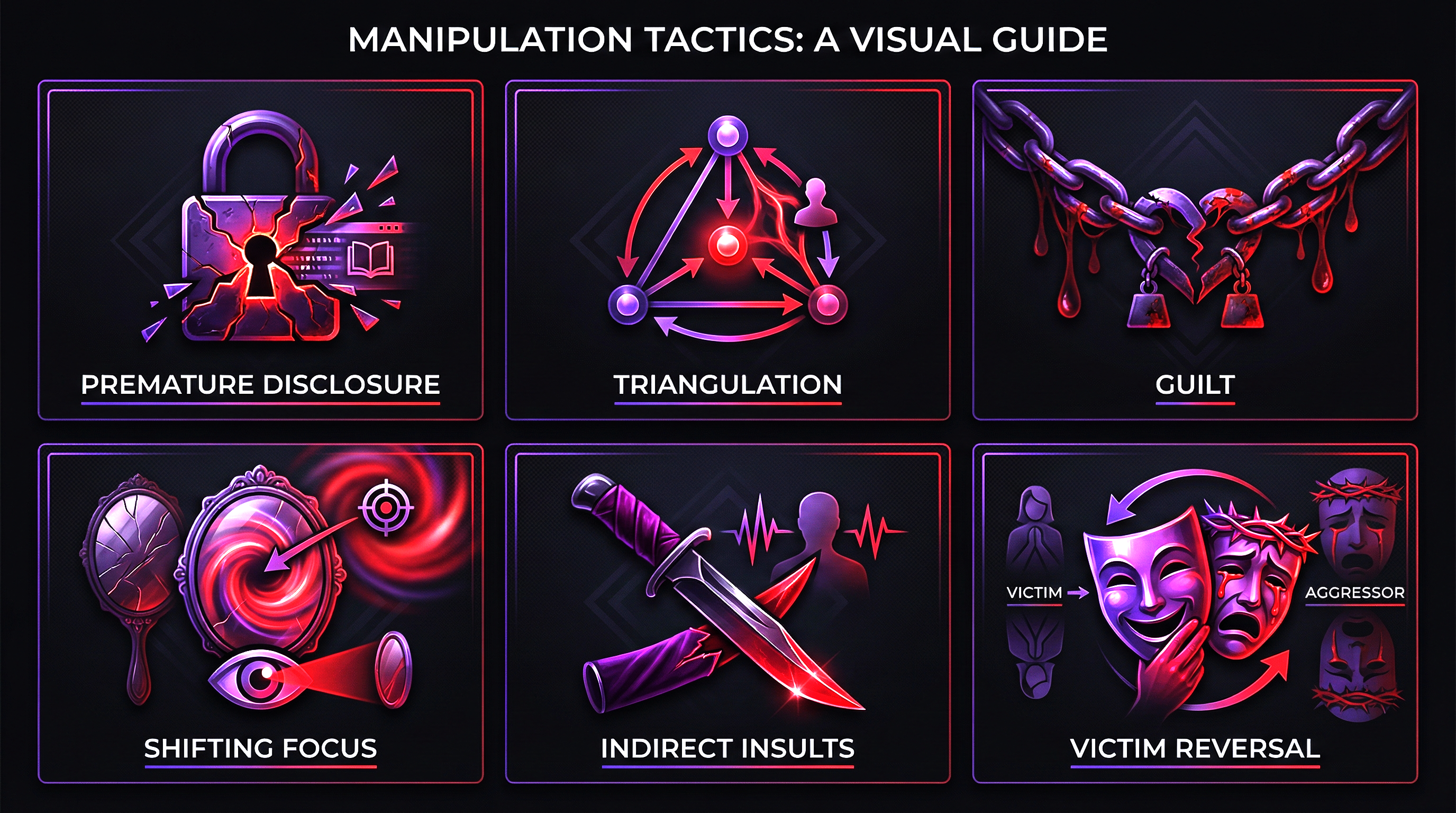
Whether it’s a con artist at a bar, a catphisher in your DMs, or a toxic partner in your living room, manipulators rely on the same core tactics. Many of these overlap with the dark psychology tactics people use to control others. Adelyn Birch, who spent years studying covert emotional manipulation, identified patterns that show up again and again.
Tactic 1: Premature Disclosure
This is the big one. A manipulator shares something deeply personal with you early. Way too early. They tell you about their childhood trauma, their biggest fear, their secret dream.
It feels like vulnerability. It feels like trust. But it’s a trap.
When someone discloses personal information, your brain’s reciprocity reflex kicks in. You feel compelled to share something equally personal in return. Before you know it, you’ve given them ammunition they can use later.
Tactic 2: Triangulation
The manipulator brings a third person into the relationship. Not literally (sometimes literally). They mention an ex, a coworker, someone who “gets them.” The goal is to make you feel insecure. Uncertain. Eager to prove yourself.
If you confront them, they’ll flip it. “The real problem is your insecurity,” they’ll say.
Tactic 3: Guilt Weaponization
Your conscience is a tool. Manipulators know this. They exploit your desire to be a good person by making you feel guilty for having boundaries.
- You say no to something? You’re selfish.
- You question their behavior? You don’t trust them.
- You try to leave? You’re abandoning them.
Tactic 4: Shifting the Focus
You catch your partner in a lie. You bring evidence. But instead of addressing what they did, they attack how you found out. Suddenly you’re the one apologizing for snooping. The original problem disappears.
Tactic 5: Indirect Insults
These are the “compliments” that sting. “That dress is so slimming on you.” “You’d be less boring if you took dance lessons.” It sounds helpful. It sounds caring. But it’s designed to erode your confidence one comment at a time.
Tactic 6: Victim Reversal
When everything falls apart, the manipulator rewrites the story. They were the victim. You were the problem. They’ll even convince your mutual friends of this version.
| Tactic | What It Looks Like | What It’s Really Doing |
|---|---|---|
| Premature Disclosure | ”I’ve never told anyone this before” | Creating false intimacy to harvest your secrets |
| Triangulation | ”My coworker really gets me” | Making you insecure so you try harder |
| Guilt Weaponization | ”After everything I’ve done for you?” | Exploiting your conscience to control you |
| Shifting the Focus | ”How dare you go through my phone” | Diverting attention from their behavior |
| Indirect Insults | ”That outfit is so brave” | Eroding your self-worth gradually |
| Victim Reversal | ”You’re the one who ruined this” | Rewriting history to avoid accountability |
Recommended read: 30 Covert Emotional Manipulation Tactics by Adelyn Birch. A concise guide to recognizing the subtle tactics manipulators use in relationships.
How Tech Companies Weaponize These Same Tricks
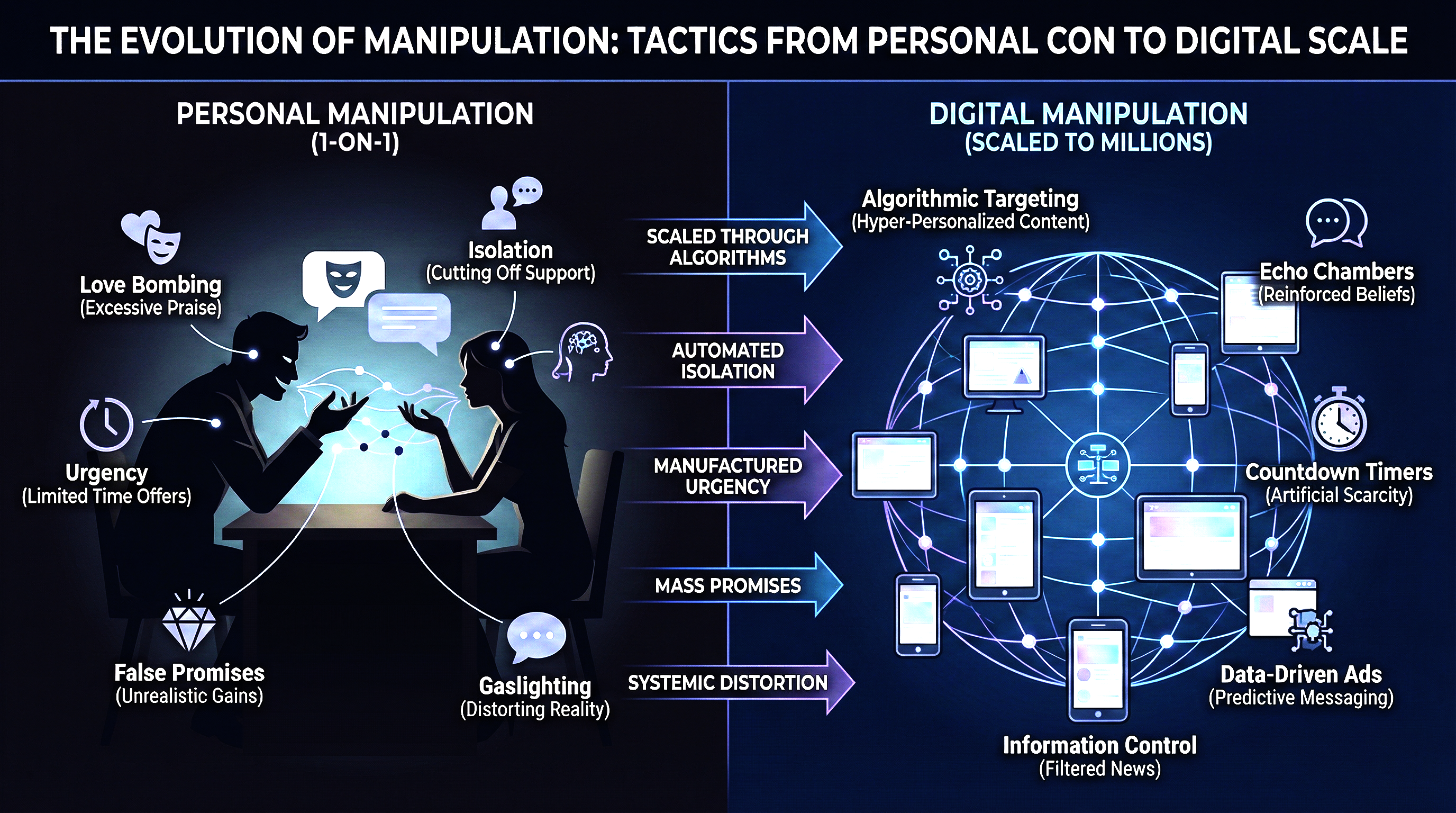
Here’s where things get really unsettling. The manipulation tactics used by con artists and toxic partners didn’t stay in the world of personal relationships. They went corporate.
Sandra Matz, a Columbia professor who helped expose the Cambridge Analytica scandal, describes a world where “a few people and organizations know an awful lot about many of us and benefit greatly from this knowledge.” The game isn’t fair. The playing field is tilted. And most of us don’t even know we’re playing.
Persuasive Design: Manipulation at Scale
Remember that Stanford class Tristan Harris took? Professor B.J. Fogg taught his students that computers could be “more persistent than human beings” and could “go where humans cannot go or may not be welcome.” The entire course was built on B.F. Skinner’s research. Find the right reinforcement and you can get anyone to do anything.
Harris’s classmates Mike Krieger and Kevin Systrom went on to co-found Instagram. They baked one of Skinner’s key lessons directly into the app: build in immediate reinforcements. Hearts. Likes. Instant feedback. It’s premature disclosure at scale. The app gives you a dopamine hit. You give it your attention, your data, your time. These same principles fuel the dark patterns that trick your brain into bad decisions across the web.
The Reciprocity Trap Goes Digital
Dan Ariely’s research shows something disturbing about dishonesty. When transactions move away from cash and into abstract currencies, people cheat more. They don’t feel like they’re stealing. The same principle applies to attention.
When an app gives you a “free” service, your brain registers it as a gift. The reciprocity reflex kicks in. You feel okay giving something back. Your data. Your location. Your browsing habits. Sixty minutes of scrolling. It doesn’t feel like a trade. But it is.
Psychological Targeting
Matz’s research revealed that companies can now predict your personality from your digital footprint. Your likes, your clicks, your purchase history. They build a psychological profile and then target you with messages designed to push your specific buttons.
- Introverts get ads emphasizing quiet, private experiences
- Extroverts get ads full of social energy and group activities
- Anxious types get urgency-driven copy with countdown timers
- Impulsive buyers see limited-time deals at exactly the right moment
It’s triangulation and guilt and premature disclosure. All automated. All personalized. All invisible.
Recommended read: Mindmasters by Sandra Matz. How big data is used to predict and change your behavior, and what we can do about it.
How to Protect Yourself
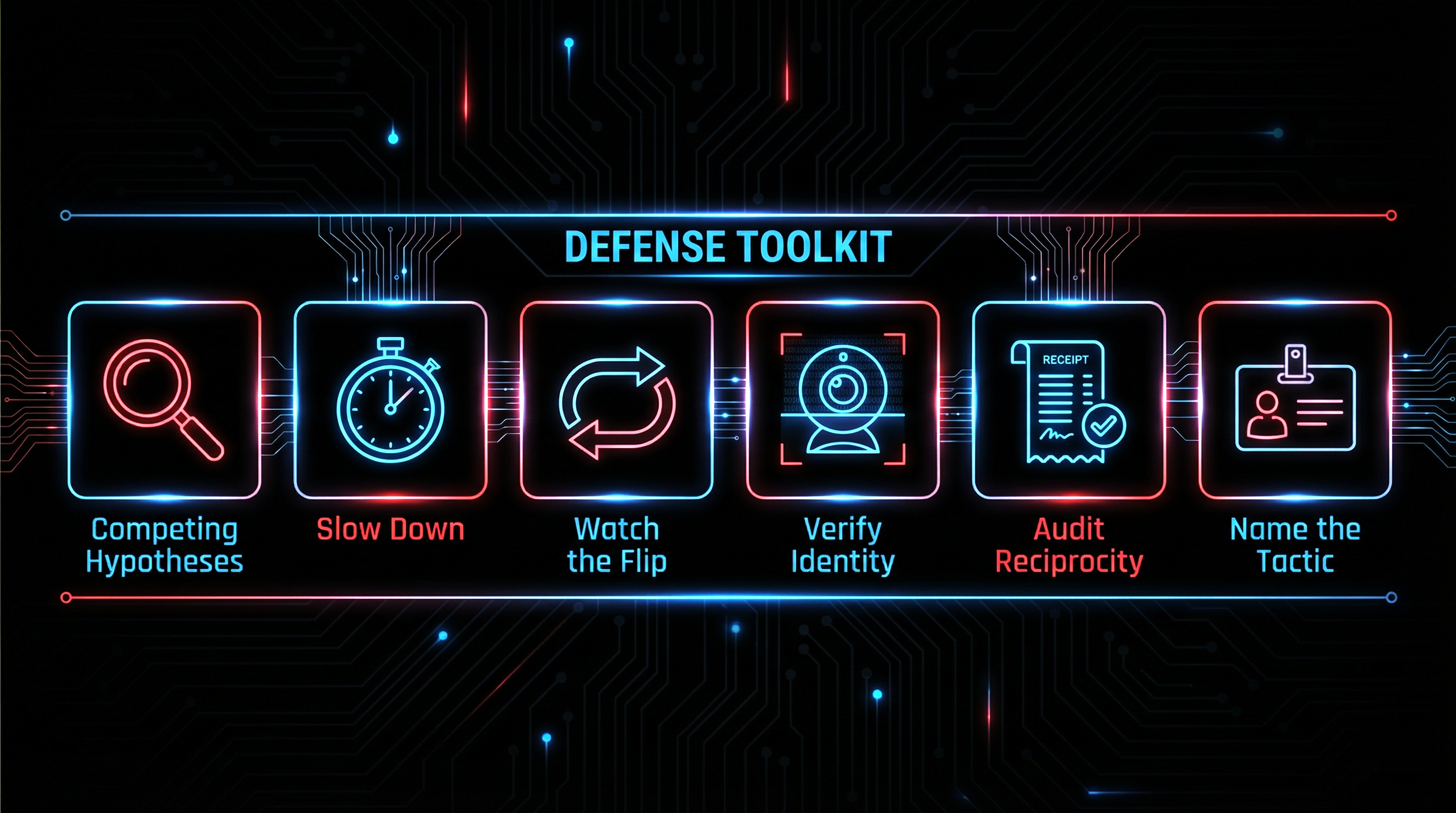
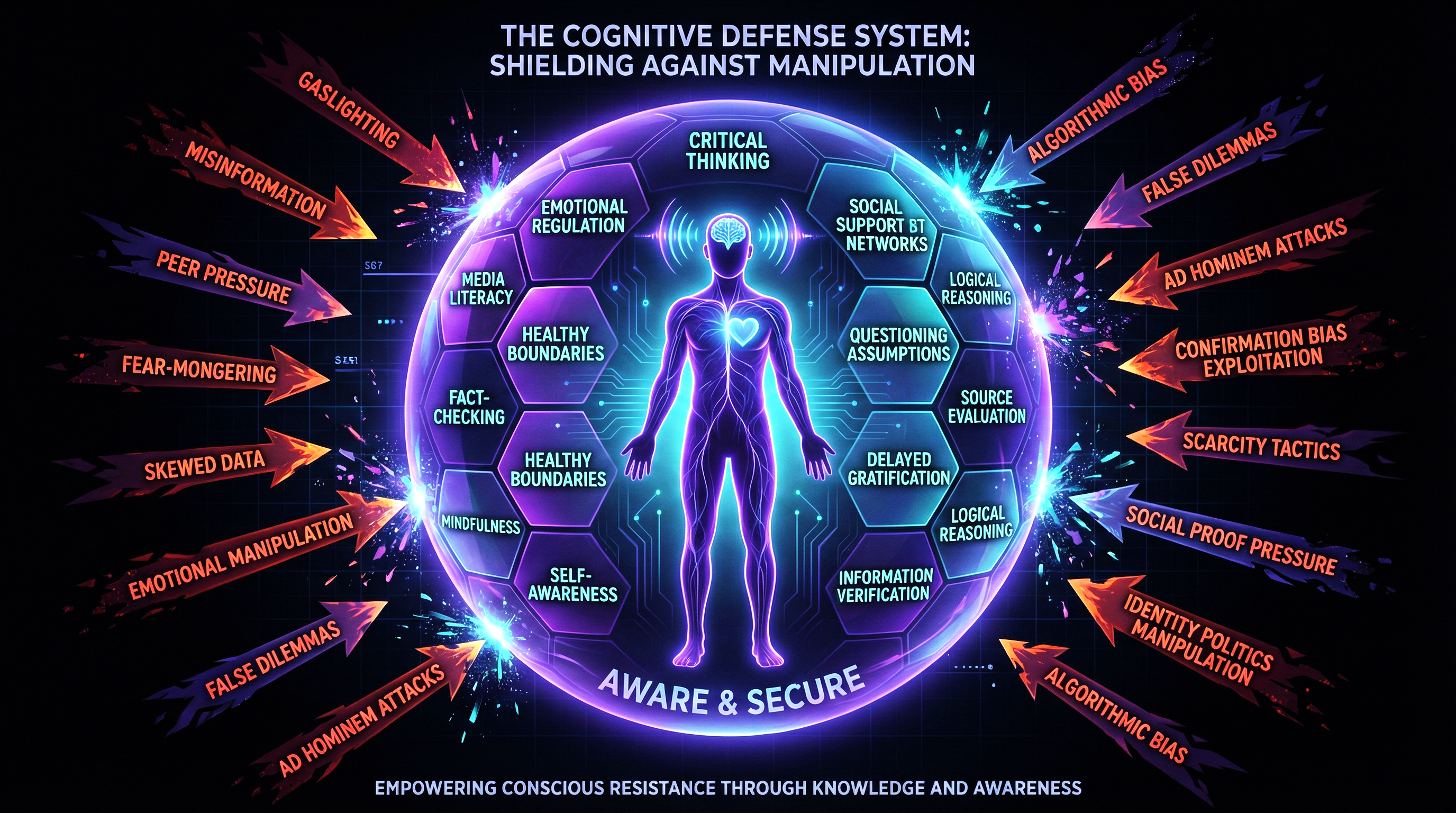
The good news is that once you understand how these tricks work, they lose a lot of their power. Here’s a practical defense toolkit.
-
Develop competing hypotheses. Jack Schafer teaches this technique from his FBI days. Whenever someone seems too good to be true, create two hypotheses. One: they’re genuine. Two: they’re deceiving you. Then look for evidence that supports each. Don’t let truth bias make the decision for you.
-
Slow down fast relationships. If someone shares deeply personal information early, that’s a yellow flag. Healthy relationships build trust gradually. Manipulators rush intimacy because it benefits them. Take your time.
-
Watch for the flip. When you raise a legitimate concern and the conversation suddenly becomes about your flaws, something is wrong. Healthy people address the issue. Manipulators shift the focus.
-
Demand visual verification online. Schafer recommends insisting on a face-to-face or video meeting as soon as possible. Someone who constantly makes excuses to avoid being seen is sending a strong signal that something is off.
-
Audit your digital reciprocity. Ask yourself what you’re really trading for “free” apps and services. Your attention has value. Your data has value. If the exchange feels invisible, that’s by design.
-
Name the tactic. When you can identify what someone is doing (guilt trip, triangulation, indirect insult), it breaks the spell. You shift from reacting emotionally to analyzing strategically.
“It is difficult to get a man to understand something when his salary depends upon his not understanding it.” . Upton Sinclair, as cited in Dan Ariely’s Predictably Irrational
Recommended read: Predictably Irrational by Dan Ariely. Why we make irrational decisions and how hidden forces shape our behavior in ways we don’t expect.
The Bottom Line
Every manipulator, from the catphisher in your inbox to the algorithm in your pocket, is exploiting the same thing. Your brain’s deep, ancient need to trust other people.
That need isn’t going away. And it shouldn’t. Trust is what makes relationships, communities, and societies work. The goal isn’t to become paranoid. It’s to become aware.
The con artist, the toxic partner, and the tech company all count on one thing: that you won’t notice what they’re doing. Now you know the playbook. The tricks only work in the dark. Turn on the lights.