
A 26-year-old scrolls through headlines about tariffs, layoffs, and another bank warning about recession. Her chest tightens. She opens a shopping app. Forty minutes later, she has spent $340 on skincare, a weighted blanket, and a candle that smells like a library.
She does not need any of it. She knows this. She buys it anyway.
Welcome to doom spending. The financial coping mechanism that makes zero rational sense and perfect emotional sense.
A 2025 Intuit Credit Karma survey found that 27% of Americans admit to doom spending.[1] For Gen Z, that number jumps to 41%. They are not shopping because they want things. They are shopping because the future feels like it is collapsing, and buying something is the one thing that still feels like control.
What Doom Spending Actually Is, and What It Is Not
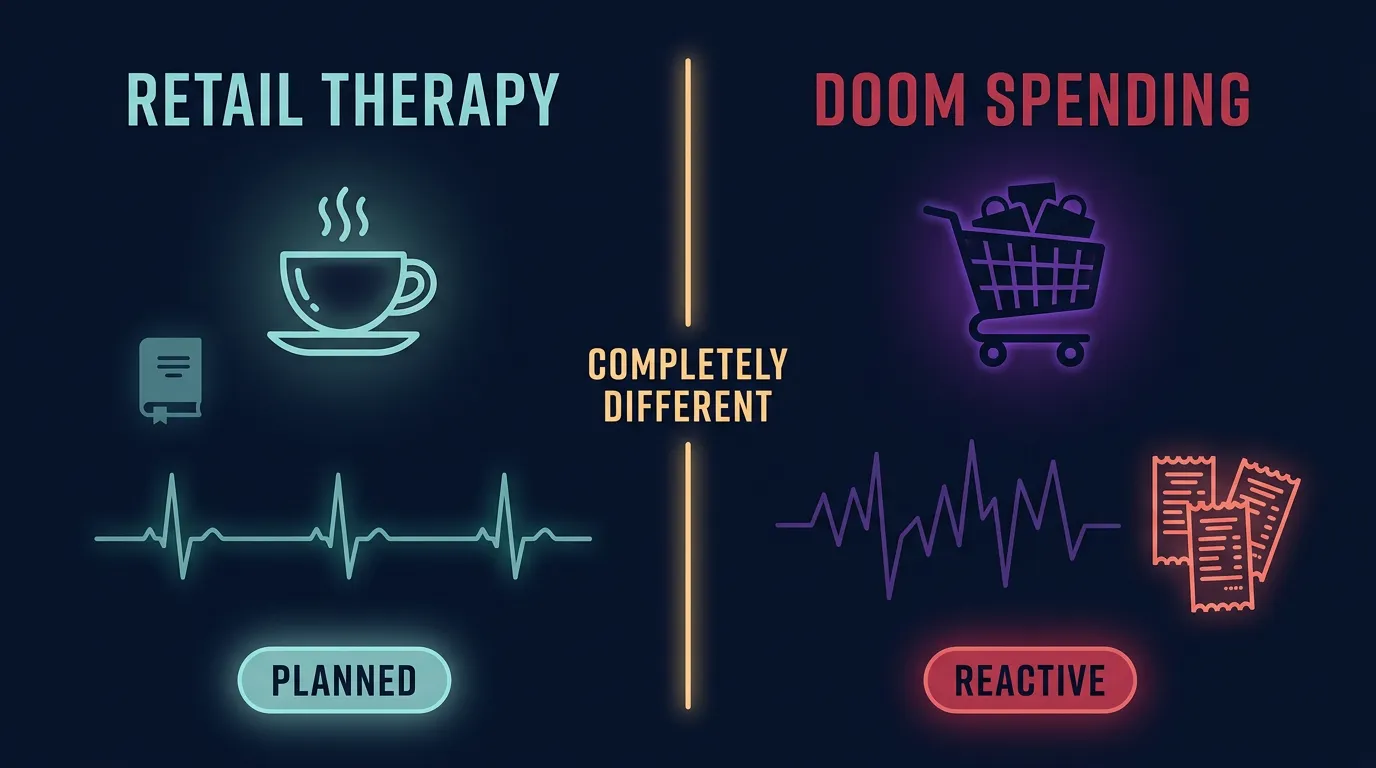
Doom spending is not retail therapy with a fancier name. The two look similar on the surface. Both involve buying things to feel better. But the psychology underneath is completely different.
Retail therapy is planned. You have a bad day, you buy yourself a nice coffee or a new book, and you move on. Research from the University of Michigan found that retail therapy can genuinely restore a sense of personal control and reduce lingering sadness.[2] It is occasional, bounded, and usually involves small purchases.
Doom spending is reactive. It is driven not by a bad Tuesday but by a creeping sense that the world is falling apart. The purchases are larger, more impulsive, and more frequent. And the relief lasts about as long as the checkout confirmation screen.
Here is how they compare:
| Feature | Retail Therapy | Doom Spending |
|---|---|---|
| Trigger | Bad day, minor stress | Economic anxiety, global dread |
| Planning | Usually intentional | Impulsive, reactive |
| Frequency | Occasional | Recurring pattern |
| Purchase size | Small treats | Often large, unaffordable |
| Emotional tone | “I deserve this” | “Nothing matters anyway” |
| Aftermath | Brief satisfaction | Guilt, financial stress, more anxiety |
The key difference is the belief driving the behavior. Retail therapy says “this will help me feel better.” Doom spending says “the future is ruined anyway, so why not.”
Recommended read: Misbehaving by Richard Thaler. The Nobel laureate explains why humans consistently make irrational economic decisions, and why traditional economics gets human behavior so wrong.
The Nihilism Engine: Why “Nothing Matters” Feels Like Permission
Financial nihilism is the engine beneath doom spending. And it did not appear out of nowhere.
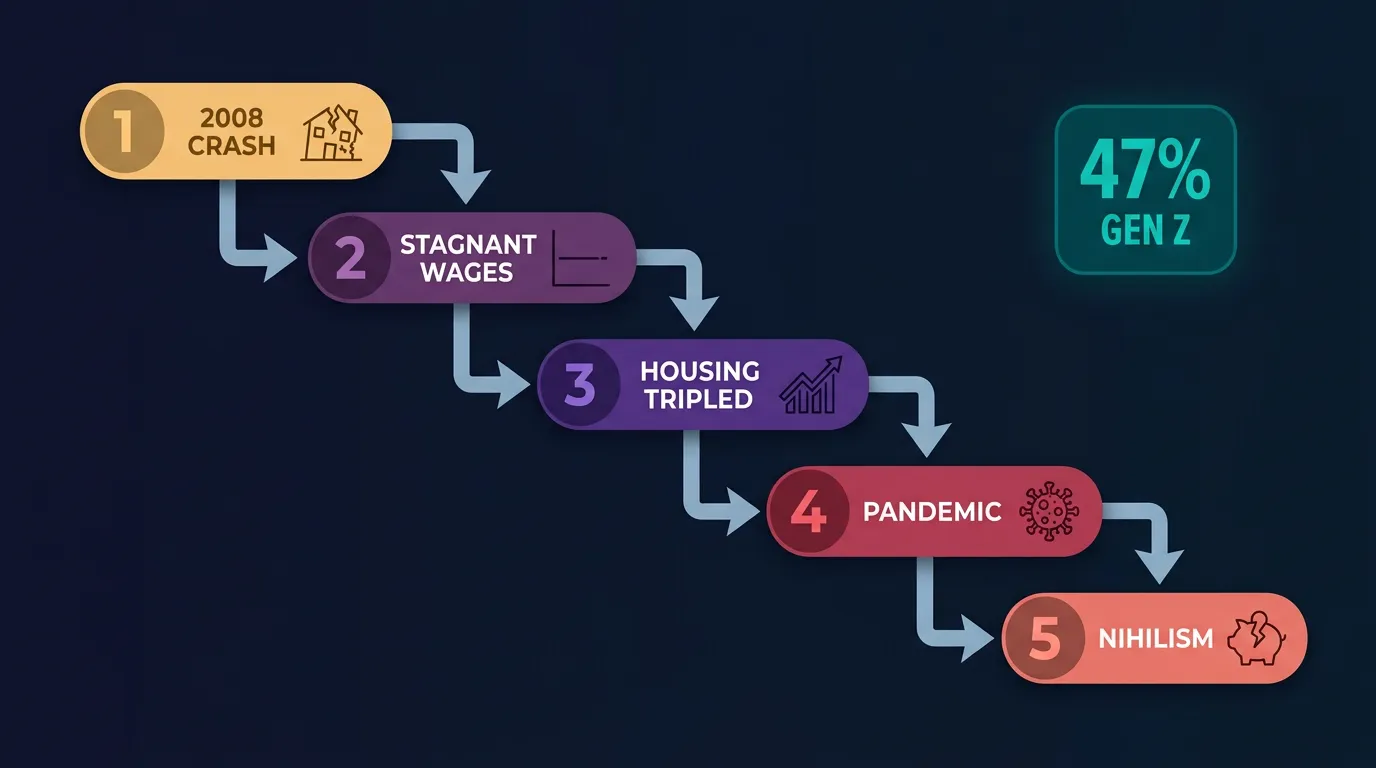
Young adults watched their parents lose homes in 2008. They graduated into a job market that demanded experience they could not get. They watched housing prices triple while wages crawled. Student loans ballooned. Then a pandemic shut down the world. Then inflation spiked.
At some point, the math stops mattering. A 2025 survey found that 36% of Americans, including 47% of Gen Z, say they cannot rationalize saving money because of uncertainty about the world and the economy.[1]
This is not laziness. It is a rational emotional response to an irrational situation. Psychologists call it learned helplessness. When you repeatedly try to improve your situation and fail, your brain eventually stops trying. Martin Seligman first demonstrated this in the 1960s. Dogs who received unavoidable shocks eventually stopped attempting to escape, even when escape became possible.[3]
Financial nihilism works the same way. If saving $200 a month will not make a dent in a $400,000 house, why not spend it on something that makes you feel good right now?
The “nothing matters” mindset creates a dangerous psychological permission structure:
- Future discounting accelerates. Your brain already undervalues future rewards. Nihilism turbocharges this, making $50 today feel infinitely more valuable than $50 saved for a retirement that feels fictional.
- Loss aversion inverts. Normally, people fear losses more than they value gains. But when you believe you have already lost, spending feels less like losing and more like claiming what is left.
- Identity shifts. Spending becomes a form of protest. “I will enjoy my life now because no one is coming to save me.”
Kyla Scanlon, the financial analyst who popularized the term “vibecession,” has argued that financial nihilism is not irrational. It is a predictable response to systems that feel rigged.[4] When young people see billionaires pay lower tax rates than teachers, saving for the future feels like a sucker’s game.
Your Brain on Shopping: The Neuroscience of the Buy Button
The reason doom spending feels so good in the moment has everything to do with your nucleus accumbens. This small structure deep in your brain is the hub of your reward system. And shopping lights it up like a pinball machine.
Stanford neuroscientist Brian Knutson used fMRI scans to watch what happens in the brain during purchasing decisions. His team found that the nucleus accumbens activates strongly when people see a product they want.[5] Critically, the dopamine spike happens during anticipation, not after the purchase. Your brain gets its reward from wanting, not having.
This is why online shopping is so addictive. Every scroll, every “add to cart,” every saved item creates a micro-hit of dopamine. The actual delivery is almost an afterthought.
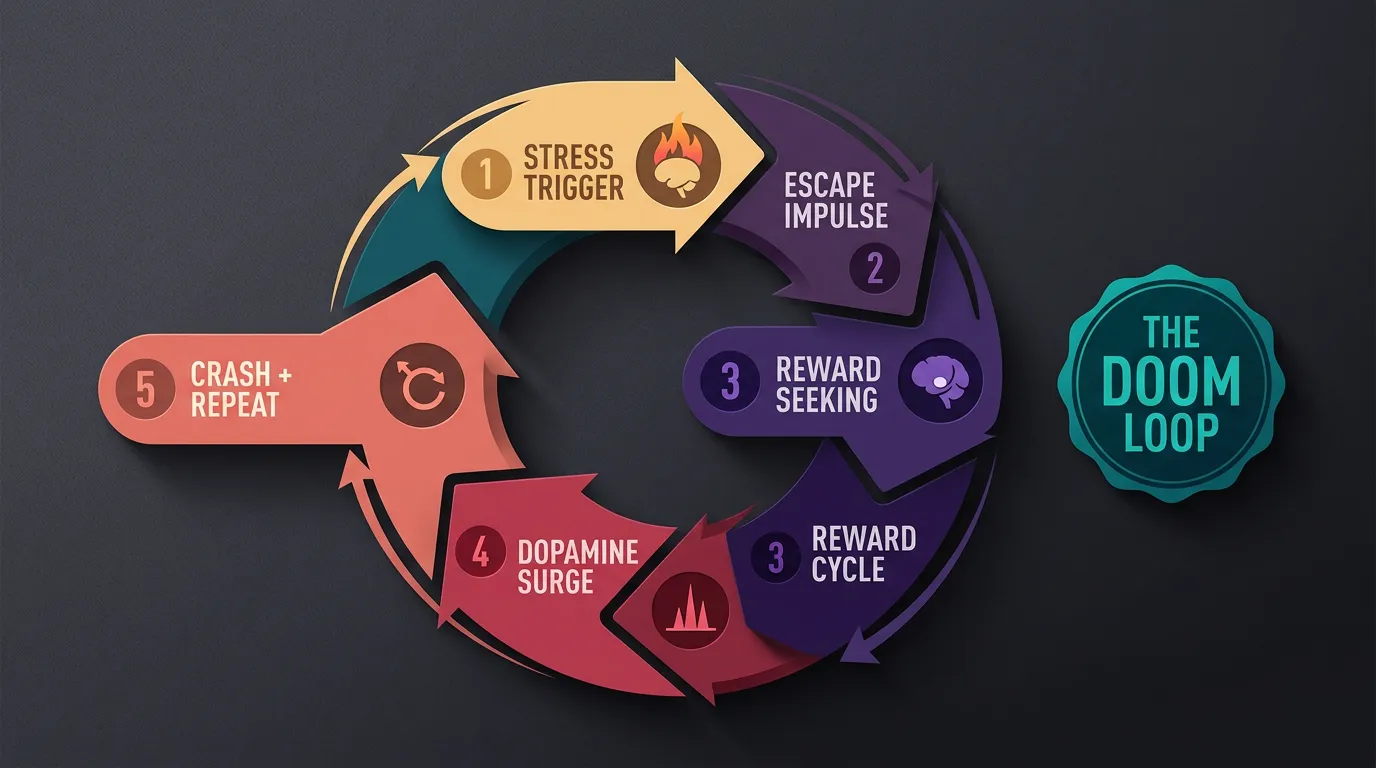
Here is what happens in your brain during a doom spending episode:
- Stress trigger. You read alarming news. Your amygdala fires, flooding your system with cortisol.
- Escape impulse. Your prefrontal cortex, the rational planning center, is suppressed by stress hormones. Your brain shifts into short-term survival mode.
- Reward seeking. Your nucleus accumbens demands something, anything, that will produce dopamine. Shopping apps are designed to deliver exactly this.
- Dopamine surge. Browsing and buying create a chemical reward. Anxiety temporarily drops.
- Crash and repeat. The dopamine fades. Financial guilt triggers more cortisol. The cycle restarts.
Individuals with compulsive buying tendencies show stronger activity in the nucleus accumbens during product viewing and weaker activity in the insula, the brain region responsible for noticing something feels wrong, during price evaluation.[6] Their brains literally turn up the volume on wanting and turn down the alarm on cost.
Recommended read: Dopamine Nation by Anna Lembke. A Stanford psychiatrist explains how the pleasure-pain balance in your brain drives compulsive behaviors, from shopping to scrolling, and what it takes to reset the system.
Psychiatrist Anna Lembke, author of Dopamine Nation, describes this as the pleasure-pain balance. Every dopamine hit tips the scale toward pleasure. But your brain always fights to restore equilibrium by tipping it back toward pain. The result is tolerance. You need bigger purchases, more frequent shopping, and more novelty just to feel the same relief.
This is why doom spending hijacks the same dopamine circuits that make social media so addictive. The neurochemistry is identical.
How Social Media Pours Gasoline on the Fire
Doom spending does not happen in a vacuum. Social media creates the perfect conditions for it. First it delivers the bad news. Then it shows you what everyone else is buying.
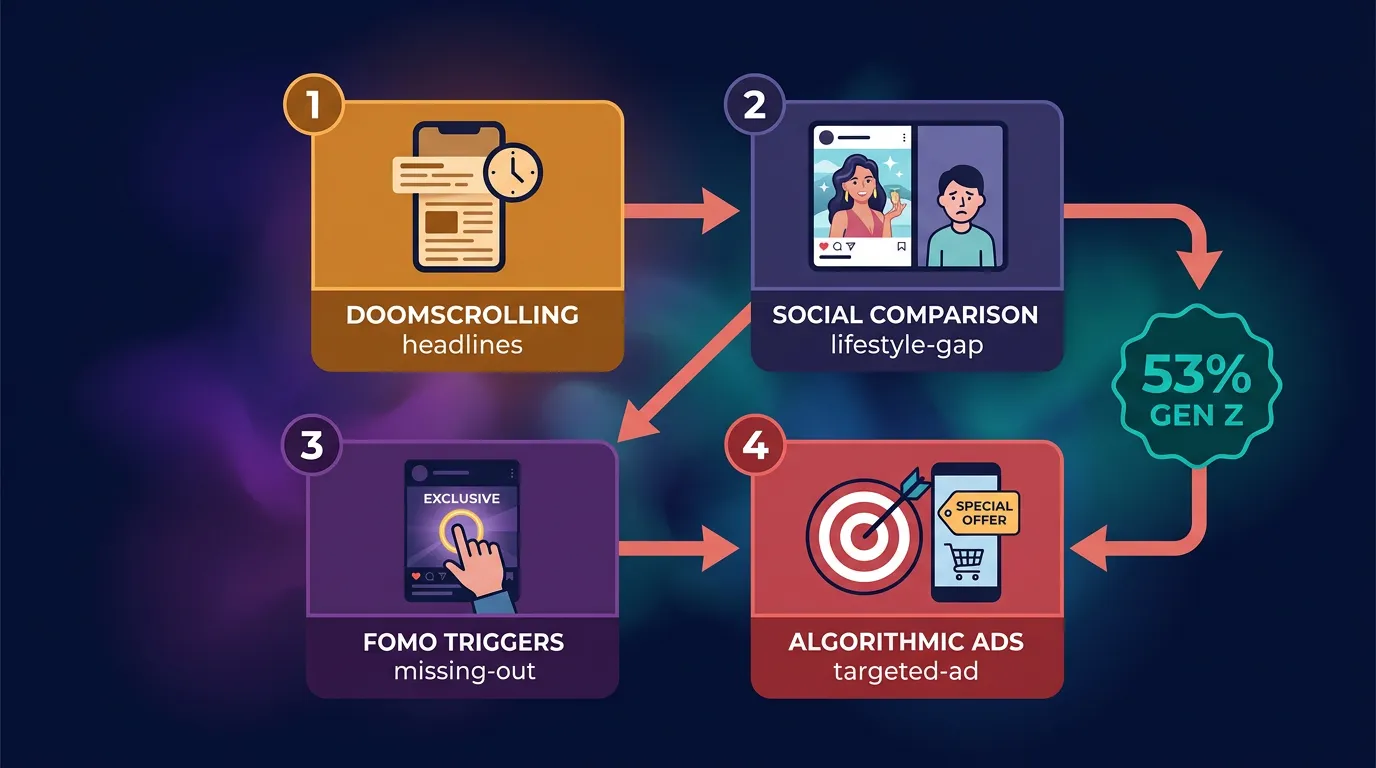
A 2025 Credit Karma survey found that 53% of Gen Zers say receiving bad news online drives them to stress spend.[1] The same platforms delivering anxiety are also delivering ads. This is not a coincidence. It is a business model.
The psychological pipeline works like this:
- Doomscrolling primes anxiety. You absorb headlines about economic collapse, climate disasters, and political chaos. Your baseline stress rises.
- Social comparison kicks in. Between the bad news, you see influencers with perfectly curated lives. Your brain calculates the gap between their life and yours.
- FOMO triggers action. A 2025 study published in Discover Psychology found that fear of missing out drives materialism and conspicuous consumption among social media users.[7] You are not buying a product. You are trying to close the gap.
- Algorithmic reinforcement. Shopping algorithms track your stress-browsing patterns. They learn when you are most vulnerable and serve targeted ads at those exact moments.
The numbers are staggering. Influencer marketing spending in the U.S. was projected to hit $6.2 billion in 2025.[8] That money is not spent on rational product demonstrations. It is spent on creating emotional gaps that only purchases can fill.
Social media also normalizes doom spending through shared language. Phrases like “treat yourself,” “you only live once,” and “soft life” reframe compulsive buying as self-care. When everyone in your feed is doing it, the behavior feels validated rather than concerning.
This is the same psychological manipulation that stores use to make you overspend. But instead of strategically placed products in a physical store, it is algorithmically placed content in your mental space.
Recommended read: Hooked by Nir Eyal. Reveals the four-step “Hook Model” that apps use to build compulsive usage habits, and why shopping platforms are designed to keep you coming back.
Breaking the Cycle: Strategies That Actually Work
Telling a doom spender to “just stop buying things” is like telling someone with insomnia to “just fall asleep.” The behavior is rooted in neuroscience, reinforced by technology, and validated by culture. You need strategies that work at the same level.
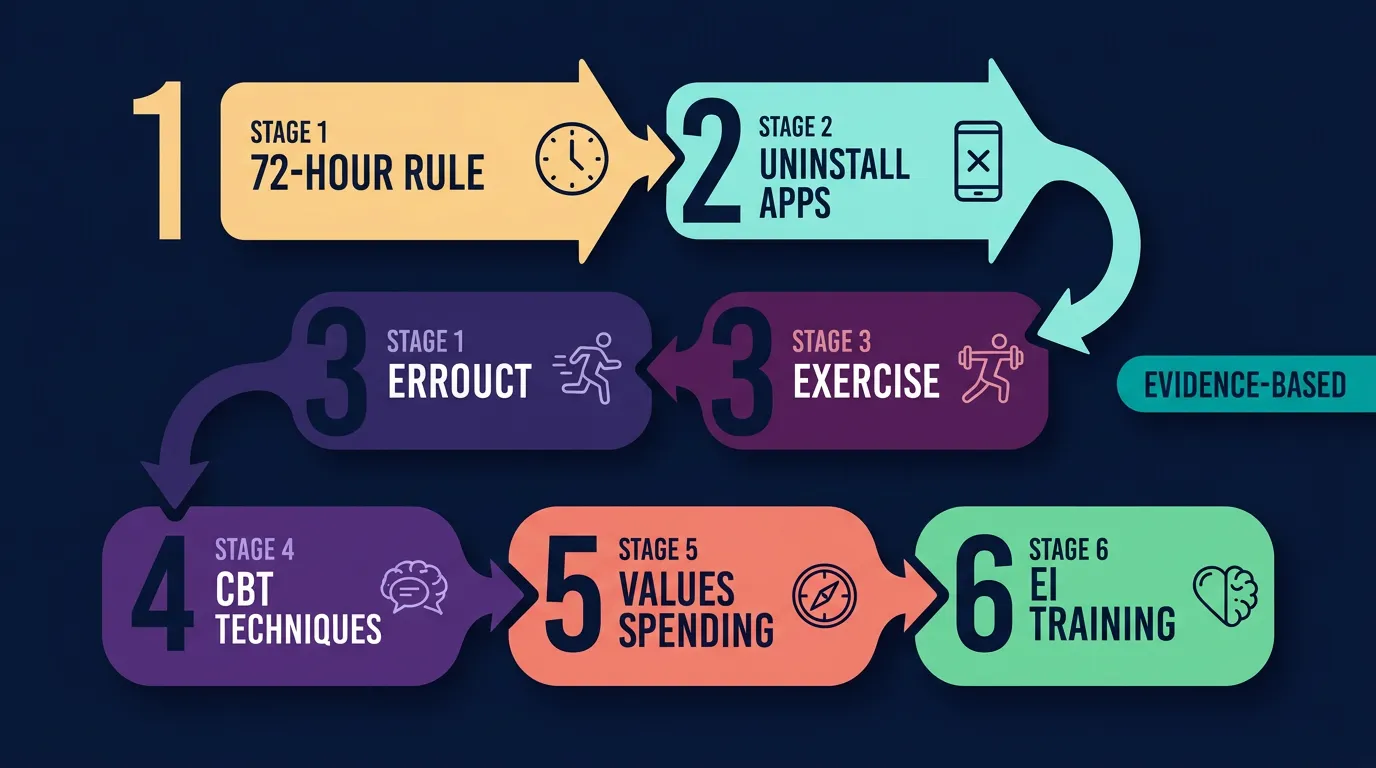
Here are evidence-based approaches from behavioral psychology and clinical research:
Interrupt the Trigger Loop
- The 72-hour rule. Put non-essential items in your cart and wait 72 hours before buying. A 2025 study on mental simulation and compulsive buying found that the urge to purchase peaks in the first moments and drops significantly with time.[9] Most items will feel irrelevant by day three.
- Uninstall shopping apps. Friction is your friend. Research on choice architecture shows that adding even small barriers to a behavior dramatically reduces its frequency.[10] Making impulse buying slightly harder can cut it significantly.
- Set screen time limits on news apps. If doomscrolling is your spending trigger, reduce the trigger.
Rewire the Reward System
- Exercise. Physical activity releases the same dopamine and endorphins as shopping, without the credit card bill. Even a 20-minute walk reduces anxiety and the urge to impulse buy.
- Creative activities. Painting, writing, cooking, and playing music activate reward circuits without the crash cycle. They also build lasting satisfaction that hedonic purchases cannot.
- Social connection. Loneliness is a major doom spending trigger. Spending time with real people, not Instagram feeds, reduces the comparison effect.
Address the Root Psychology
- Cognitive behavioral techniques. Identify the thought pattern: “The economy is collapsing, so saving is pointless, so I might as well buy this.” Then challenge each link. Is the economy actually collapsing? Is saving truly pointless? Does buying this actually help?
- Values-based spending. Write down your top three values. Before every purchase, ask: does this align? This shifts decision-making from emotional impulse to intentional choice.
- Financial micro-goals. Instead of “save for retirement” (too abstract, too far away), try “save $50 this week.” Concrete, achievable goals restore the sense of agency that doom spending tries to replace.
A 2022 study published in Frontiers in Psychology found that emotional intelligence training significantly reduced both materialism and compulsive buying tendencies among university students.[11] The skills are learnable. The cycle is breakable.
| Strategy | Targets | Difficulty | Impact |
|---|---|---|---|
| 72-hour rule | Impulse control | Easy | High |
| Uninstall shopping apps | Environmental triggers | Easy | Medium |
| Exercise replacement | Dopamine system | Medium | High |
| CBT thought challenging | Core beliefs | Medium | Very high |
| Values-based spending | Decision framework | Medium | High |
| Emotional intelligence training | Root vulnerability | Hard | Very high |
Sources
What Doom Spending Actually Is, and What It Is Not
The Nihilism Engine: Why “Nothing Matters” Feels Like Permission
3. Learned Helplessness at Fifty: Insights from Neuroscience (Psychological Review, 2016)
4. Gen Z and Financial Nihilism (Kyla Scanlon, 2024)
Your Brain on Shopping: The Neuroscience of the Buy Button
5. Neural Predictors of Purchases (Neuron, 2007)
6. Neurocognitive Functioning in Compulsive Buying Disorder (Annals of Clinical Psychiatry, 2014)
How Social Media Pours Gasoline on the Fire
Breaking the Cycle: Strategies That Actually Work
9. Mental Simulation and Compulsive Buying: A Multiple Mediation Model (Frontiers in Psychology, 2025)