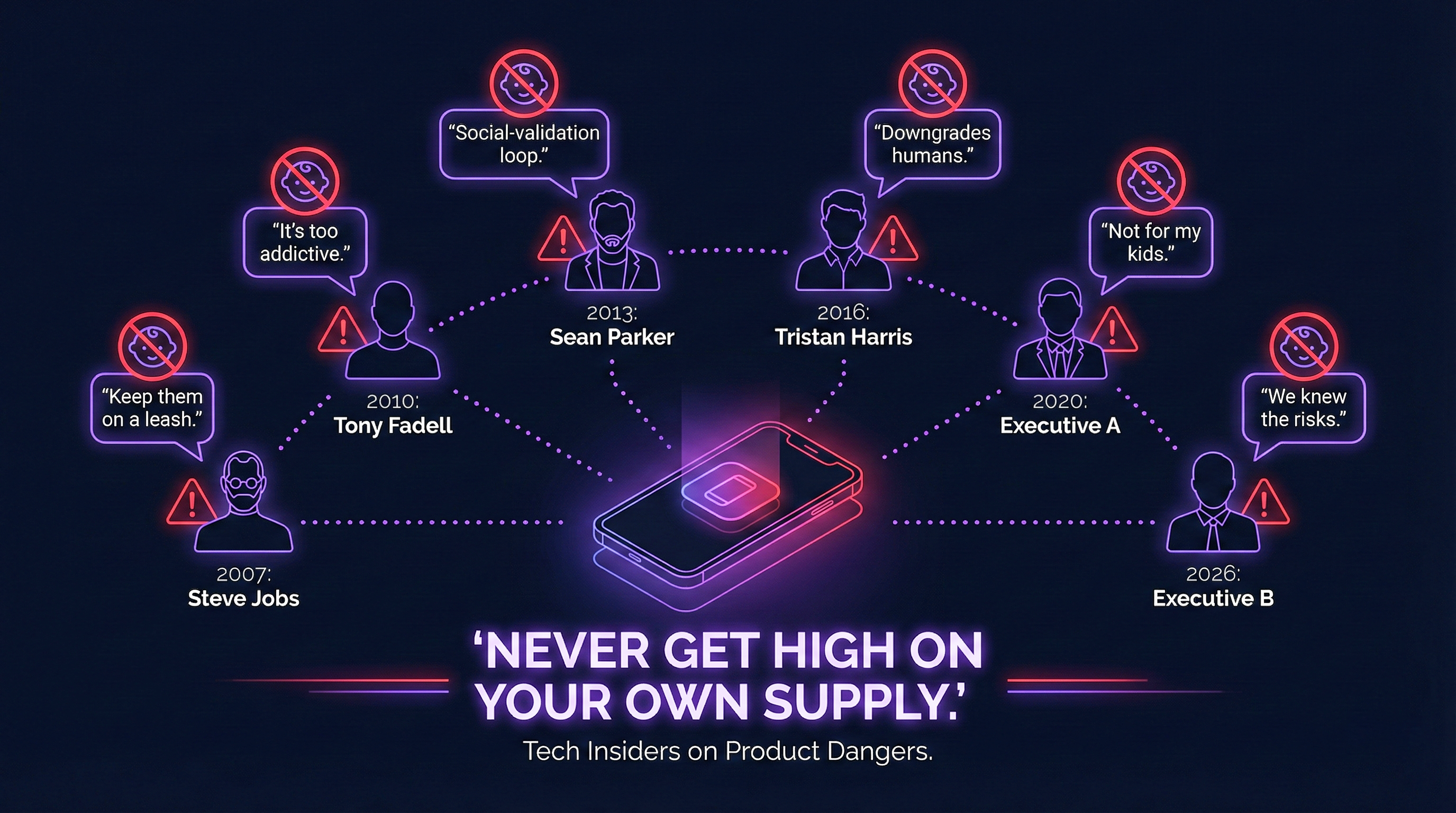
When Steve Jobs unveiled the iPad in 2010, he called it “extraordinary” and “phenomenal.” But later that year, he told a New York Times journalist something surprising. His own children had never used it.
“We limit how much technology our kids use in the home,” he said.
He wasn’t alone. The people who build our favorite apps don’t let their own families use them. The reason has everything to do with a tiny chemical in your brain called dopamine.
The People Who Built Your Apps Are Terrified of Them
The Silicon Valley insiders who created our most addictive technology are doing everything they can to keep it away from their own families.
- Chris Anderson (former editor of Wired) enforced strict screen-time limits on all five of his children. None were ever allowed screens in their bedrooms. His reason? “We have seen the dangers of technology firsthand.”
- Evan Williams (co-founder of Twitter and Medium) bought hundreds of books for his young sons. But he refused to give them an iPad.
- Greg Hochmuth (Instagram founding engineer) admitted he was building “an engine for addiction.” The platform takes on “its own life, like an organism, and people can become obsessive.”
- Tony Fadell (co-inventor of the iPhone) said he wakes up “in cold sweats” thinking they’d helped create “a nuclear bomb” that can “blow up people’s brains and reprogram them.”
Nobody Raised Their Hand
James Williams, a former Google strategist, once asked a room full of leading tech designers a simple question:
“How many of you want to live in the world you are designing?”
There was silence. Nobody put up their hand.
“There are a thousand people on the other side of the screen whose job it is to break down the self-regulation you have.” - Tristan Harris, design ethicist
These aren’t conspiracy theories. These are the people who built the technology telling us exactly what it does.
Recommended read: Irresistible by Adam Alter. A deep dive into why we can’t stop scrolling and the psychology behind addictive tech design.
Your Brain on Apps: The Dopamine Trap
So what’s actually happening inside your brain when you scroll? It starts with dopamine. That’s a chemical your brain releases when something feels good. You get small hits of dopamine from simple things like drinking water when you’re thirsty or warming your hands by a fire.
But apps don’t give you small hits. They send your dopamine production into overdrive.
The Tolerance Problem
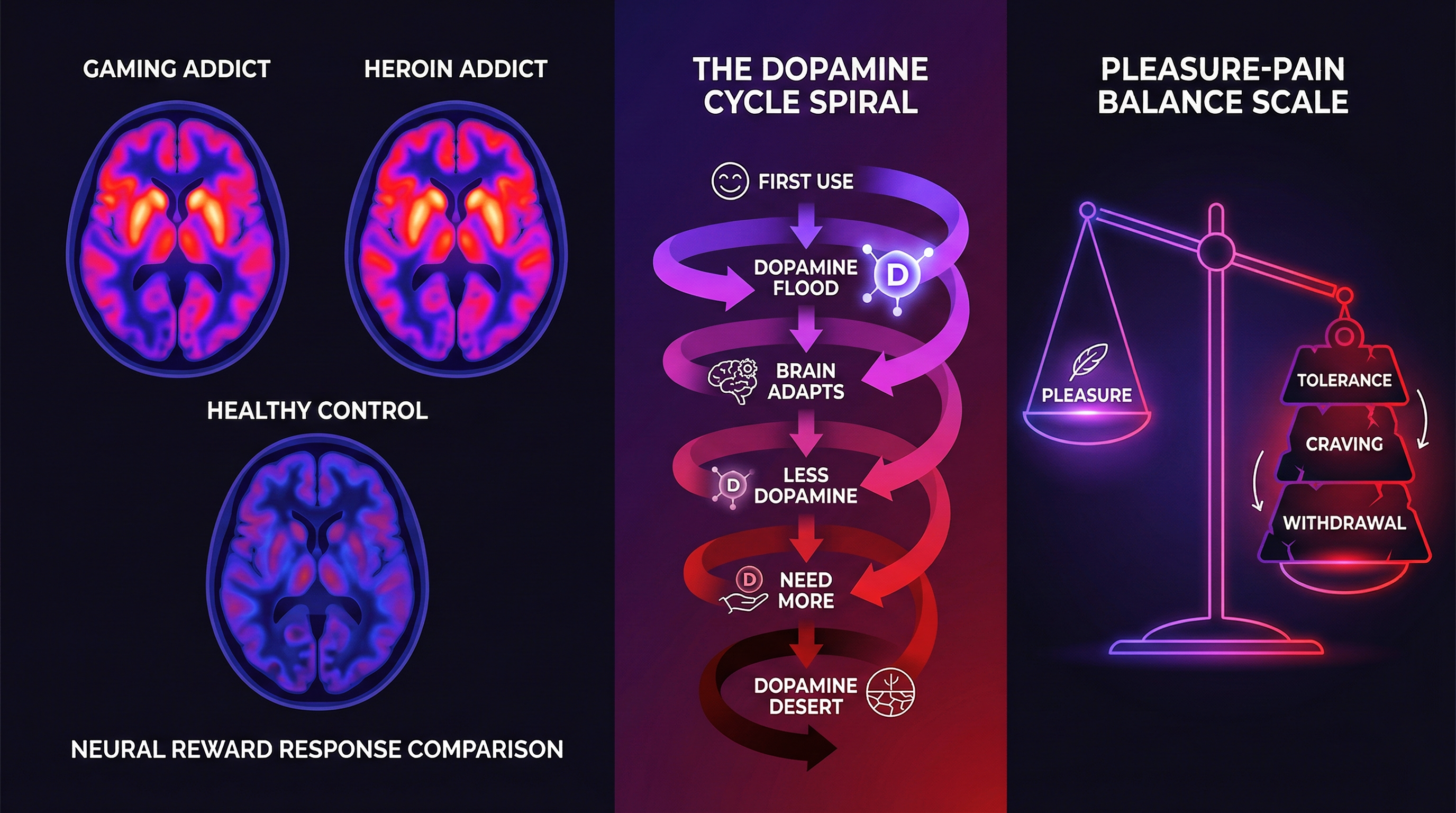
Here’s where it gets dangerous. When your brain gets flooded with too much dopamine, it thinks something is wrong. So it starts producing less and less dopamine on its own. This is called tolerance. It’s the same thing that happens with drugs.
What tolerance looks like in practice:
- You need more scrolling to feel the same satisfaction you used to get
- Simple pleasures like a walk, a meal, or a conversation start feeling flat
- You pick up your phone without thinking because it becomes automatic
- You feel restless or anxious when you can’t check your notifications
Neuroscientist Claire Gillan put it simply: “Drugs and addictive behaviors activate the same reward center in the brain.” Cocaine has a more direct effect than gaming or social media. But they all work “by the same mechanism on the same systems.”
How App Addiction Compares to Drug Addiction
| Comparison | Drug Addiction | App/Screen Addiction |
|---|---|---|
| Brain area affected | Reward center (nucleus accumbens) | Same reward center |
| Mechanism | Dopamine flood, then tolerance, then craving | Same dopamine cycle |
| Brain scan pattern | Reduced dopamine receptor activity | Nearly identical pattern |
| Withdrawal symptoms | Anxiety, irritability, restlessness | Same symptoms, milder intensity |
| Tolerance | Need more of the drug for same effect | Need more screen time for same satisfaction |
Brain scans show that a heroin addict injecting heroin and a gaming addict starting a new quest in World of Warcraft produce almost identical brain patterns. The intensity is different but the machinery is the same.
The Dopamine Desert
Neuroscientist Nora Volkow used brain imaging to show what happens after heavy, prolonged use. In a healthy brain, the reward center “lights up bright red.” In people with addiction who’d stopped for two weeks, that same region had “little or no red.”
This is called a dopamine deficit state. Nothing feels good anymore.
Dr. Anna Lembke, a psychiatrist at Stanford, describes the cruel paradox:
Hedonism (chasing pleasure for its own sake) leads to anhedonia (the inability to feel pleasure at all). The pursuit of constant pleasure can ultimately destroy your ability to feel it.
Recommended read: Dopamine Nation by Anna Lembke. The science of the pleasure-pain balance and how to reset your brain’s reward system.
The Six Tricks Apps Use to Hook You
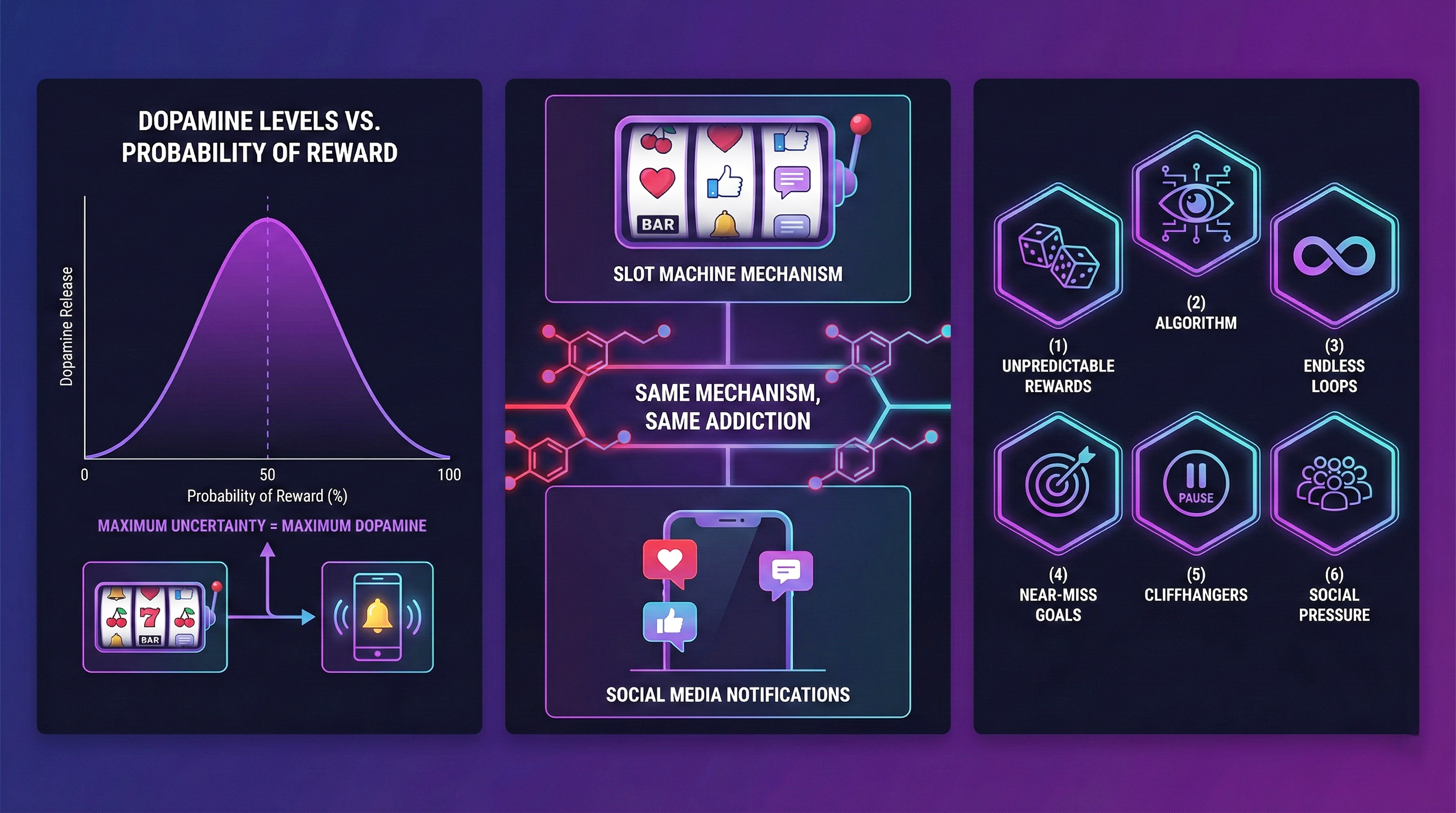
Apps don’t accidentally keep you scrolling. They’re built with specific psychological tricks that exploit your dopamine system. Researcher Adam Alter identified six ingredients of behavioral addiction:
| # | Trick | How It Works | App Example |
|---|---|---|---|
| 1 | Unpredictable rewards | Dopamine spikes highest at 50/50 odds | Instagram likes vary wildly |
| 2 | The algorithm | Shows you what keeps you looking | Facebook’s personalized feed |
| 3 | Endless loops | Removes natural stopping points | Netflix autoplay, infinite scroll |
| 4 | Goals just out of reach | Small wins trigger “just one more” | Game missions, fitness badges |
| 5 | Cliffhangers | Unresolved tension demands resolution | ”Just one more episode” |
| 6 | Social pressure | Ties engagement to friendships | Posting for likes, streaks |
Unpredictable Rewards: The Big One
This is the most powerful trick. Think about posting a photo on Instagram. Sometimes you get tons of likes. Sometimes barely any. That unpredictability is what makes it irresistible.
It works exactly like a slot machine. A 2010 study by Jakob Linnet measured dopamine in gamblers’ brains. The result?
- Dopamine spiked highest when the odds of winning or losing were exactly equal. That means maximum uncertainty.
- Pathological gamblers even showed increased dopamine when they lost money
- Your notification bell works the same way. Maybe there’s something exciting. Maybe there isn’t.
The Algorithm That Knows You
When you open Facebook, what you see isn’t random. A powerful algorithm decides what appears in your feed. Its one driving principle: show you things that keep you looking at your screen. That’s because your attention is a product that big tech sells to advertisers.
“The more time you look, the more money they make.” - Tristan Harris
Facebook could design a button that says “I want to meet up, who’s nearby and free?” It would be easy to build. But people would spend only a few minutes on the app instead of fifty minutes a day. So that button doesn’t exist.
Endless Loops, Near-Miss Goals, Cliffhangers, and Social Pressure
The remaining four tricks reinforce the first two:
- Endless loops remove natural stopping points. These are just some of the dark patterns that trick your brain into staying longer. Think infinite feeds, autoplay, and “keep swiping.”
- Near-miss goals dangle the next achievement. One more badge, one more level, one more streak day.
- Cliffhangers exploit the Zeigarnik Effect. Your brain can’t let go of unfinished tasks so you watch “just one more episode.”
- Social pressure ties your engagement to your friendships. You post hoping for likes then return to support friends, chasing that next hit of validation.
The Real Cost: What the Numbers Show
App developer Kevin Holesh created an app called Moment to track his own phone use. He was shocked to find he spent 1 hour and 15 minutes a day. Then he let 8,000 other people try it.
What People Think vs. Reality
| What Was Measured | What People Guessed | The Reality |
|---|---|---|
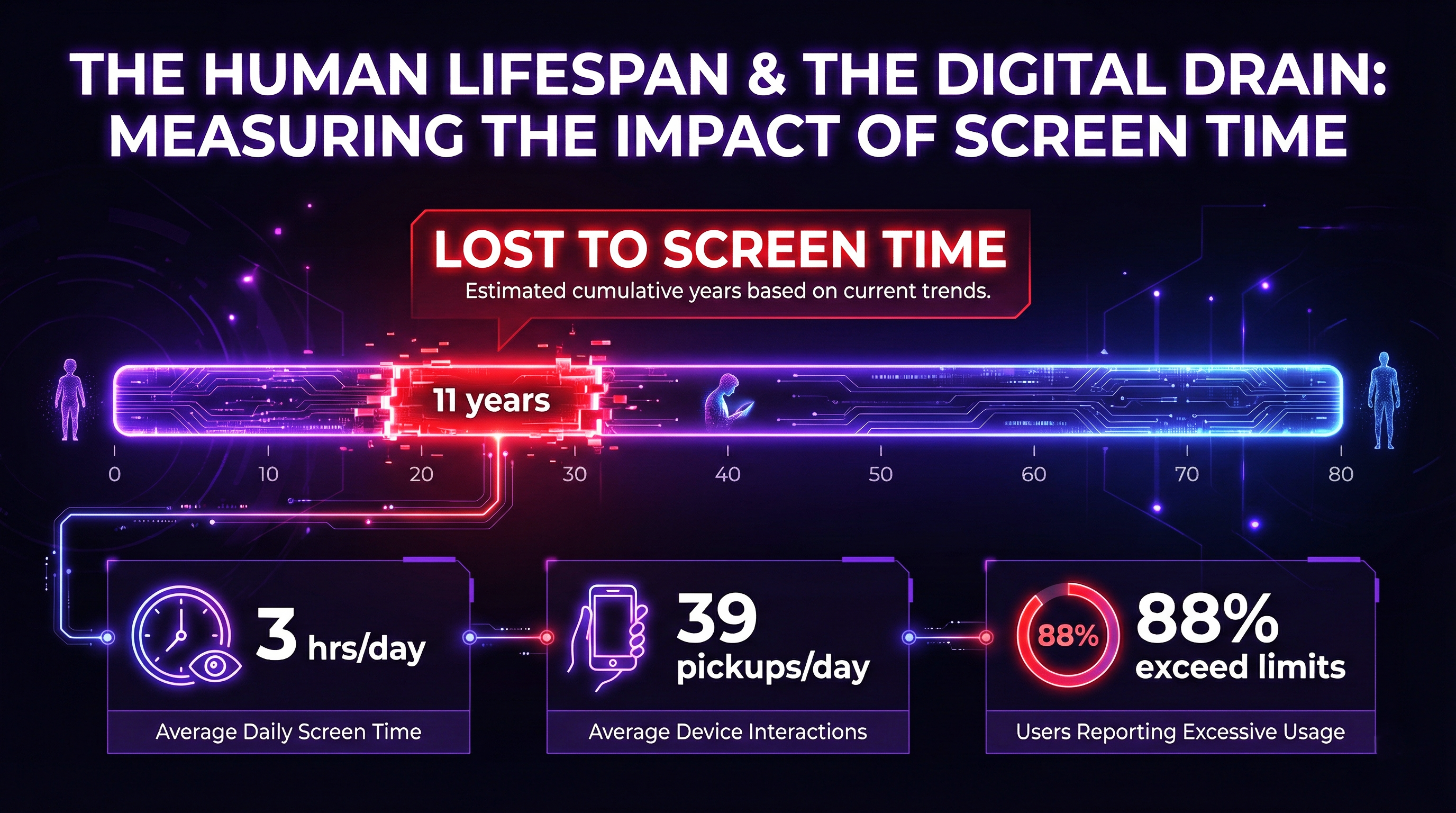
| Daily phone usage | ~1.5 hours | 3 hours |
| Daily phone pickups | ~20 times | 39 times |
| Percentage exceeding 1hr/day | n/a | 88% |
The average person spends a quarter of their waking life on their phone. That’s more than any daily activity except sleeping. Over a lifetime, that’s roughly 11 years staring at a screen.
It Wrecks Your Sleep
Blue light from screens destroys your sleep cycle:
- 95% of people use screens that emit blue light before bed
- Blue light at night stops your pineal gland from producing melatonin (the hormone that makes you sleepy)
- A 2013 study found iPad users before bed produced significantly less melatonin, slept more poorly, and felt more tired the next day
- 60% of adults sleep with their phone next to them
- You’re basically giving yourself jet lag every single night
The Hidden Addictions
Behavioral addictions are everywhere. And they’re much easier to hide than drug abuse:
- One psychologist described a patient: “Very beautiful, very bright, very accomplished. Two master’s degrees. A teacher. But addicted to online shopping. $80,000 in debt.”
- Another patient checked his email hundreds of times a day and couldn’t relax on vacation
- Clinical psychologists report these cases are increasing rapidly
Recommended read: Stolen Focus by Johann Hari. An investigation into why our attention spans are collapsing and who profits from it.
How to Fight Back
The good news? Your brain can recover. Dr. Lembke explains that “if we wait long enough, our brains usually readapt to the absence of the drug and we reestablish our baseline.” That means a level balance where simple things feel good again.
Here’s how to start:
-
Know the game. These apps are designed by thousands of engineers to keep you hooked. It’s not a willpower problem. It’s a design problem. Understanding this takes the shame out of it.
-
Track your actual use. Download a screen-time tracker. Most people underestimate their usage by about 50%. You can’t fix what you can’t see.
-
Follow the tech insiders’ lead. Steve Jobs, Chris Anderson, and Evan Williams all set strict tech limits for their families. Set screen-free zones (bedroom, dinner table) and time limits for the apps that drain you most.
-
Create stopping points. Since apps remove natural break points, you have to build your own. Set a timer. Use app blockers. Delete the infinite-scroll apps from your home screen.
-
Give your dopamine system a break. Do things that produce healthy, natural dopamine. Exercise, time outdoors, face-to-face conversations. Your brain needs time to recalibrate so everyday pleasures feel good again.
The Bottom Line
The technology in your pocket isn’t neutral. It was built to capture your attention and keep it. And the data you generate while scrolling feeds an entire economy built on surveillance capitalism and your personal data. But now that you know how the trick works, you have something those thousand engineers on the other side of the screen didn’t count on: awareness.
Recommended read: The Shallows by Nicholas Carr. How the internet is physically reshaping our brains and what we can do about it.
