
What would you do if you found out your entire life was running on a computer somewhere?
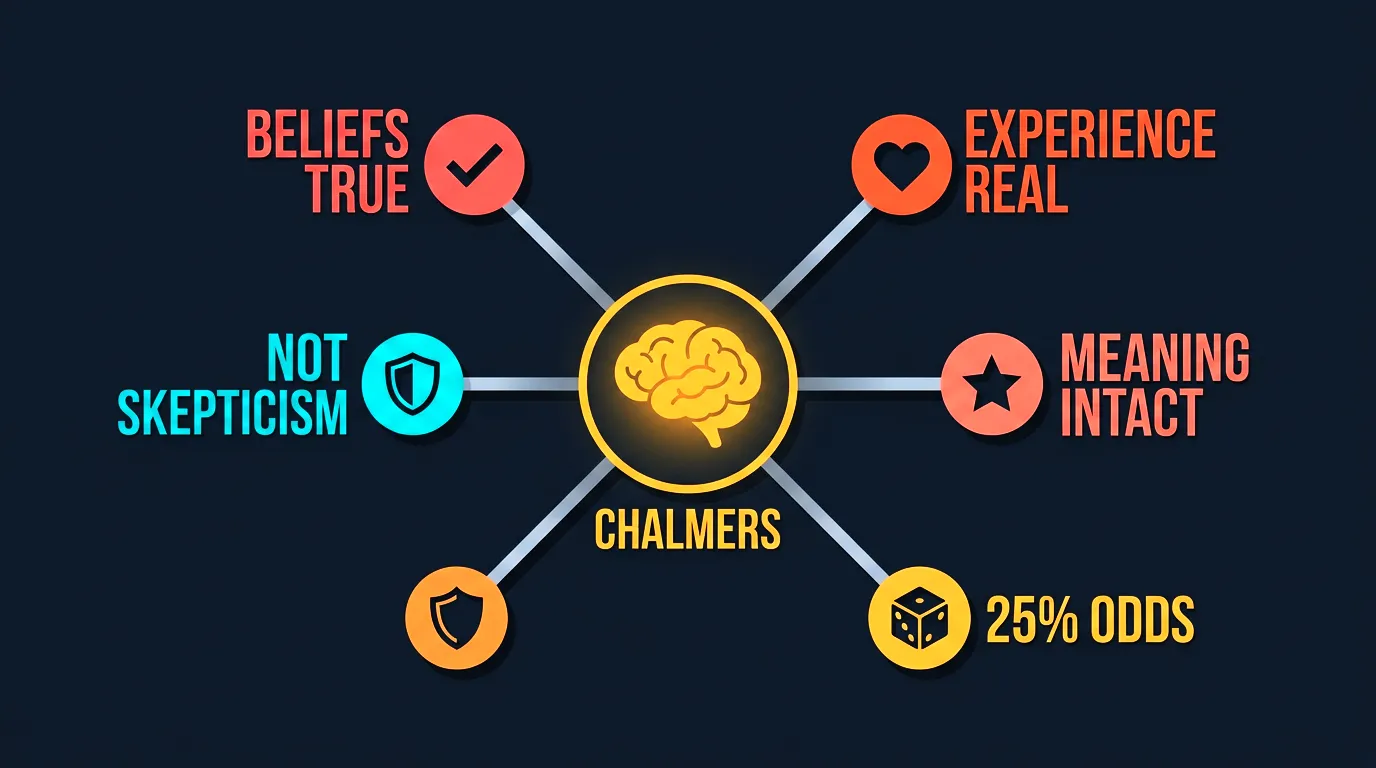
Most people imagine panic. Existential dread. A Matrix-style breakdown where nothing feels real anymore. But David Chalmers, one of the most respected philosophers alive, looked at this exact scenario and came to a surprising conclusion. Even if we are living in a simulation, your life is still real. Your relationships still matter. And your beliefs are mostly true.
His argument is not what you’d expect. And it might actually make you feel better about reality, whatever it turns out to be.
The Philosopher Who Called the Simulation a Non-Problem
David Chalmers is not some internet conspiracy theorist. He’s the philosopher who coined the term the hard problem of consciousness, one of the most influential ideas in modern philosophy of mind. When he writes a paper about simulation theory, the academic world pays attention.
In 2024, Chalmers published “Taking the Simulation Hypothesis Seriously” in Philosophy and Phenomenological Research, one of the top journals in the field.[1] His core argument was deceptively simple. The simulation hypothesis is not a skeptical hypothesis.
What does that mean? Most people assume that if we’re in a simulation, then everything we believe is wrong. The sky isn’t really blue. Your coffee isn’t really hot. Your mom isn’t really your mom.
Chalmers says that’s completely backwards. If we live in a perfect simulation, most of our ordinary beliefs are still true.[1] The sky IS blue. Your coffee IS hot. Only the underlying substrate is different. The experience itself is real.
If you’ve ever felt the pull toward believing we’re in a simulation, Chalmers’ answer might surprise you. He doesn’t dismiss it. He embraces it. And he puts the probability at “at least 25 percent or so.”[1]
That’s not a fringe number. That’s a serious philosopher saying there’s a one-in-four chance your reality is code. And he’s totally fine with it.
Recommended read: The Experience Machine by Andy Clark — explores how your brain already constructs reality from predictions, making the simulation question even more fascinating.
Bostrom’s Trilemma, The Argument That Started It All
The simulation hypothesis didn’t come from science fiction. It came from a precise philosophical argument published in 2003 by Oxford philosopher Nick Bostrom.[2]
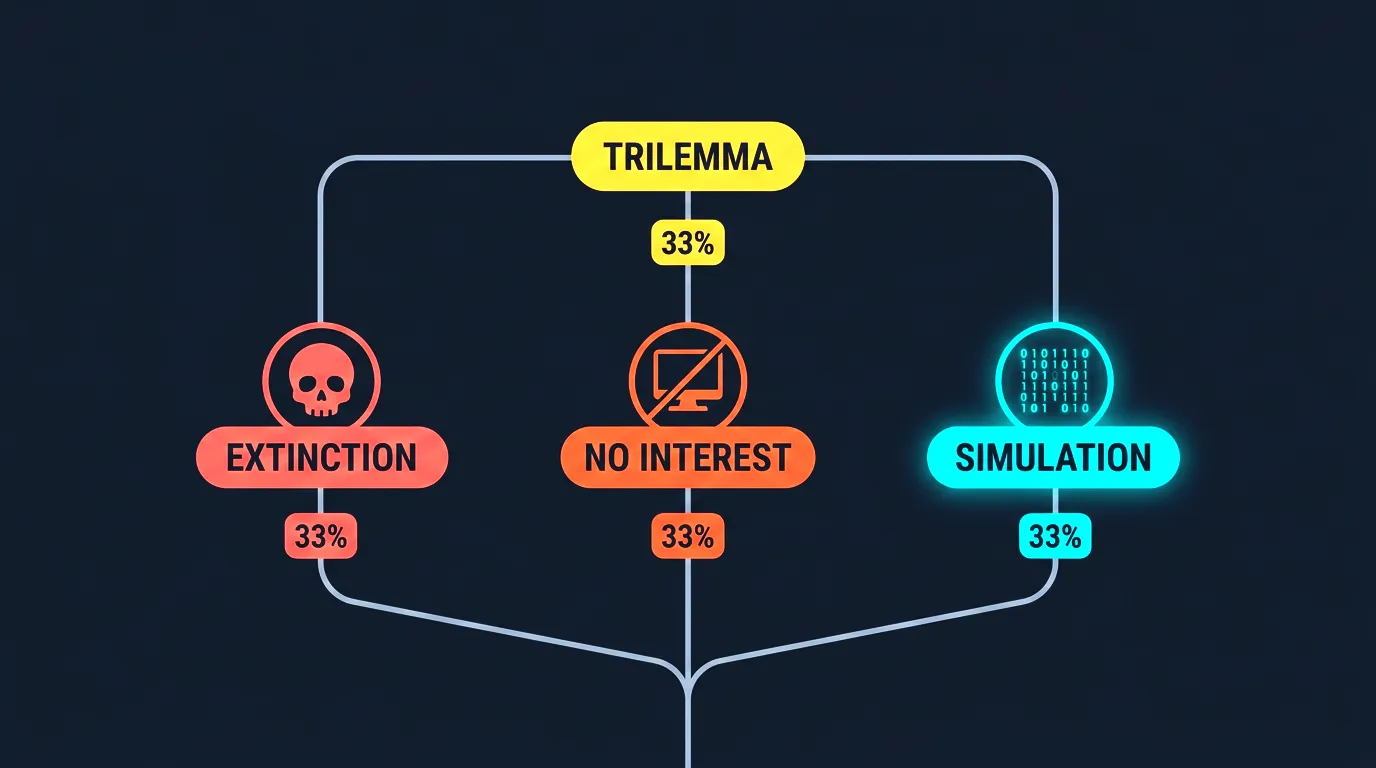
Bostrom’s trilemma gives you three options. Exactly one must be true.
- Option 1. Almost all civilizations go extinct before developing simulation technology.
- Option 2. Advanced civilizations exist but choose not to run detailed simulations of their ancestors.
- Option 3. We are almost certainly living inside a simulation right now.
There is no fourth option. The math is straightforward. If even one civilization runs a large number of ancestor simulations, the simulated beings vastly outnumber the real ones. A randomly chosen conscious being would almost certainly be simulated.[2]
This argument sparked a wave of serious scientific engagement. Here’s where the probability estimates land:
| Who | Estimate | Method |
|---|---|---|
| Nick Bostrom | ~33% for each option | Philosophical trilemma |
| Elon Musk | “One in billions” we’re real | Technological trajectory |
| David Kipping (Columbia) | ~50/50 | Bayesian statistics |
| David Chalmers | At least 25% | Philosophical reasoning |
Astronomer David Kipping at Columbia University used Bayesian reasoning to analyze Bostrom’s three scenarios. His conclusion? The odds are roughly 50/50 that we’re in a simulation.[3] That’s a coin flip on the nature of reality.
Two decades after Bostrom’s original paper, nobody has definitively ruled out option three.[2] That’s what makes Chalmers’ response so important. Instead of arguing whether the simulation is real, he asks what it means if it is.
Why Chalmers Says Your Beliefs Still Hold Up
This is where Chalmers makes his most powerful move. He introduces an idea called simulation realism, built on a concept from philosophy of physics called structural realism.[1]
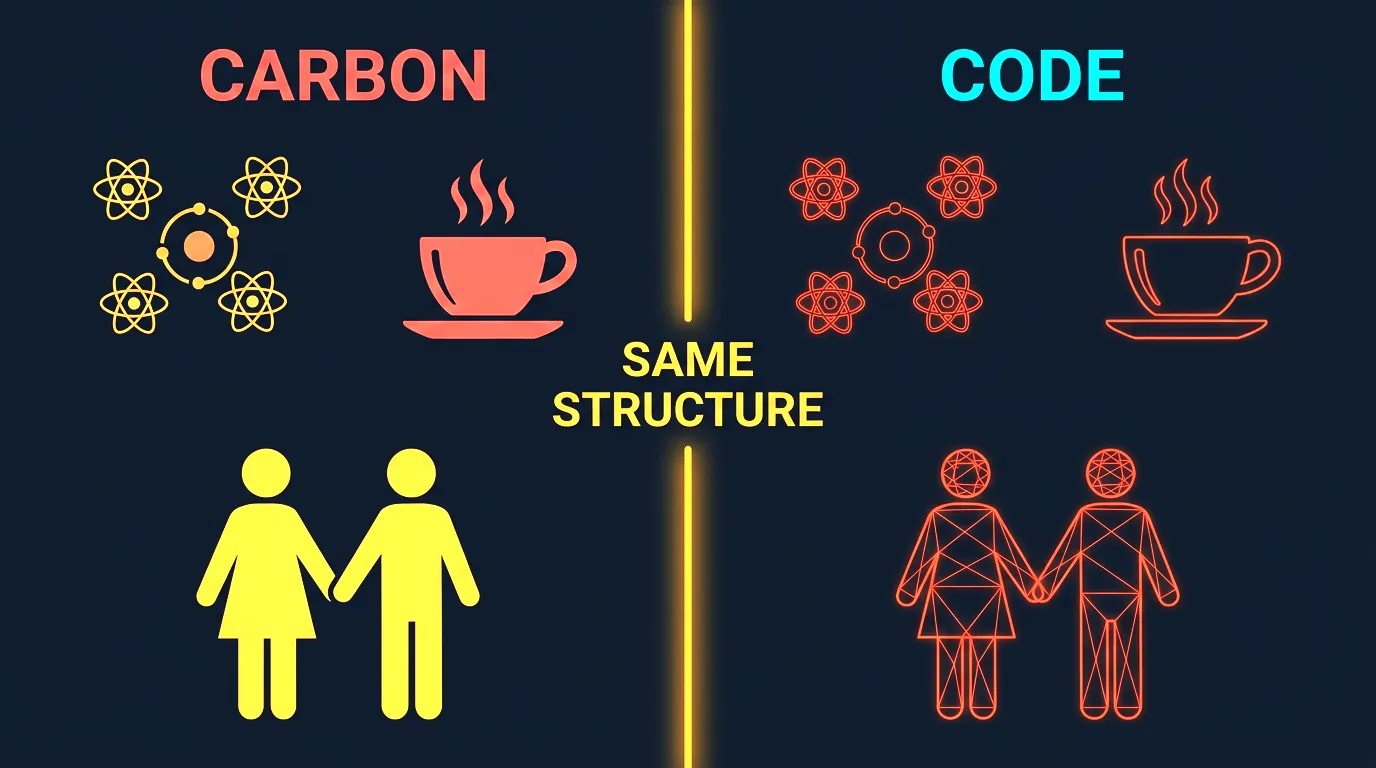
Here’s the basic idea. What makes something “real” isn’t what it’s made of. It’s how it behaves.
Think about atoms. An atom in a simulation follows the same rules, has the same relationships with other atoms, and produces the same outcomes as an atom in base reality. Chalmers argues that if the causal structure is the same, the thing IS the same.[1]
This has huge implications:
- Your coffee is still hot because “hot” means molecules moving fast. Simulated molecules moving fast equals real heat.
- Gravity still works because the structure of gravity is preserved, even if the “substance” is different.
- Your relationships are still real because love, trust, and connection are patterns of interaction. Those patterns exist in any substrate.
“If we are in a simulated world, the world around us is still real. It’s not a situation where none of this is real.” — David Chalmers
Philosopher Grace Helton pushed this further. She examined whether social knowledge survives inside a simulation. Her conclusion is that relationships maintain their reality because what makes a friendship real is the pattern of mutual care and trust, not the material generating it.[4]
Chalmers draws a comparison to virtual reality. In his book Reality+, he argued that VR worlds are genuine realities, not fake ones.[1] The same logic applies to simulation. If you can’t distinguish the experience, and the structure is identical, calling it “fake” is a category error.
Recommended read: Nexus by Yuval Noah Harari — traces how information networks shape reality from ancient myths to AI, raising deep questions about what counts as “real.”
The Philosophers Who Pushed Back
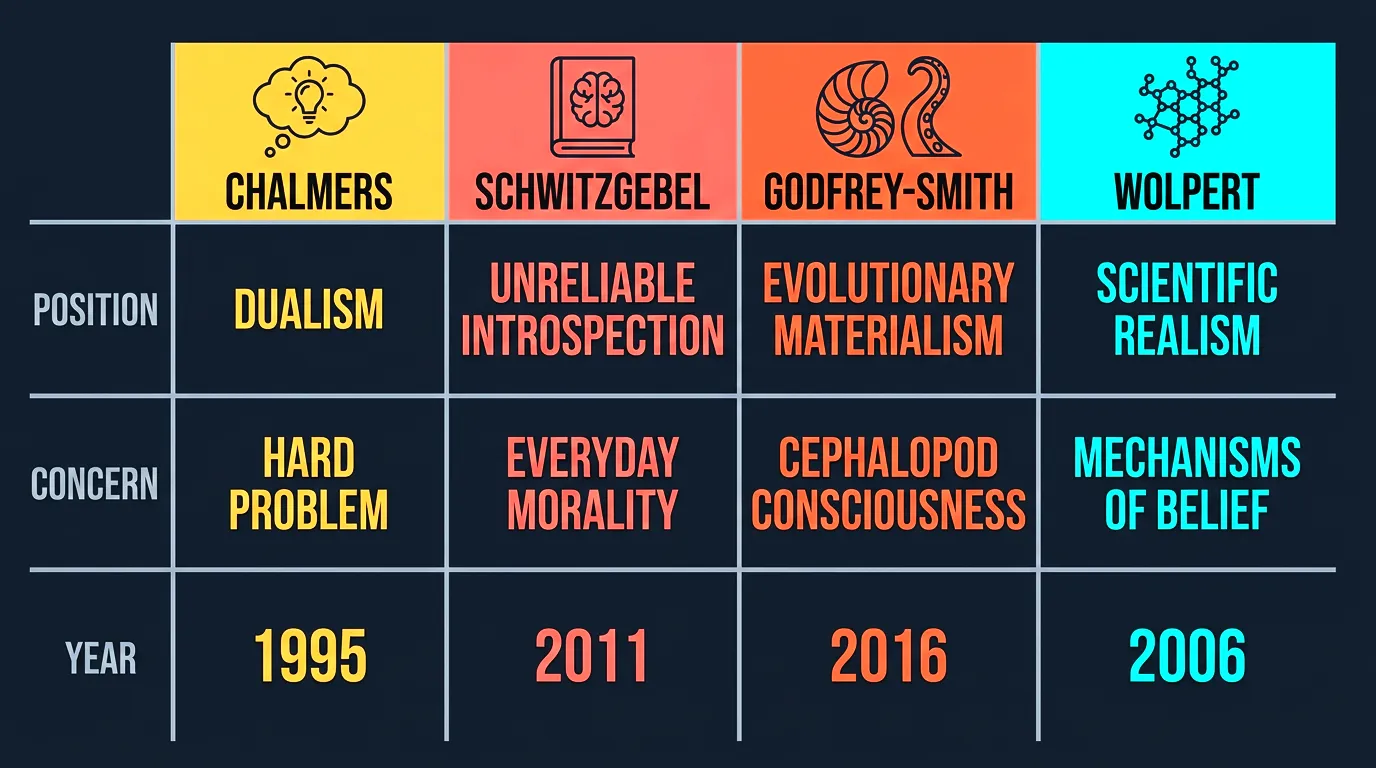
Not everyone agrees with Chalmers. The same journal issue included sharp responses from major philosophers. And a 2025 paper added mathematical complexity to the debate.
Eric Schwitzgebel, We Should Hope It’s Not True
UC Riverside philosopher Eric Schwitzgebel wrote a response titled “Let’s Hope We’re Not Living in a Simulation.”[5] His concern isn’t about whether beliefs are true. It’s about survival.
If we’re in a simulation, we exist at the mercy of whoever is running it. They could shut it down tomorrow. Schwitzgebel argues we should take seriously the possibility that our simulation could be small, brief, or about to end.[5] Cost considerations might favor “cheap” simulations. Running a full universe is expensive. Running a brief experiment that ends next Tuesday is much cheaper.
Peter Godfrey-Smith, Consciousness Might Need Biology
Sydney philosopher Peter Godfrey-Smith raised a different objection.[6] He argues that consciousness might be specifically biological. The timing of neural firing, the chemical dynamics of neurotransmitters, the physical texture of a hot shower. These might not be things a digital simulation can replicate.
His worry is that a simulation could represent the dynamics of consciousness without actually producing felt experience. This echoes the deeper question of how brains construct perception from scratch, which is the same mechanism behind the glitches people report in everyday reality.
David Wolpert, The Math Gets Stranger
In December 2025, Santa Fe Institute physicist David Wolpert published the first mathematically rigorous framework for simulation theory in the Journal of Physics: Complexity.[7]
His key findings challenge everything we assumed:
- A universe that simulates ours could itself be perfectly simulated inside our universe. The loops can be infinite.
- Using Kleene’s second recursion theorem from computer science, he showed that a program can generate and run an exact copy of itself. Extended to universes, this means no “base reality” is necessary.
- The framework grounds the entire debate in the physical Church-Turing thesis, giving simulation theory mathematical precision it never had before.[7]
| Philosopher | Position | Core Concern |
|---|---|---|
| Chalmers | Simulation is fine | Beliefs and meaning survive intact |
| Schwitzgebel | Simulation is dangerous | Could end any moment |
| Godfrey-Smith | Might lack consciousness | Biology may be required |
| Wolpert | Stranger than anyone thought | Infinite loops, no base reality |
What This Actually Means for How You Live
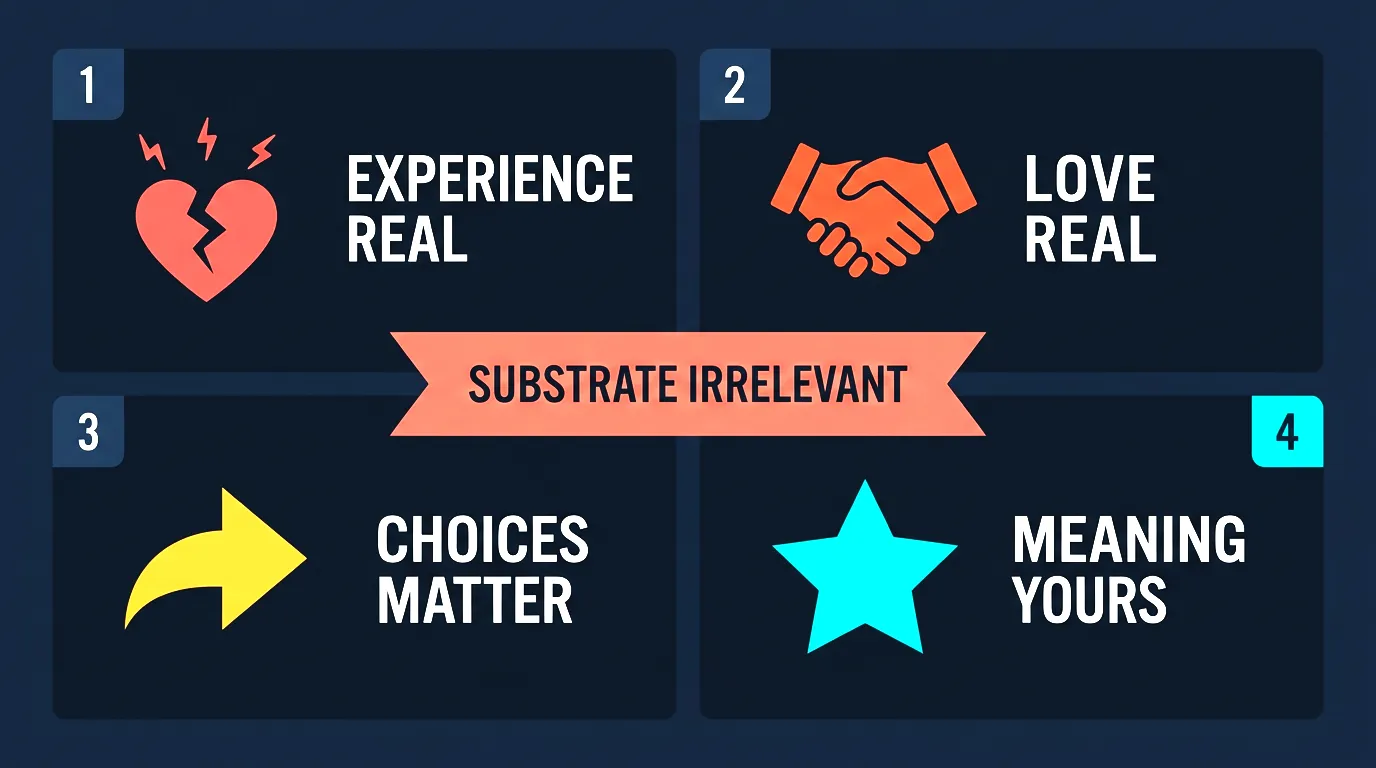
Here’s the practical takeaway. Whether your atoms are made of carbon or code, your choices still matter. Chalmers’ argument is essentially this: stop worrying about the substrate and start paying attention to the structure.
This framing turns simulation theory from an existential crisis into something liberating. If even a top philosopher says life is meaningful inside a simulation, then the “is it real?” question becomes the wrong question entirely.
The better question is: does it change anything?
- Your experiences are still real. Pain hurts. Joy feels good. These are structural facts about your conscious experience, regardless of what generates them.
- Your relationships still matter. Love, trust, and betrayal are patterns of interaction between conscious beings. The pattern is what counts.
- Your choices still have consequences. Whether gravity runs on physics or code, jumping off a building still kills you. Actions produce real outcomes.
- Meaning is something you create. Chalmers’ deepest insight is that meaning was never about the material substrate of reality. It was always about the structures we build within it.
Recommended read: Third Millennium Thinking by Saul Perlmutter — a Nobel physicist’s guide to thinking clearly about the biggest questions, including what counts as evidence and how to navigate deep uncertainty.
The simulation hypothesis, taken seriously, doesn’t destroy meaning. It reveals something Chalmers has been arguing for decades. Reality is what it does, not what it’s made of. And what your reality does, simulated or not, is give you a life worth living.
Sources
The Philosopher Who Called the Simulation a Non-Problem
1. Taking the Simulation Hypothesis Seriously (Philosophy and Phenomenological Research, 2024)
Bostrom’s Trilemma, The Argument That Started It All
2. Are You Living in a Computer Simulation? (Philosophical Quarterly, 2003)
3. Do We Live in a Simulation? Chances Are About 50/50 (Scientific American, 2020)
Why Chalmers Says Your Beliefs Still Hold Up
4. The Simulation Hypothesis, Social Knowledge, and a Meaningful Life (Oxford University Press, 2024)
The Philosophers Who Pushed Back
5. Let’s Hope We’re Not Living in a Simulation (Philosophy and Phenomenological Research, 2024)
6. Simulation Scenarios and Philosophy (Philosophy and Phenomenological Research, 2024)