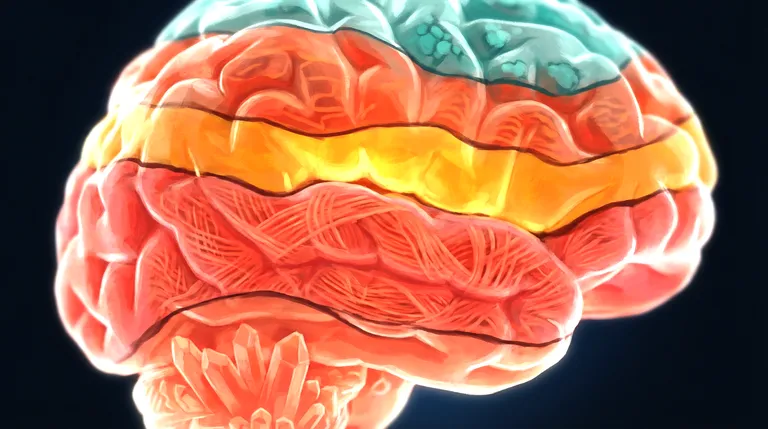
Your brain is shrinking right now. Not because of age. Not because of disease. Because you’re alone too much.
That’s not a metaphor. Brain scans of thousands of people show that chronic loneliness physically reduces the size of your brain. The regions that control memory, emotions, and decision making all get smaller when you spend too much time isolated. And in 2023, the U.S. Surgeon General declared loneliness a full-blown public health epidemic, calling it as deadly as smoking 15 cigarettes a day.[1]
More than half of American adults report feeling lonely. Among Gen Z, the number climbs to 80%. And the latest neuroscience says this isn’t just an emotional problem. It’s a structural one. Your brain is literally losing volume.
Your Brain on Loneliness, Region by Region
Scientists used to think loneliness was just a feeling. Something unpleasant but harmless. Modern brain imaging has destroyed that idea.
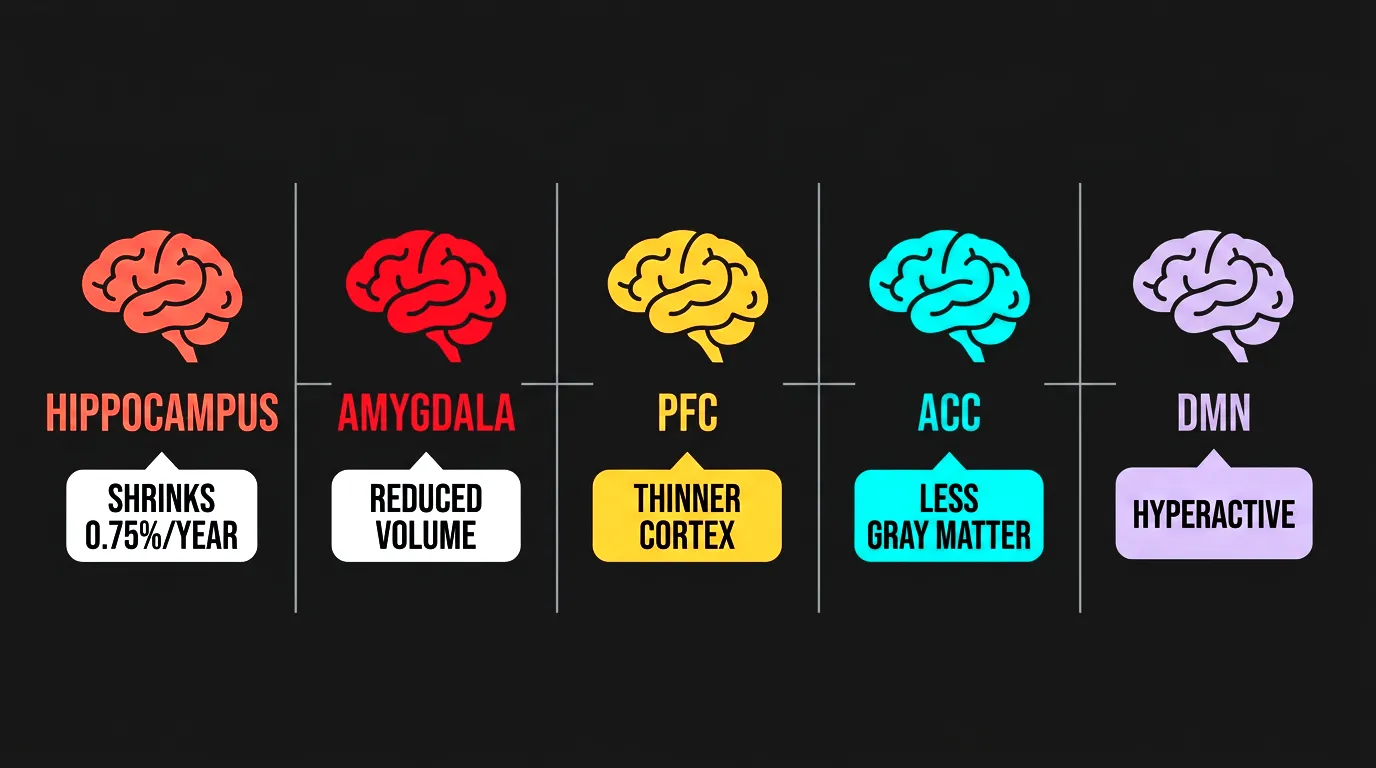
A population-based longitudinal neuroimaging study published in eLife tracked 1,335 participants over six years using MRI scans.[2] The results were clear. Social isolation was associated with smaller volumes of the hippocampus and clusters of reduced cortical thickness across multiple brain areas. The hippocampus is your memory center. When it shrinks, learning and recall get worse.
But it doesn’t stop there. A study published in Scientific Reports found that lonely individuals had smaller gray matter volumes in three distinct brain clusters.[3]
- The left amygdala and anterior hippocampus. This region processes emotional memories and threat detection.
- The left posterior parahippocampus. This area handles spatial memory and scene recognition.
- The left cerebellum. This coordinates motor learning and some emotional processing.
Research from the UK Biobank also found reduced gray matter in the anterior cingulate cortex and the right ventrolateral prefrontal cortex.[8] These regions control decision making, impulse control, and emotional regulation.
| Brain Region | Function | Effect of Loneliness |
|---|---|---|
| Hippocampus | Memory and learning | Reduced volume, faster shrinkage |
| Amygdala | Emotional processing | Smaller gray matter volume |
| Prefrontal cortex | Decision making | Reduced thickness and volume |
| Anterior cingulate | Impulse control | Less gray matter |
| Default mode network | Self-reflection | Hyperactive, more rumination |
A 2025 study in the Schizophrenia Bulletin took this even further. Researchers found that loneliness independently predicts widespread brain volume changes.[5] And the damage was worse in people with higher genetic vulnerability to schizophrenia. Loneliness didn’t just correlate with brain shrinkage. It predicted it.
Recommended read: Why Brains Need Friends by Ben Rein. A neuroscientist explains exactly why your brain was built for connection and what happens when it doesn’t get it.
The Stress Cascade That Eats Your Brain
So how does feeling lonely actually shrink brain tissue? The answer starts with cortisol.
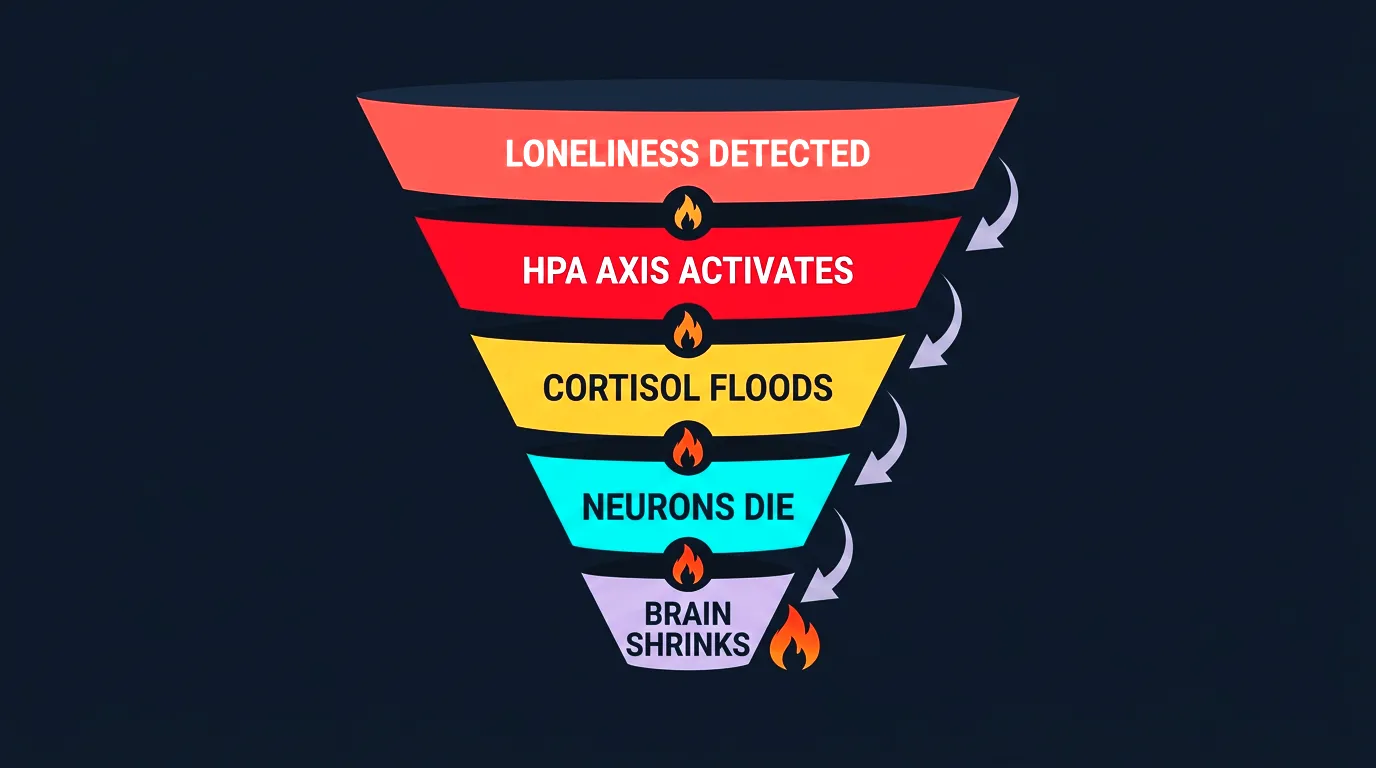
When you feel socially disconnected, your brain treats it like a threat. The same alarm system that fires when you see a predator fires when you feel excluded. Your hypothalamic-pituitary-adrenal axis kicks into gear and floods your body with cortisol, the stress hormone.
Short bursts of cortisol are fine. They help you react to danger. But chronic loneliness keeps the cortisol flowing for months or years. Research shows that lonely people have elevated cortisol levels throughout the day.[4] Even worse, they show a flattened diurnal cortisol rhythm, which means their stress system never fully turns off.
Here’s what chronic cortisol does to your brain.
- Kills neurons in the hippocampus, directly shrinking your memory center
- Weakens synaptic connections between brain cells, making communication slower
- Triggers neuroinflammation that damages healthy tissue over time
- Suppresses neurogenesis, the process of growing new brain cells
The inflammation piece is especially dangerous. Lonely people show a proinflammatory gene expression profile.[12] Their immune cells produce more inflammation-promoting molecules and fewer anti-inflammatory ones. This creates a feedback loop. Inflammation damages brain tissue, which impairs emotional regulation, which makes you withdraw more, which increases loneliness.
And then there’s the default mode network. This is the brain network that activates when you’re not focused on the outside world. It handles daydreaming, self-reflection, and thinking about other people. In lonely individuals, the default mode network becomes hyperconnected.[6] It runs in overdrive.
“The default mode network is more connected in the brains of lonely people. They spend a lot of time thinking about what happened in the past and what will happen in the future, with feelings of worry, anxiety, and dread.” - Dr. Nathan Spreng, McGill University
This hyperactivity explains why you can’t control your emotions when you’re isolated. Your brain gets stuck in a loop of rumination and social threat monitoring. You’re scanning for rejection even when nobody is around.
Recommended read: The Balanced Brain by Camilla Nord. A Cambridge neuroscientist breaks down how stress, inflammation, and daily habits reshape your brain’s mood systems.
The Loneliness Epidemic in Numbers
This isn’t a niche problem affecting a small group of people. Loneliness is one of the fastest-growing health crises on the planet.
In May 2023, U.S. Surgeon General Dr. Vivek Murthy released a landmark advisory titled “Our Epidemic of Loneliness and Isolation.”[1] The report laid out the scope of the crisis in stark numbers.
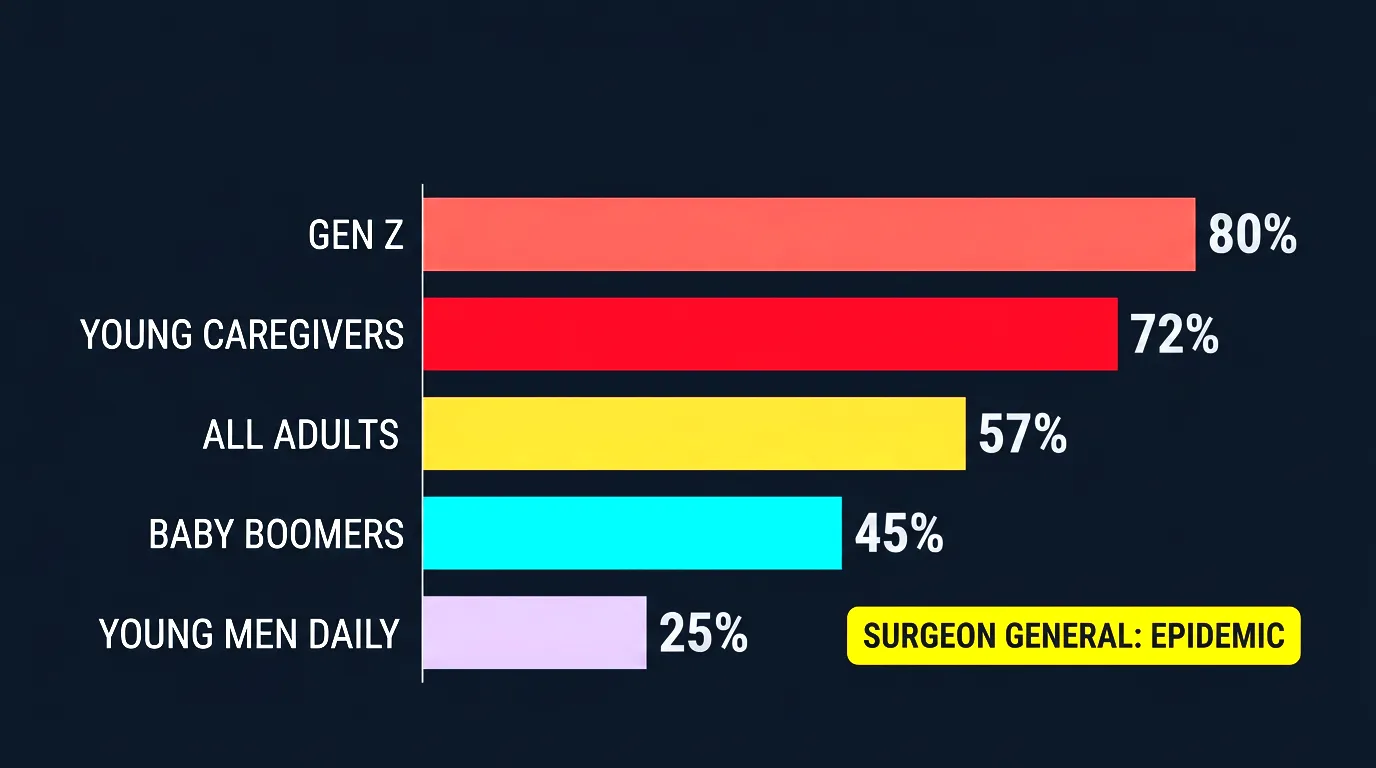
- 57% of American adults report feeling lonely, according to the 2025 Cigna survey
- 80% of Gen Z say they’ve felt lonely in the past 12 months
- Loneliness increases mortality risk by 26%, comparable to smoking 15 cigarettes daily
- 29% increased risk of heart disease
- 32% increased risk of stroke
- 50% increased risk of dementia in older adults
Young people are hit hardest. A Gallup poll found that 30% of adults aged 18 to 34 experience loneliness every day or several times a week. Among Gen Z men specifically, 25% report chronic loneliness compared to 17% of all other adults.
| Demographic | Loneliness Rate |
|---|---|
| All U.S. adults | 57% |
| Gen Z ages 18-26 | 80% |
| Young men 18-34 | 25% daily/weekly |
| Young caregivers 18-32 | 72% |
| Baby boomers | 45% |
The cognitive damage is measurable too. A 2025 study in JAMA Network Open found that childhood loneliness predicted faster cognitive decline and higher dementia risk decades later.[9] Even people who stopped being lonely as adults still carried the neural scars from early isolation.
And a separate 2025 study tracking loneliness trajectories found that persistent loneliness significantly increased odds of developing dementia.[10] Temporary loneliness did not carry the same risk. The duration matters. The longer you stay isolated, the deeper the damage goes.
If you’ve been wondering why nothing makes you happy anymore, chronic loneliness could be rewiring your brain’s reward system without you even realizing it.
How to Reverse the Damage
Here’s the good news. The brain changes caused by loneliness are not permanent. Your brain is plastic. It can rebuild.
Penn Medicine researchers studying people who spent extended periods in extreme isolation found that structural brain changes reversed when social connection was restored.[7] The key word is “restored.” Passive exposure to people doesn’t count. You need genuine, repeated, meaningful interaction.
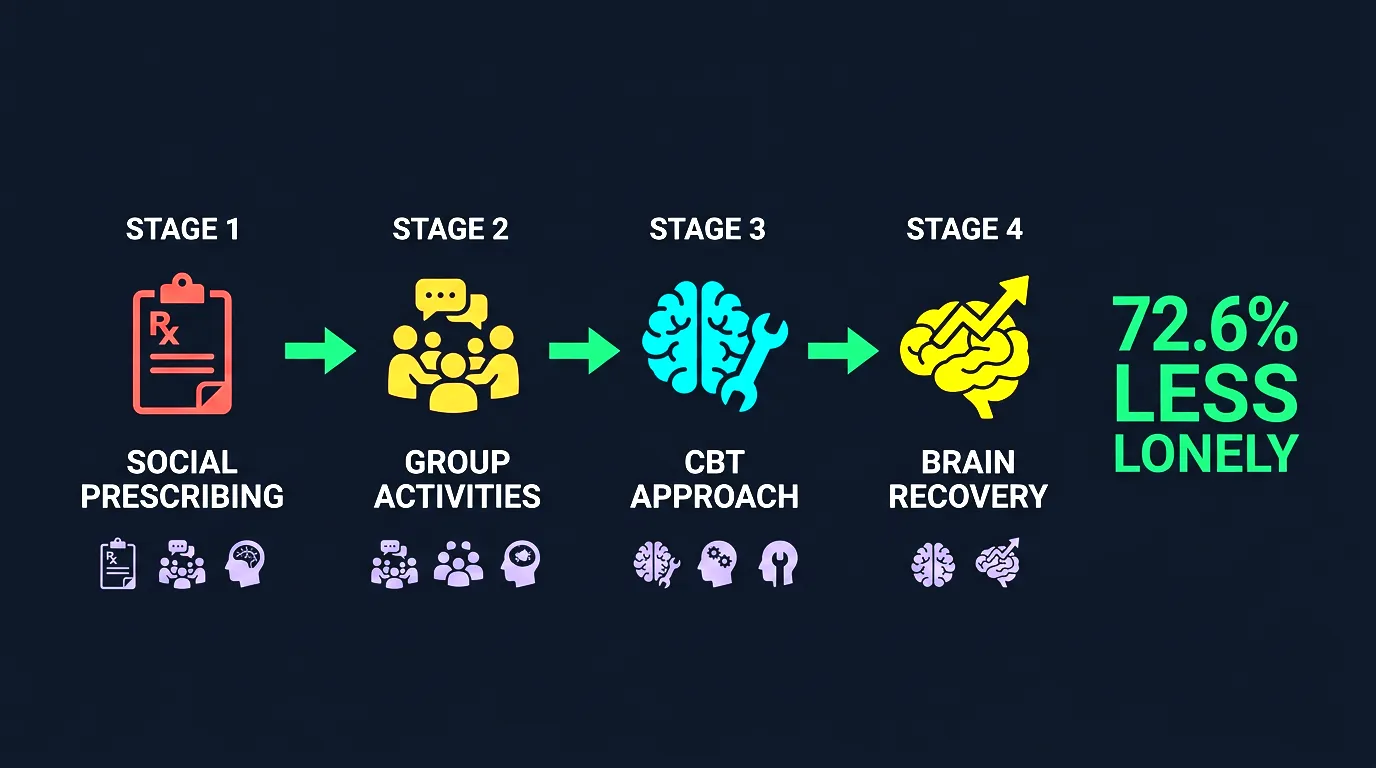
Social prescribing is one of the most promising interventions. This is when a doctor literally prescribes social activities instead of medication. The UK has been leading this approach, and the results are impressive.
- 72.6% of social prescribing participants reported feeling less lonely after the program[13]
- An 8-week social prescribing program showed significant reductions in loneliness scores
- Participants also reported increased trust in other people
Here’s what the research says actually works to rebuild your social brain.
- Group-based activities with regular attendance. Consistency matters more than intensity. Weekly is better than monthly.
- Nature-based interventions like community gardening and group walks. The combination of nature and social contact amplifies benefits.
- Cognitive behavioral approaches that target maladaptive social thinking. Many lonely people have distorted beliefs about how others see them.
- Volunteering in community organizations. Helping others activates reward circuits and builds genuine bonds.
Recommended read: Hope for Cynics by Jamil Zaki. Stanford psychologist shows why we underestimate other people’s goodness and how to rebuild social trust.
The research is clear that quality beats quantity. Having two or three close relationships protects your brain more than having 500 social media followers. Deep conversation, shared vulnerability, and physical presence all trigger oxytocin release, which directly counters cortisol’s damaging effects.
People with signs of low emotional intelligence often struggle most with rebuilding connection because they miss social cues that would help them bond with others. But emotional intelligence can be developed at any age.
Why Connection Is Brain Medicine
Your brain was built for other people. That’s not a feel-good platitude. It’s a biological fact.
Humans evolved in tight social groups for millions of years. Your brain developed specialized circuits for reading faces, interpreting tone of voice, and predicting other people’s behavior. The social brain hypothesis suggests that human intelligence itself evolved primarily to navigate complex social relationships, not to solve abstract problems.
When you disconnect from others, you’re depriving your brain of the input it was literally designed to process. It’s like unplugging a machine from its power source and wondering why it starts breaking down.
The neuroscience of connection shows a clear pattern.
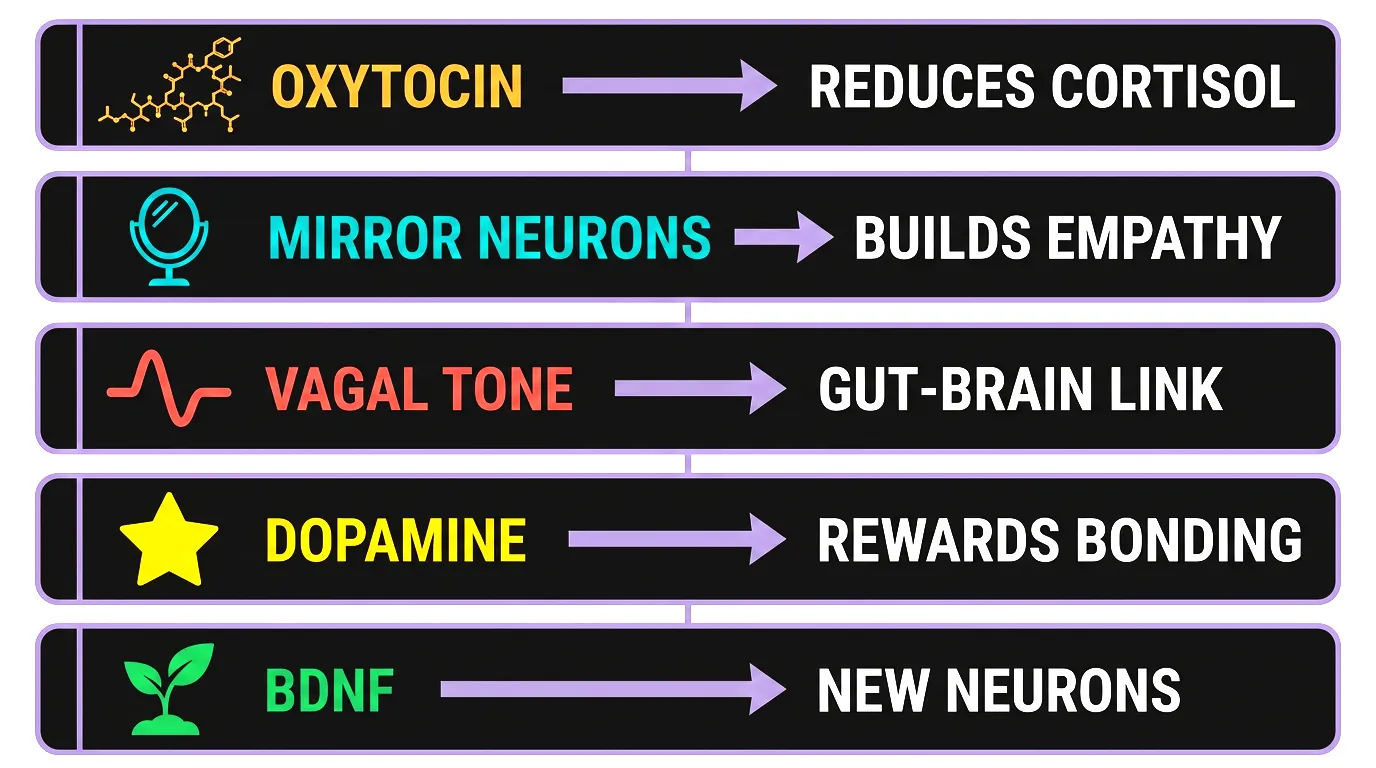
- Oxytocin released during social bonding reduces cortisol and inflammation
- Mirror neurons fire when you watch someone else’s actions, keeping your empathy circuits active
- Vagal tone improves with positive social interaction, strengthening the gut-brain connection
- Dopamine pathways activate during meaningful conversation, reinforcing social seeking behavior
- BDNF production increases with social stimulation, promoting new neural growth
A large prospective study in the Schizophrenia Bulletin found that addressing loneliness may be a key strategy to prevent schizophrenia development and protect brain structure.[11] This means social connection isn’t just nice to have. It’s preventive medicine for your brain.
Recommended read: How to Know a Person by David Brooks. A practical guide to seeing other people deeply, the kind of connection that actually changes your brain chemistry.
The takeaway from all this research is brutally simple. Your brain needs people the way your lungs need air. Not occasionally. Not virtually. Regularly, in person, with depth. Every week you spend isolated, your brain pays a measurable price. Every genuine conversation you have, your brain gets a little bit of what it needs to stay whole.
You don’t need a hundred friends. You need a few real ones. And the science says your brain is counting on it.
Sources
Your Brain on Loneliness, Region by Region
1. Our Epidemic of Loneliness and Isolation: The U.S. Surgeon General’s Advisory (HHS, 2023)
3. Structural Brain Correlates of Loneliness among Older Adults (Scientific Reports, 2019)
4. Neurobiology of loneliness: a systematic review (Neuropsychopharmacology, 2021)
The Stress Cascade That Eats Your Brain
How to Reverse the Damage
7. Measuring the impact of loneliness and social isolation on the brain (Penn Medicine, 2024)
The Loneliness Epidemic in Numbers
9. Childhood Loneliness and Cognitive Decline and Dementia Risk (JAMA Network Open, 2025)
Why Connection Is Brain Medicine
11. Social Withdrawal, Loneliness, and Health in Schizophrenia (Schizophrenia Bulletin, 2023)
12. Affective Neuroscience of Loneliness (Perspectives on Psychological Science, 2023)