Close your eyes. Picture a bright red apple sitting on a white table. Really see it. The shine on the skin, the little stem at the top, the shadow it casts.
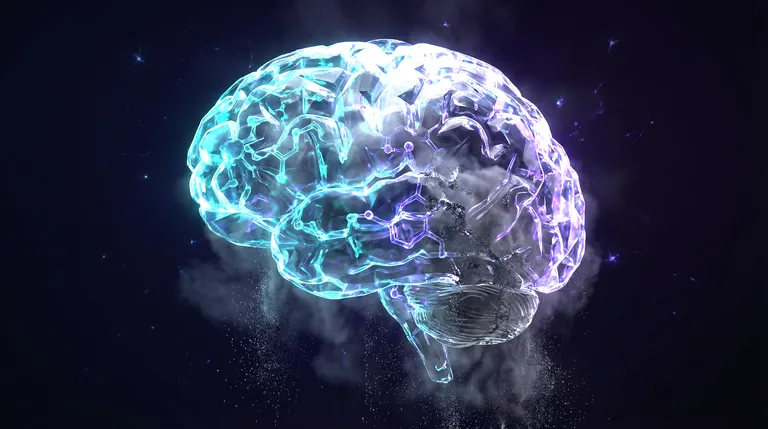
Now here’s what just happened inside your skull. The same brain regions that fire when you look at a real apple just lit up. Your visual cortex activated. Your fusiform gyrus started humming. For a brief moment, your brain treated that imaginary apple almost the same way it treats a real one.
So how does your brain know the difference? A groundbreaking 2025 study from University College London just found the answer.[1] And it turns out, the system isn’t as reliable as you’d think.
The Discovery That Changed How We Understand Reality
In June 2025, neuroscientist Nadine Dijkstra and her team at UCL published a paper in Neuron that solved one of the oldest puzzles in brain science.[2] How does your brain decide what’s real and what’s imagined?
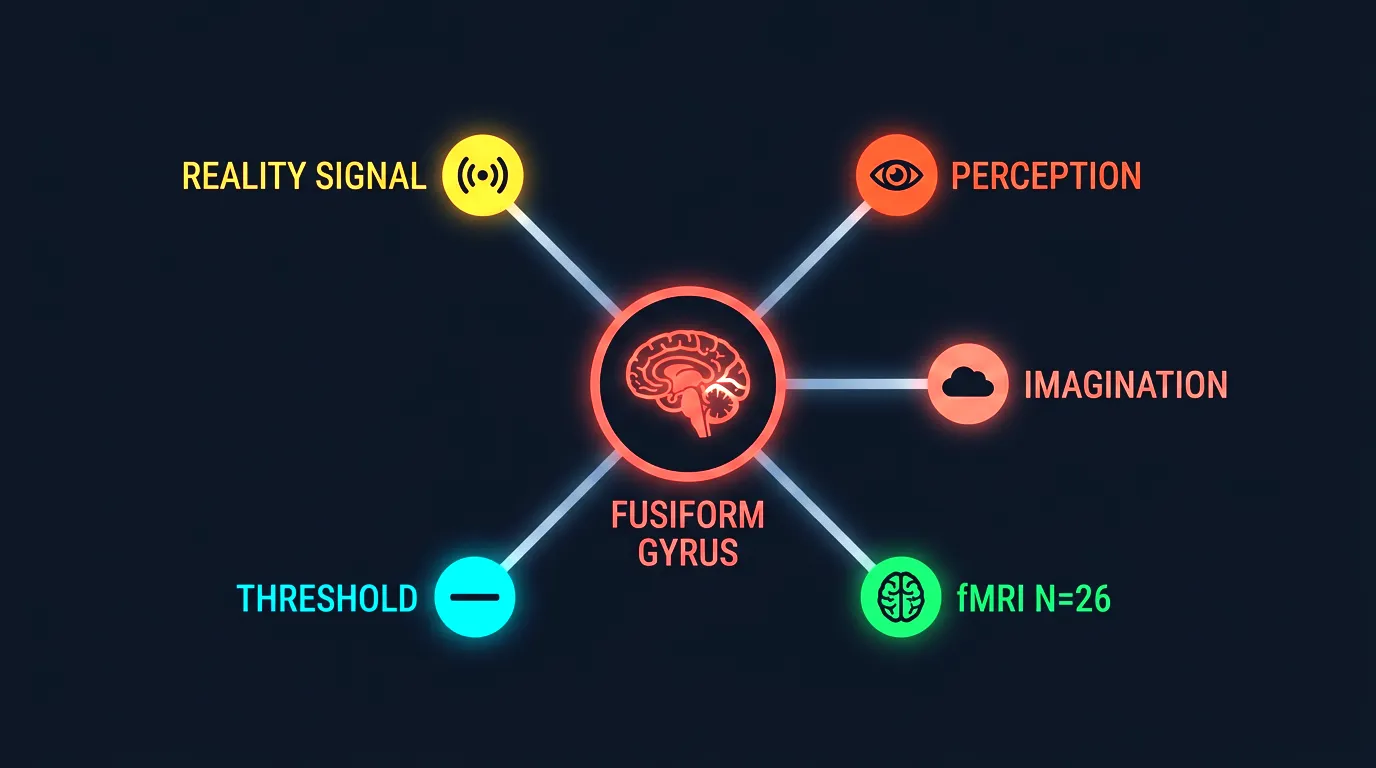
The team used fMRI brain scans on 26 participants. They showed people faint visual patterns on a screen while simultaneously asking them to vividly imagine similar patterns. Then they asked a simple question. Did you actually see that, or did you imagine it?
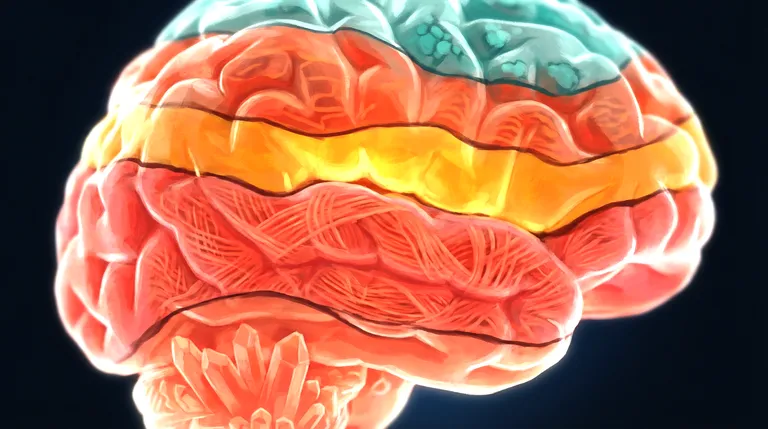
Here’s what they found. A brain region called the fusiform gyrus, located behind your temples on the underside of your temporal lobe, generates what the researchers call a “reality signal.”[3] This signal is the combined strength of sensory activity from both perception and imagination.
- When you see something real, the fusiform gyrus fires strongly
- When you imagine something, it fires more weakly
- The brain uses the strength of this signal to decide what’s real
- When imagination is vivid enough, the signal crosses a threshold and your brain calls it “real”
“Our findings suggest that the brain uses the strength of sensory signals to distinguish between imagination and reality.” — Nadine Dijkstra, UCL
The study tracked these confusions trial by trial.[4] Every time the fusiform gyrus produced an unusually strong signal during imagination, participants were more likely to report that they had actually seen the pattern. Even when nothing was there.
This isn’t a glitch. It’s how the system is designed. And that design has a vulnerability.
Recommended read: The Experience Machine by Andy Clark — A deep dive into how your brain constructs all experience through prediction, and why perception is really a kind of controlled hallucination.
How Your Reality Switch Actually Works
Think of your brain’s reality system like a thermostat with a threshold. Below a certain temperature, the heat stays off. Above it, the heat kicks on.
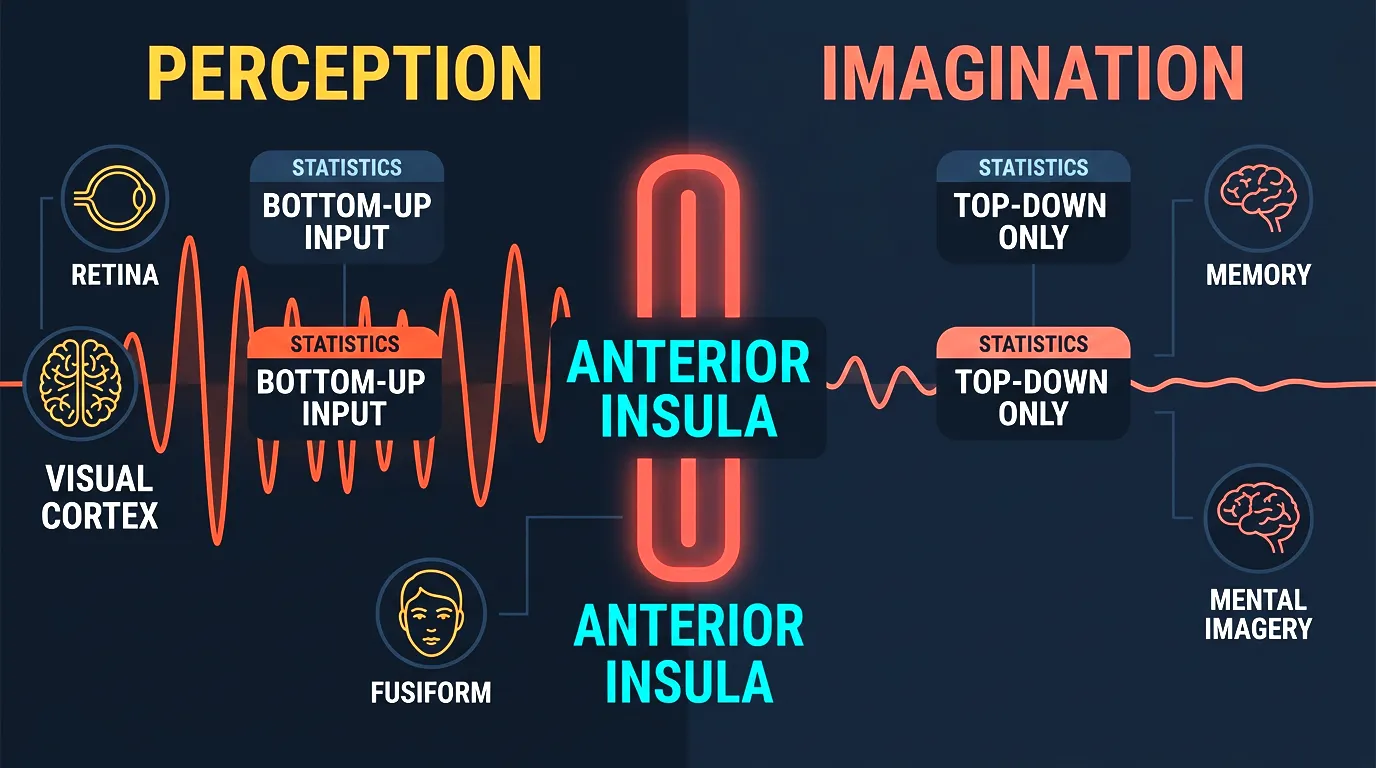
The fusiform gyrus generates a signal every time you perceive or imagine something visual. Real perceptions produce stronger signals because they come with bottom-up sensory input, actual photons hitting your retina and traveling through your visual cortex. Imagination only activates top-down signals from memory and mental imagery networks.
Usually, the difference is obvious. Seeing a tiger produces a much stronger signal than imagining one. But the system has a second player.
The Gatekeeper in Your Brain
The anterior insula, a region tucked deep in your frontal cortex, acts as the final decision-maker.[11] It evaluates the reality signal from the fusiform gyrus and makes a binary call. Real or not real.
- Activity above the threshold registers as real perception
- Activity below the threshold registers as imagination
- The anterior insula works with the dorsomedial prefrontal cortex to encode this judgment
- The decision happens automatically, without your conscious input
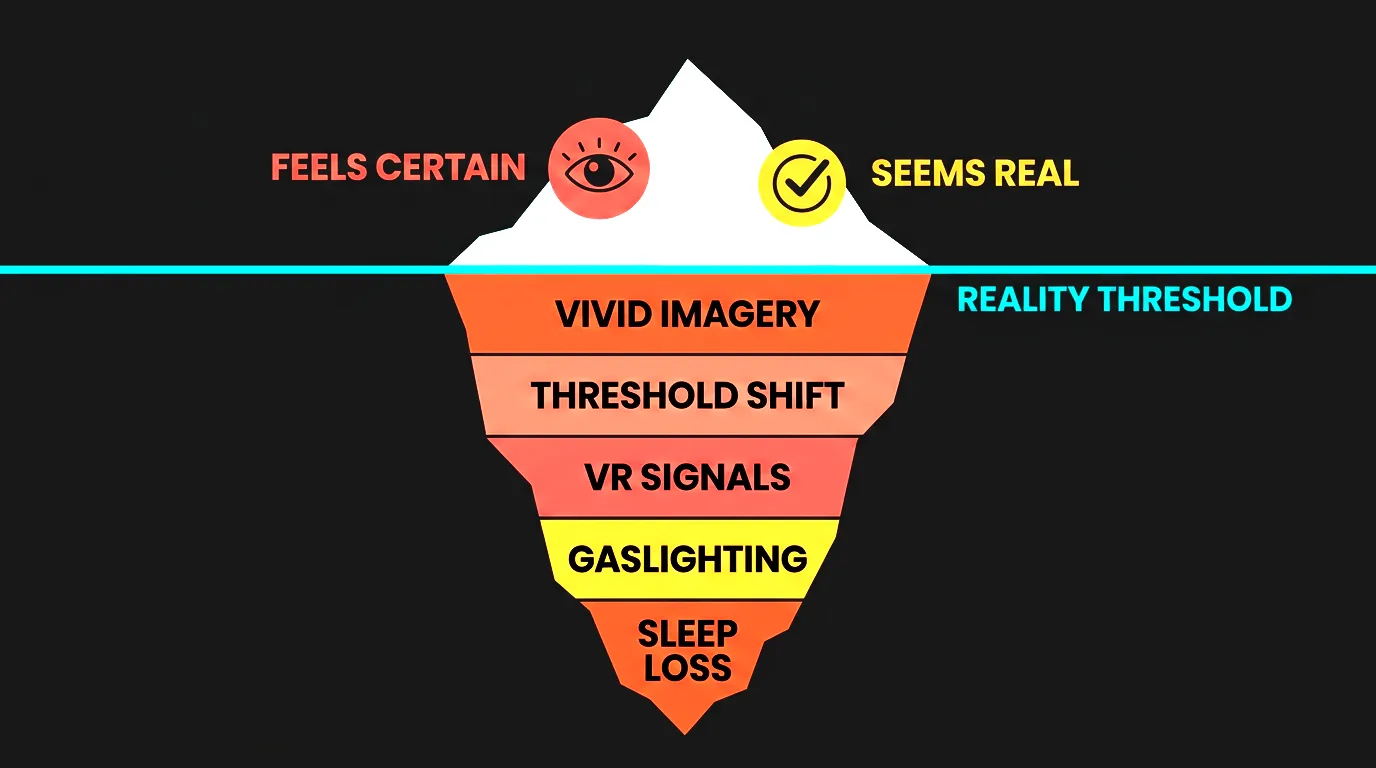
Here’s what makes this system fragile. The threshold isn’t fixed. It can shift. And the signal itself can be amplified.
When you imagine something with extreme vividness, the fusiform gyrus produces a signal strong enough to cross the threshold. Your anterior insula says “real.” And you genuinely believe you perceived something that was never there.
This is also why your memories can’t always be trusted. The same neural machinery that decides “this is real right now” also stamps memories as real or imagined after the fact.
When the Reality Switch Breaks
Your brain’s reality signal works well enough in everyday life. But there are several situations where it fails spectacularly. And some of them are more common than you’d expect.
Hallucinations and Schizophrenia
Dijkstra’s team specifically noted that their findings could explain hallucinations in schizophrenia.[5] If the fusiform gyrus produces signals that are too strong during imagination, or if the anterior insula sets its threshold too low, a person could genuinely experience imagined things as real.
Schizophrenia has been associated with abnormalities in both regions. This research suggests that hallucinations may not be a problem of “seeing things.” They may be a problem of reality threshold calibration.
False Memories and Source Monitoring Errors
Source monitoring errors happen when your brain correctly remembers something but misidentifies where it came from.[9] You remember the information, but you think you experienced it when you actually just imagined it or heard about it.
Research shows that source monitoring errors are especially common in young children and elderly adults.[10] But they happen to everyone. Sleep deprivation makes them worse. Stress amplifies them. And people with naturally vivid mental imagery are more vulnerable.
VR Immersion and Digital Deception
Your visual cortex treats virtual images as real, triggering the same neurological reactions as actual perception.[12] The hippocampus maps virtual environments and creates real memories of them. Repeated VR exposure even stimulates neurogenesis, creating new neurons specialized for virtual spatial navigation.
This means VR doesn’t just trick your eyes. It tricks your fusiform gyrus. The reality signal fires as though the virtual world is genuine. And the more immersive the technology gets, the harder it becomes for your anterior insula to tell the difference.
Gaslighting and Manipulation
A 2025 study published in Personality and Social Psychology Review reframed gaslighting as a learning process rooted in how your brain handles prediction error minimization.[6] When someone you trust repeatedly contradicts your experience, your brain’s prediction system starts to update.
Close relationships have a privileged role in verifying your reality.[7] When a trusted person insists your perception is wrong, your brain faces a conflict. The gaslighter’s confidence creates its own kind of “signal strength,” and over time, internalization can make you accept their version as real.[8]
| Situation | What Happens to the Reality Signal | Why It Fails |
|---|---|---|
| Vivid imagination | Fusiform gyrus signal crosses threshold | Top-down signals mimic bottom-up input |
| Schizophrenia | Threshold set too low in anterior insula | Reality gatekeeper misfires |
| False memories | Signal at encoding was ambiguous | Source monitoring can’t distinguish origin |
| VR immersion | Visual cortex treats virtual as real | Bottom-up sensory input is genuine |
| Gaslighting | Prediction errors override perception | Trusted source overrides your own signal |
| Sleep deprivation | Source monitoring accuracy drops | Prefrontal cortex can’t maintain threshold |
Recommended read: Mistakes Were Made (but Not by Me) by Carol Tavris and Elliot Aronson — How cognitive dissonance and self-justification warp your reality without you noticing.
This research explains some of the strange perception glitches people report. Those moments when reality seems to stutter or skip. Your brain’s reality signal is constantly calibrating. Sometimes it miscalibrates.
How to Protect Your Reality Perception
Knowing that your brain has a hackable reality switch isn’t just interesting. It’s useful. Here are practical strategies backed by the neuroscience.
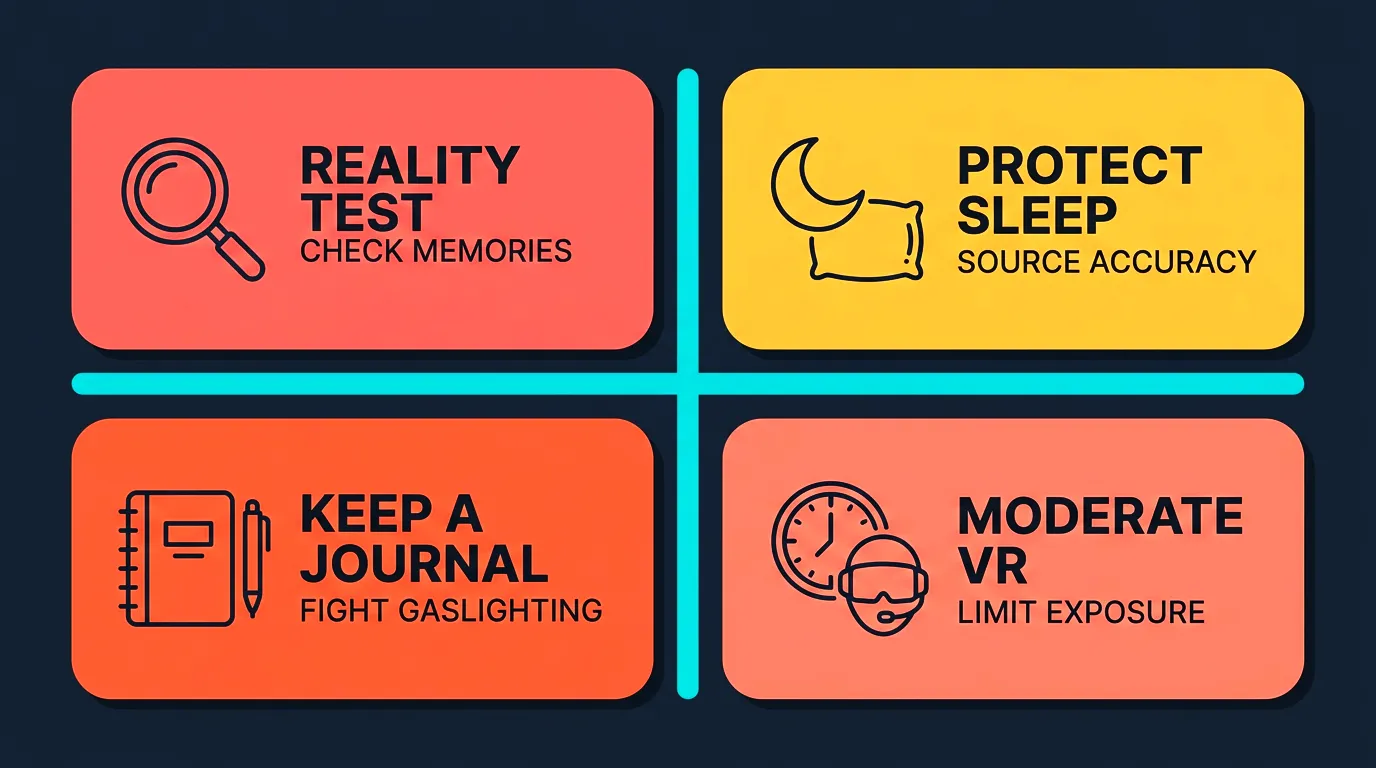
Reality-Test Your Vivid Memories
When a memory feels extremely real and emotionally charged, that’s exactly when you should question it most. Vivid emotions amplify the fusiform gyrus signal, making imagined events feel more “real” in retrospect.
- Ask yourself when and where you first encountered this memory
- Check with other people who were present
- Look for corroborating evidence before treating vivid memories as fact
- Be especially skeptical of memories recovered under stress or strong emotion
Protect Your Sleep
Sleep deprivation is one of the fastest ways to degrade your source monitoring. When your prefrontal cortex is fatigued, the anterior insula’s threshold becomes unreliable. Studies show that even one night of poor sleep increases false memory formation.
Strengthen Your Critical Thinking Against Manipulation
Gaslighting works because your brain gives epistemic weight to trusted sources. Knowing this is your first defense.
- Keep a journal of key events and conversations
- Notice patterns where someone consistently contradicts your experience
- Trust physical evidence over someone else’s insistence
- Maintain a network of independent reality-checkers, friends and family who aren’t under the same influence
Be Mindful of VR and Immersive Media
The more time you spend in immersive digital environments, the more your brain creates real neural pathways for virtual experiences. This isn’t dangerous in moderation. But it does mean your brain is literally building memories it can’t easily distinguish from real-world ones.
Recommended read: Nobody’s Fool by Daniel Simons and Christopher Chabris — The science of why smart people get deceived and practical strategies for protecting yourself from manipulation.
What This Means for Consciousness Itself
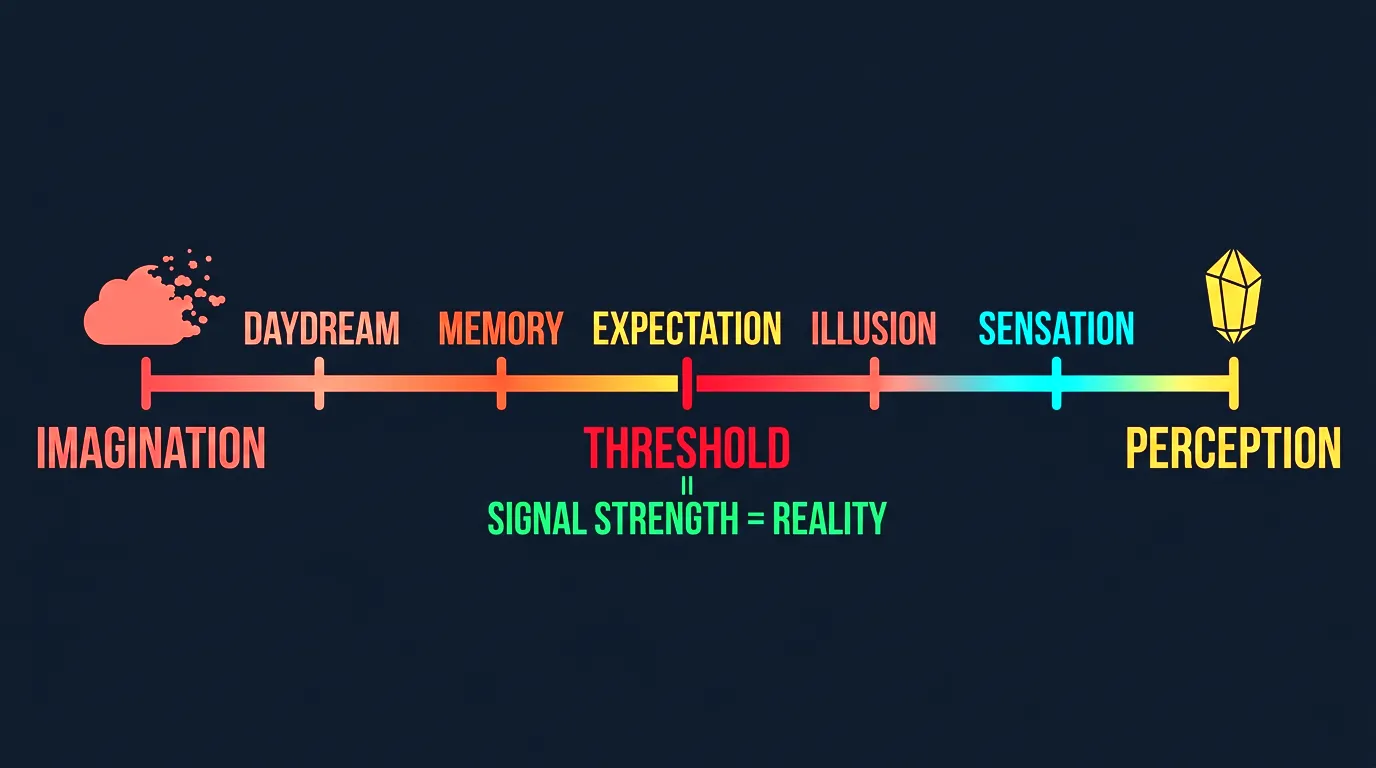
Dijkstra’s research opens a door that most neuroscientists have been tiptoeing around. If your experience of reality is just a signal strength threshold, then “real” and “imagined” aren’t categories. They’re a spectrum.
Your brain doesn’t have direct access to the outside world. Everything you experience is a reconstruction. Light hits your retina, gets converted to electrical signals, bounces through multiple processing stages, and eventually produces a conscious experience. At every stage, your brain is making guesses about what’s out there.
The fusiform gyrus and anterior insula are just the final checkpoint. And as Dijkstra’s work shows, that checkpoint can be fooled.
This connects to a deeper question. If your brain wants to believe in simulation theory, maybe it’s because the system already knows, on some level, that what you call “reality” is really just a well-calibrated hallucination.
- Your brain constructs reality from incomplete sensory data
- The “reality signal” is a measure of signal strength, not actual truth
- Perception and imagination use the same neural machinery
- The only thing separating them is a threshold that can shift
The researchers at UCL hope their findings will lead to better diagnosis and treatment for conditions where reality monitoring breaks down. But for the rest of us, it’s a humbling reminder. You trust your perception completely. And that trust rests on a signal that can be fooled by a vivid daydream.
Sources
The Discovery That Changed How We Understand Reality
1. A Neural Basis for Distinguishing Imagination from Reality (Neuron, 2025)
2. Brain Mechanisms That Distinguish Imagination from Reality Discovered (UCL News, 2025)
4. Why Does the Brain Sometimes Mistake Imagination for Reality? (BrainPost, 2025)
When the Reality Switch Breaks
7. Gaslighting and Memory: The Effects of Partner-Led Challenges on Recall (Memory, 2025)
8. How Gaslighting Tricks the Brain Into Questioning Reality (ScienceDaily, 2025)
9. Source Monitoring and Memory Distortion (PMC)
10. Cognitive and Neural Mechanisms Underlying False Memories (PMC, 2023)
How Your Reality Switch Actually Works
11. Anterior Insula as a Gatekeeper of Executive Control (Neuroscience and Biobehavioral Reviews, 2022)
12. Being in Virtual Reality and Its Influence on Brain Health (PMC, 2024)