You’re sitting at your desk, staring at a blank page. You’ve been trying to come up with a good idea for an hour. Nothing comes. So you give up and go for a walk. And then, somewhere between the mailbox and the corner store, it hits you. The perfect idea.
That’s not a coincidence. Your brain was working harder when you stopped trying.
A wave of 2025 and 2026 research is proving what most people feel but can’t explain. Your best creative thinking happens when you’re bored, fidgeting, or letting your mind wander. And the harder you force it, the worse your ideas get.
Your Brain’s Hidden Creative Network
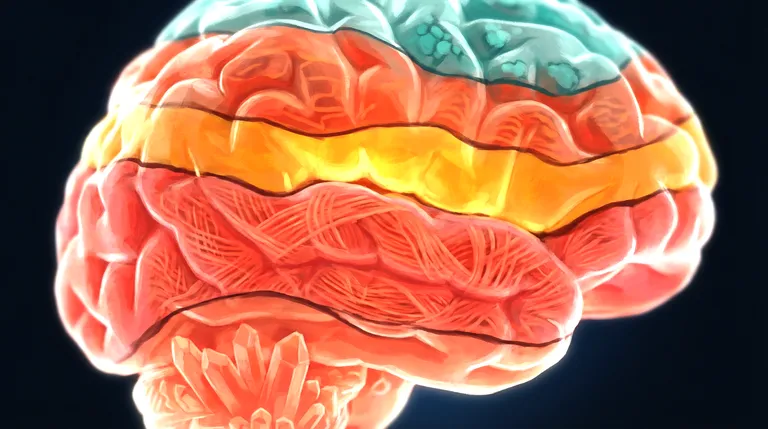
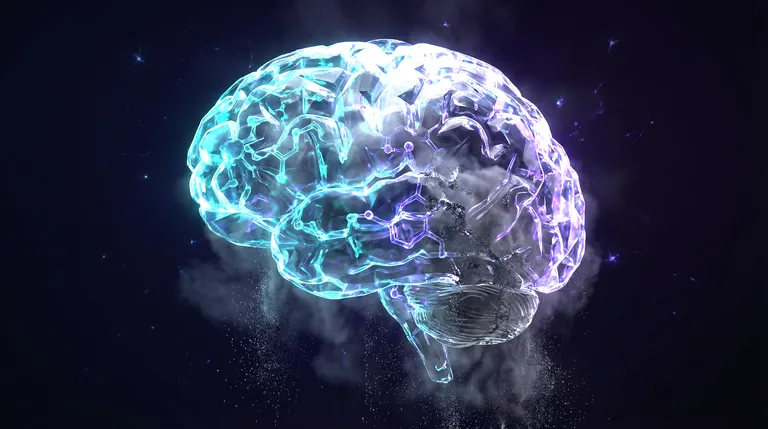
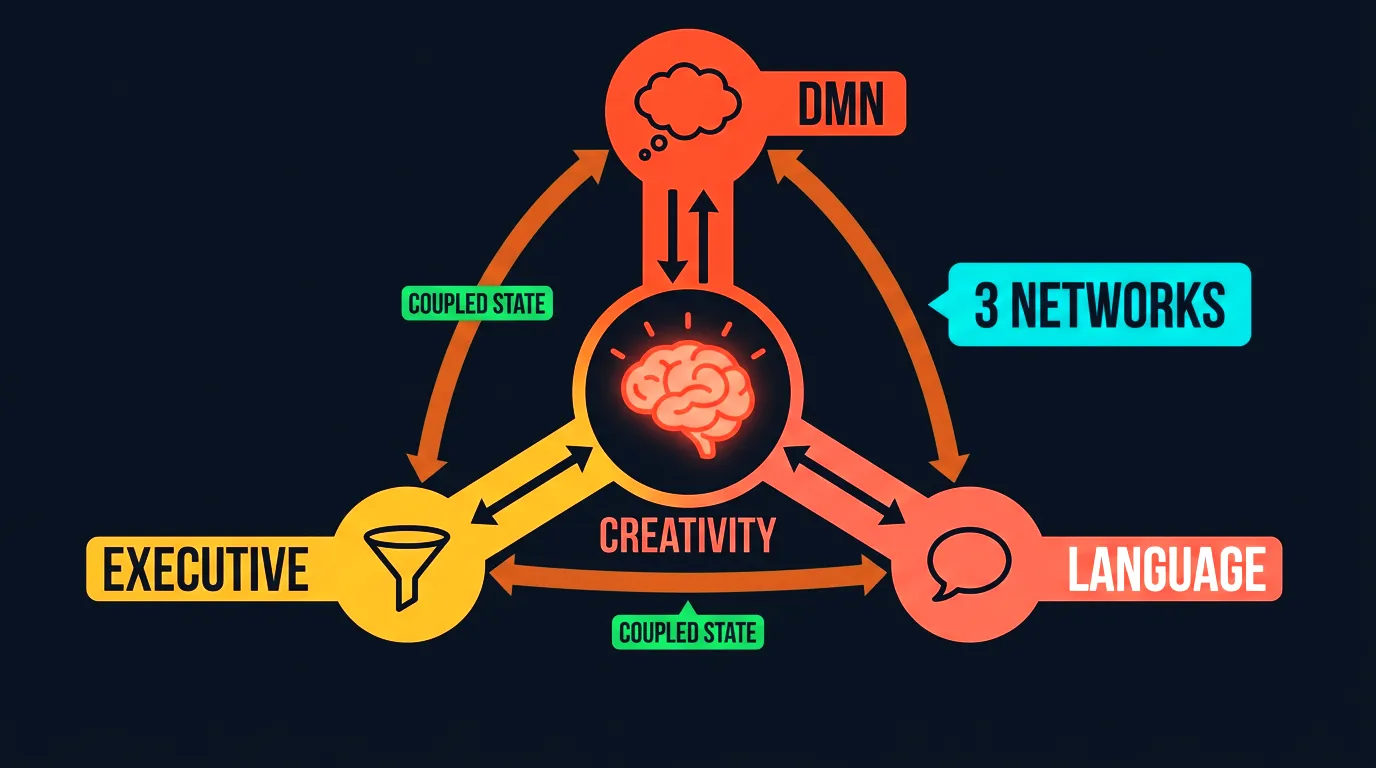
Creativity doesn’t come from one part of your brain. It comes from three separate networks learning to talk to each other at the same time.
A 2025 fMRI study of jazz musicians captured this in real time.[1] Researchers scanned 16 professional jazz players while they improvised. What they found was a three-network creative brain state that had never been fully documented before.
Here are the three networks that fire together during creative thinking:
- Default mode network (DMN): The daydreaming network. It generates raw ideas, memories, and mental simulations when you’re not focused on anything specific.
- Executive control network (ECN): The filter. It evaluates ideas and decides which ones are worth keeping.
- Language network: Translates abstract creative impulses into something you can express and communicate.
When all three fire in sync, you enter what researchers call a coupled brain state.[2] This is the neural signature of creativity. And the first causal evidence for it came from a 2025 neurofeedback study published in Cerebral Cortex.
That study trained people to strengthen the connection between their DMN and executive network using real-time brain feedback.[2] The result was a measurable boost in originality that lasted up to 24 hours after a single session.
“We now have the first causal evidence that coupling between the default mode and executive networks directly enhances creative thinking.” — Researchers, Cerebral Cortex, 2025
A related 2025 study on flow states confirmed this pattern from another angle.[3] When people enter flow, their DMN and ECN stop fighting each other and start cooperating. At the same time, amygdala activity drops. That means the fear and self-doubt circuits quiet down while the creative circuits light up.
This explains why your best ideas come when you’re relaxed. Your brain needs those opposing networks to cooperate. And they cooperate best when you’re not white-knuckling your way through a task.
Recommended read: The Creative Brain by Anna Abraham — A neuroscientist busts common myths about creativity and shows what’s actually happening in your brain when inspiration strikes.
Why Boredom and Mind Wandering Fuel Better Ideas
Your brain doesn’t shut off when you’re bored. It shifts into a mode that’s perfect for creative connections.
A 2025 study published in Scientific Reports tested what happens when people take breaks during creative tasks.[4] Participants worked on a creative problem, took a break, then returned to the same prompt. The people whose minds wandered most during the break came back with significantly better ideas.
Let that sink in. Mind wandering during a break wasn’t a distraction. It was the engine of creative improvement.[4]
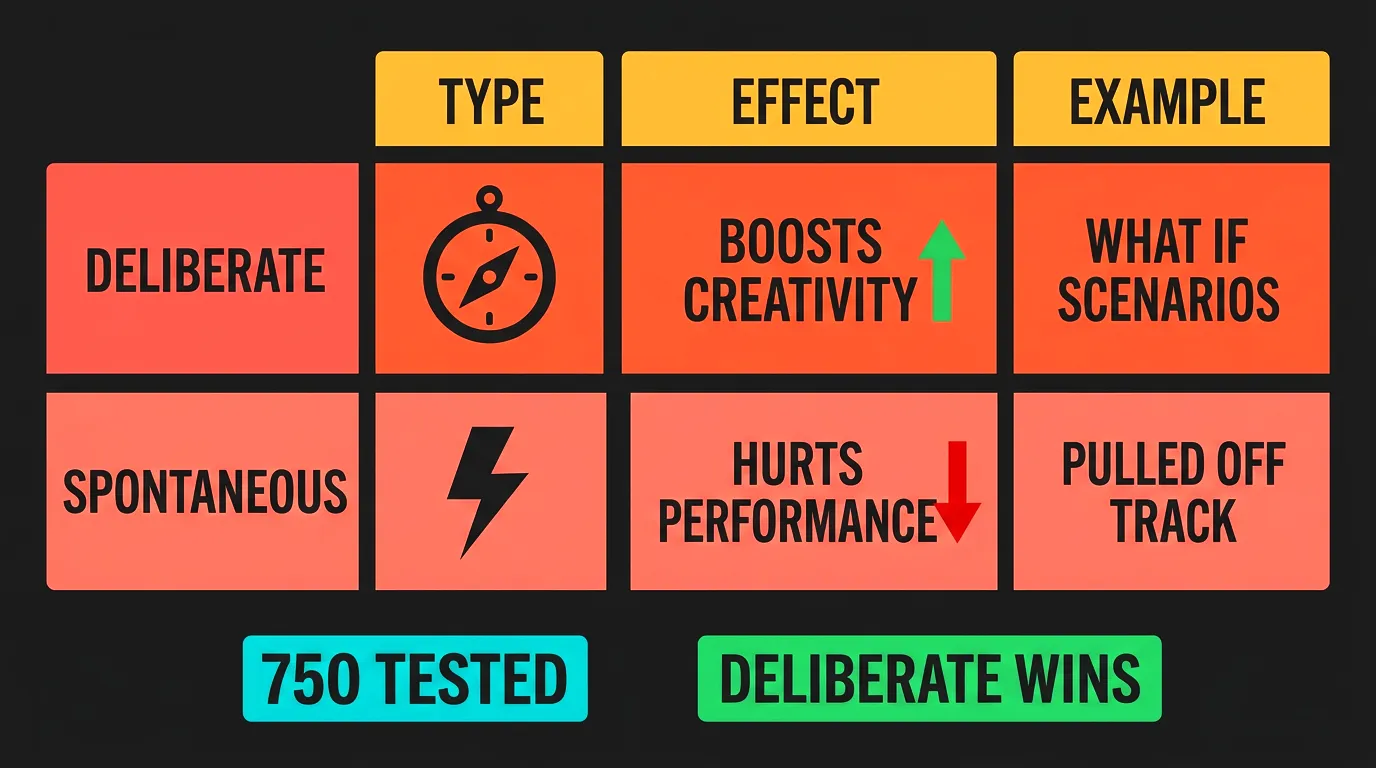
But there’s a catch. Not all mind wandering is the same. A 2025 study presented at the ECNP Congress tested 750 participants and found a critical split.[5]
| Type of Mind Wandering | Effect on Creativity | Example |
|---|---|---|
| Deliberate mind wandering | Boosts creativity significantly | Letting your mind explore “what if” scenarios on purpose |
| Spontaneous mind wandering | Can hurt performance | Involuntary thoughts pulling you away from what you’re doing |
People with ADHD naturally engage in more deliberate mind wandering, which partly explains the long-observed link between ADHD and creativity.[5] Their brains drift on purpose. And that deliberate drifting is where creative breakthroughs live.
This also connects to why boredom works. When you’re bored, your DMN lights up. It starts pulling together random threads. Memories from five years ago. A conversation you overheard last week. A fact you read somewhere. Your brain never stops building new connections, and boredom gives it the space to make unusual ones.
The problem with modern life is that we’ve eliminated boredom. Every idle moment gets filled with a phone screen. And that constant stimulation keeps your brain in reactive mode instead of creative mode.
Recommended read: Stolen Focus by Johann Hari — A deep investigation into why your ability to focus and think creatively is being systematically destroyed.
Your Body Knows What Your Mind Needs
It’s not just your wandering mind that boosts creativity. Your fidgeting body does too.
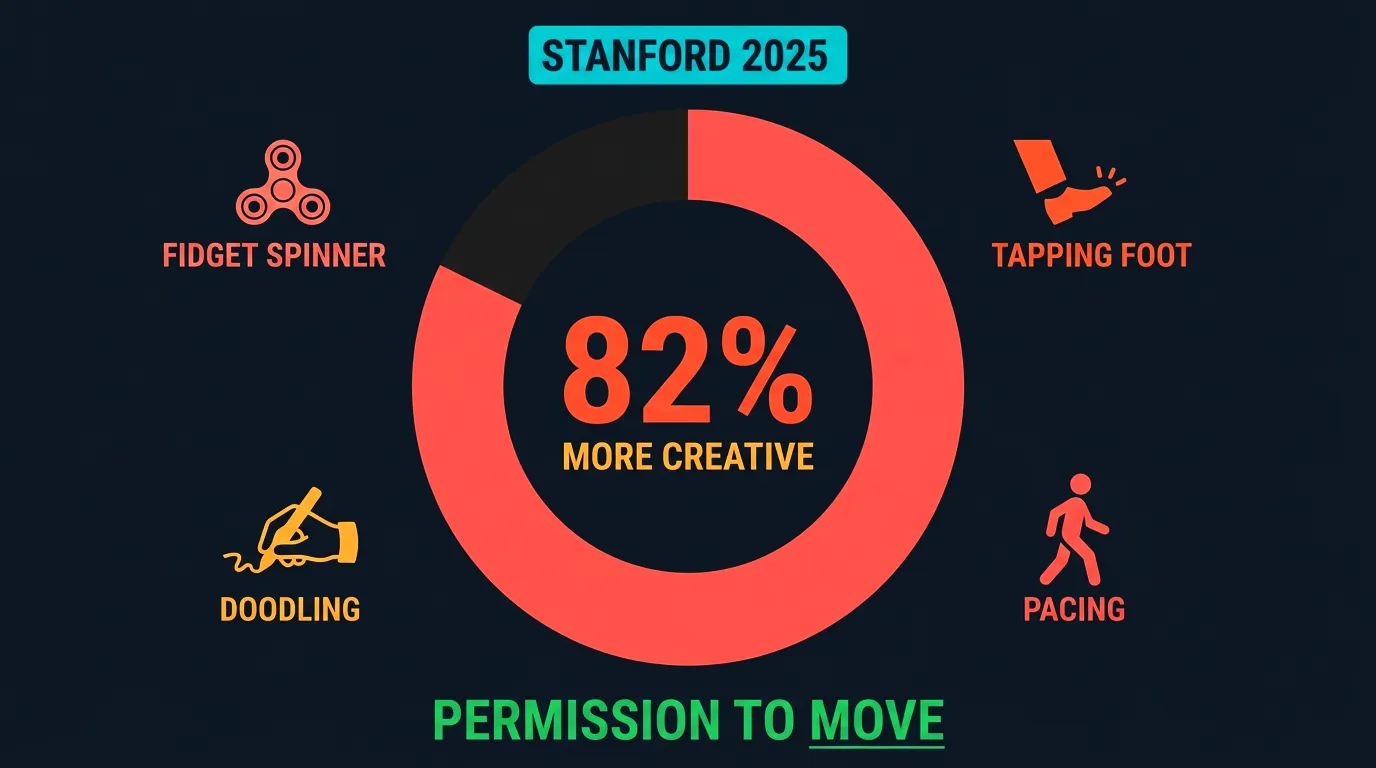
Stanford researchers published a landmark study in late 2025 that tracked students’ creative output based on whether they were allowed to move during thinking tasks.[6] The results were striking. Between 80% and 82% of students showed higher creative performance when given permission to fidget.
Here’s what made the finding even more interesting. The amount of fidgeting didn’t matter. What mattered was the permission to move.[6]
- Students told “stay perfectly still” produced fewer creative ideas
- Students told “move however you want” produced significantly more
- The actual amount of movement varied widely. It didn’t predict creativity.
- The psychological freedom to move was the real driver
This makes sense when you understand how your brain and body are connected. Physical movement activates sensorimotor circuits that feed back into higher-order thinking. When you freeze your body, you’re also partially freezing your mind.
Think about the stereotypical genius. Einstein took long walks. Darwin had a “thinking path.” Steve Jobs held walking meetings. These weren’t quirks. They were strategies that let the body’s movement circuits feed creative thinking.
Your brain isn’t fully developed until your early thirties, and the prefrontal cortex is the last piece to come online. That’s the same region responsible for the executive control network that evaluates creative ideas. Younger brains especially benefit from physical freedom during creative work because those evaluation circuits are still being built.
The lesson is simple. If you want better ideas, let your body move. Pace around the room. Doodle on a notepad. Tap your foot. Your body isn’t distracting you. It’s helping you think.
The AI Creativity Paradox Nobody Is Talking About
Here’s where things get complicated. AI can boost your individual creativity. But it might be destroying creativity at the group level.
A January 2026 study in Scientific Reports tested over 100,000 humans against leading AI models on standard creativity tests.[7] The headline finding surprised many people. The top 50% of humans outperformed every single AI model. GPT-4 showed a particularly telling weakness. It used the word “microscope” in roughly 70% of its creative responses.[7] AI is fluent, but it’s repetitive.
A 2024 study published in Science Advances uncovered an even deeper problem.[8] When individuals used AI to help with creative writing, their individual stories got better. But when you looked at the group as a whole, everyone’s stories started sounding the same. AI boosted each person’s output but crushed the diversity of ideas across the group.
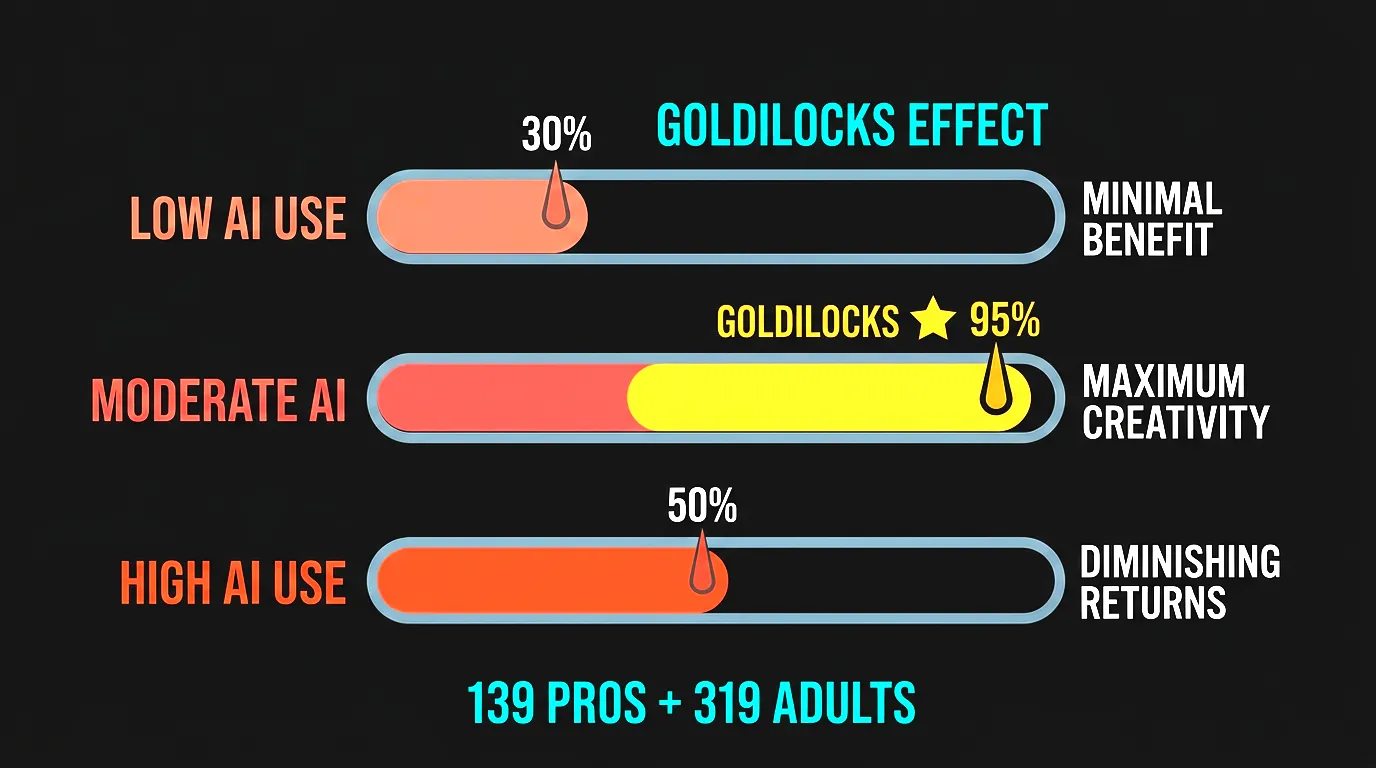
A December 2025 study in the Journal of Experimental Psychology found the sweet spot.[9] Testing 139 professionals and 319 adults, researchers discovered a Goldilocks effect of AI collaboration:
- Low AI use: Minimal creative benefit
- Moderate AI use: Maximum creative boost
- High AI use: Creativity drops back down
The people who benefited most from AI had something in common. A December 2025 study in the Journal of Applied Psychology found that metacognitive strategies determined who gained the most from AI tools.[10] People who actively monitored their own thinking process used AI as a springboard, not a crutch.
There’s also the Google problem. A 2025 study in Memory & Cognition found that groups given access to Google during brainstorming sessions generated fewer novel solutions than groups without internet access.[11] Having instant answers killed the productive struggle that leads to original thinking. The same thing is happening with AI on a larger scale.
Recommended read: A Brain for Innovation by Min W. Jung — A neuroscientist explains how your brain generates novel ideas and why abstract thinking is the engine behind real innovation.
| AI Use Level | Individual Creativity | Group Diversity |
|---|---|---|
| None | Baseline | High diversity |
| Moderate | Highest boost | Some convergence |
| Heavy | Diminishing returns | Severe convergence |
How to Actually Unlock Your Creative Brain
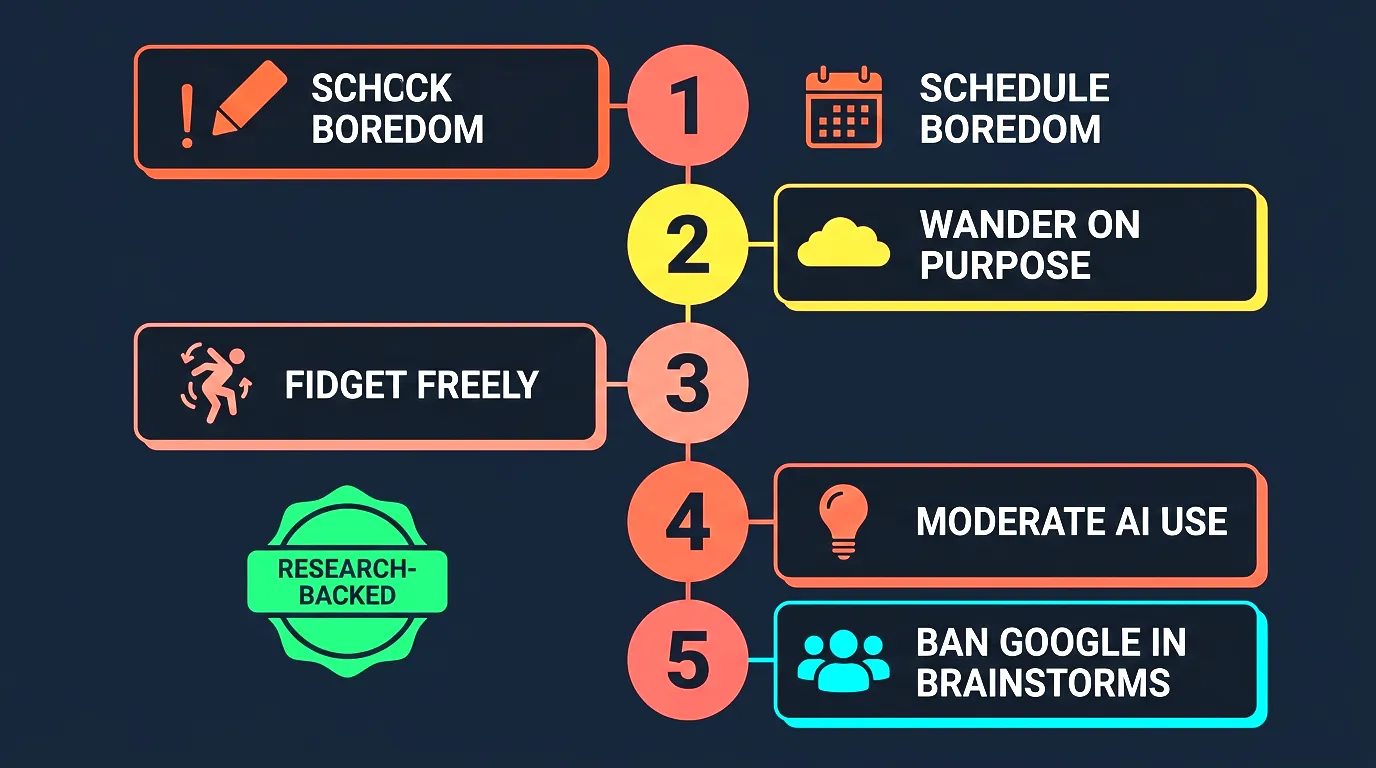
The research points to a clear set of strategies. Your brain’s creative potential is enormous. But you have to stop getting in its way.
Schedule boredom on purpose
Block 15 to 20 minutes of phone-free, task-free time into your day. Walk without headphones. Sit in a waiting room without scrolling. This activates your DMN and lets it start making the unexpected connections that produce creative ideas.[4]
Let your mind wander deliberately
There’s a difference between getting pulled off track by random thoughts and intentionally letting your mind explore. Practice the deliberate version. When you’re stuck on a problem, set the problem aside and let your mind play with “what if” scenarios. The ECNP research shows this deliberate wandering is the kind that actually drives breakthroughs.[5]
Give yourself permission to fidget
You don’t need to sit perfectly still to think well. The Stanford data is clear. The freedom to move your body while thinking is what matters.[6] Try pacing, doodling, or playing with a stress ball during brainstorming sessions.
Use AI as a springboard, not a replacement
The Goldilocks research suggests moderate AI use for creative tasks.[9] Use it to generate starting points or challenge your assumptions. But do the real creative work yourself. And be aware that heavy AI dependence makes your ideas converge with everyone else’s.
Protect group brainstorming from instant answers
When you’re brainstorming with a team, consider banning Google and AI tools during the initial divergent thinking phase.[11] Let the group struggle productively first. The Memory & Cognition research shows the struggle itself produces more novel ideas.
Here’s a quick checklist for creative sessions:
- Phone in another room (not just face down)
- No AI tools during initial brainstorming
- Permission to move, stand, pace, or doodle
- 5 minute “mind wander” breaks between focused bursts
- Deliberate “what if” exploration before evaluating ideas
The thread connecting all this research is simple. Your brain is a creative powerhouse. But it needs space. It needs movement. It needs boredom. The less you try to force creativity, the more your brain delivers it. Stop procrastinating out of anxiety and start procrastinating on purpose. Your best idea is probably waiting in a quiet moment you haven’t allowed yourself to have yet.
Recommended read: Anatomy of a Breakthrough by Adam Alter — A research-backed guide to getting unstuck, including why stepping back is often the fastest way forward.
Sources
Your Brain’s Hidden Creative Network
1. New Research on the Cognitive Science of Creativity (Psychology Today, 2025)
3. Flow States Bridge Opposing Brain Networks (Frontiers in Behavioral Neuroscience, 2025)
Why Boredom and Mind Wandering Fuel Better Ideas
4. Mind Wandering During Breaks Predicts Creative Improvement (Scientific Reports, 2025)
5. ADHD Minds Wander to Creativity: Deliberate vs. Spontaneous Mind Wandering (ECNP Congress, 2025)
Your Body Knows What Your Mind Needs
6. Students’ Fidgeting Boosts Creative Thinking (Journal of Educational Psychology, 2025)
The AI Creativity Paradox Nobody Is Talking About
7. AI Beats Average Humans on Creativity, But Top 50% Outperform All Models (Scientific Reports, 2026)
8. AI Enhances Individual But Kills Collective Creativity (Science Advances, 2024)
9. The Goldilocks Effect of AI Collaboration on Creativity (Journal of Experimental Psychology, 2025)
10. LLM Boosts Workplace Creativity for High Metacognition Users (Journal of Applied Psychology, 2025)
11. Google Access Kills Group Creativity in Brainstorming (Memory and Cognition, 2025)