
You could be surrounded by people every single day and still be dying from loneliness.
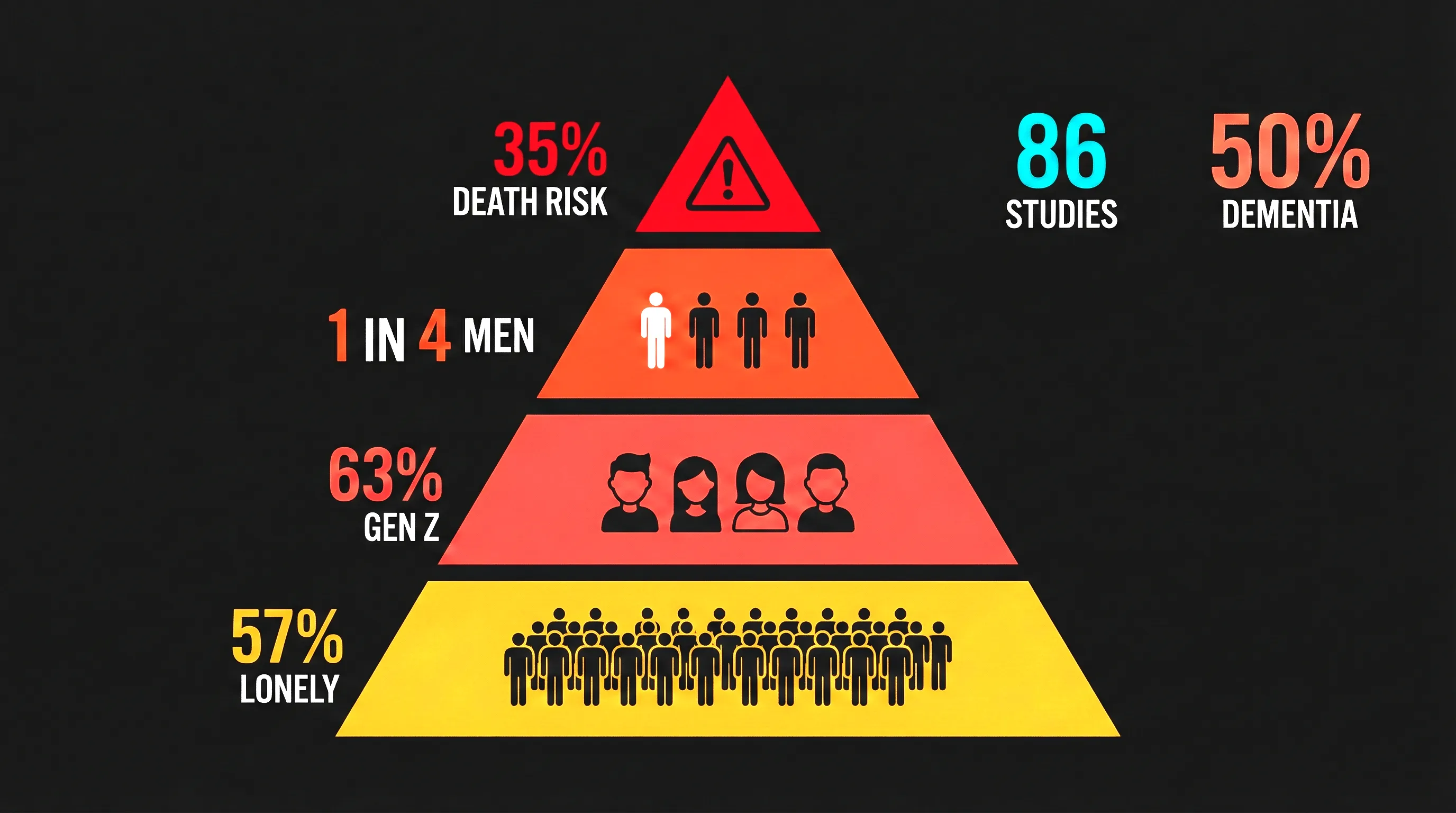
That’s not a metaphor. A January 2025 meta-analysis reviewed 86 studies and found that social isolation raises your risk of death by 35%.[1] That’s a bigger effect than obesity. Bigger than physical inactivity. And roughly on par with smoking 15 cigarettes a day.[2]
In 2023, U.S. Surgeon General Dr. Vivek Murthy declared loneliness a national epidemic.[3] He called it “far more than just a bad feeling.” And the data backs him up. About half of American adults report feeling lonely. Among young adults aged 18 to 24, that number climbs to nearly 60%.[4]
This is not just about feeling sad on a Friday night. Loneliness is a biological threat. And the science shows it’s killing people quietly, one stress hormone at a time.
The Loneliness Epidemic, by the Numbers
The scale of this problem is staggering. And it’s getting worse.
The Surgeon General’s 2023 advisory laid out the hard numbers. Americans are spending less time with friends, family, and community than at any point in recorded history.[3] Since 2003, time spent alone has increased by 24 hours per month. Time spent with friends has dropped by nearly half.
Here’s what the research tells us about who’s affected:
- 57% of U.S. adults report feeling lonely, according to a 2025 Cigna survey[4]
- Young men aged 15 to 34 are the loneliest demographic in the U.S., with 25% reporting they felt lonely “a lot of the previous day”[5]
- 63% of Gen Z report feeling lonely frequently or sometimes[4]
- Older adults living alone face a 21% higher mortality risk than those who don’t[1]
The health consequences are just as alarming:
| Health Outcome | Increased Risk from Isolation |
|---|---|
| All-cause mortality | 35%[1] |
| Heart disease | 29%[3] |
| Stroke | 32%[3] |
| Dementia | 50%[6] |
| Depression | 26%[7] |
These numbers put loneliness in the same league as the most well-known public health threats. And yet most people don’t take it nearly as seriously.
“We now know that loneliness is a common feeling that many people experience. It’s like hunger or thirst. It’s a feeling the body sends us when something we need for survival is missing.” - U.S. Surgeon General Vivek Murthy[3]
If you’ve noticed that nothing seems to make you happy anymore, chronic loneliness could be one of the hidden drivers behind that feeling.
How Loneliness Kills, the Biology
Loneliness doesn’t just make you feel bad. It rewires your biology from the inside out.
Your Brain Treats Loneliness Like a Threat
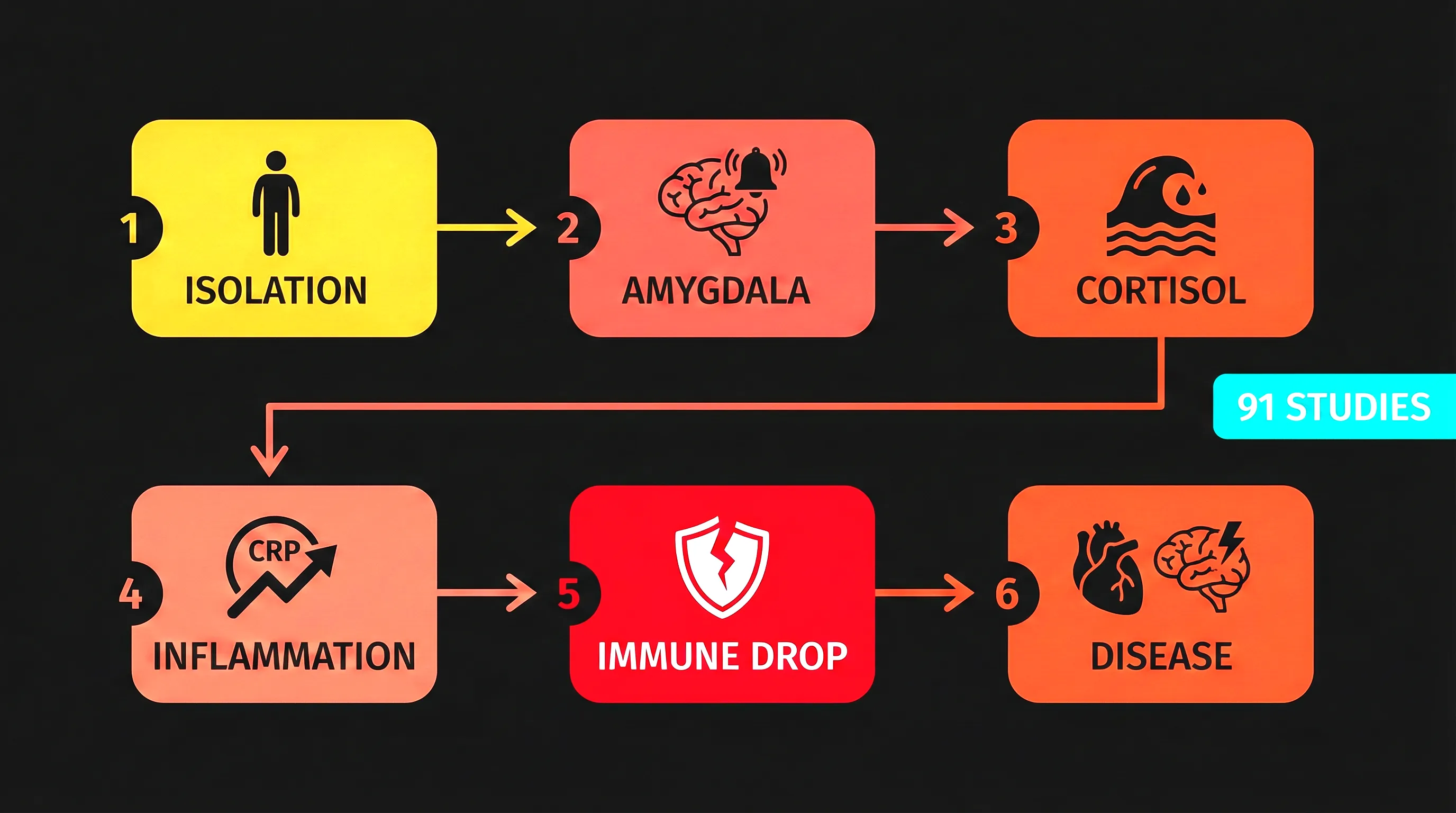
When you feel chronically disconnected, your brain flips into survival mode. The amygdala, your brain’s threat detection center, becomes hyperactive. It starts scanning for danger everywhere. Neutral faces look hostile. Ambiguous comments sound like insults.[8]
This is the same stress response your ancestors needed to survive being separated from their tribe. Back then, isolation meant death by predator or starvation. Your brain still reacts as if that’s the case.
The Cortisol Cascade
Chronic loneliness dysregulates your hypothalamic-pituitary-adrenal (HPA) axis, the system that controls your stress response.[8] The result is abnormally high levels of cortisol, the stress hormone, flooding your system around the clock.
Here’s what sustained high cortisol does to your body:
- Weakens immune function. Lonely people produce more inflammation and fewer antiviral antibodies.[9]
- Damages blood vessels. Chronic inflammation accelerates atherosclerosis, the buildup of plaque in arteries.
- Shrinks the brain. Prolonged stress reduces gray matter in the prefrontal cortex and hippocampus, the areas responsible for decision-making and memory.[8]
- Disrupts sleep. Lonely individuals show more fragmented sleep patterns, which compounds every other health risk.
If you’ve ever wondered why your emotions seem to spiral out of control, chronic loneliness may be the hidden factor. When your amygdala is permanently on high alert, emotional regulation becomes much harder.
Inflammation, the Silent Killer
A meta-analysis of 91 studies found that social isolation is associated with significantly higher levels of C-reactive protein and other inflammatory markers.[9] This chronic low-grade inflammation is the same biological process that drives heart disease, Type 2 diabetes, and Alzheimer’s.
“Social species do not fare well when forced to live solitary lives.” - John Cacioppo, neuroscientist and loneliness researcher
Recommended read: Why Brains Need Friends by Ben Rein. A neuroscientist explains why your brain literally needs other people to function properly and stay healthy.
Loneliness and Isolation Are Not the Same Thing
This is one of the most important distinctions in the entire field. And most people get it wrong.
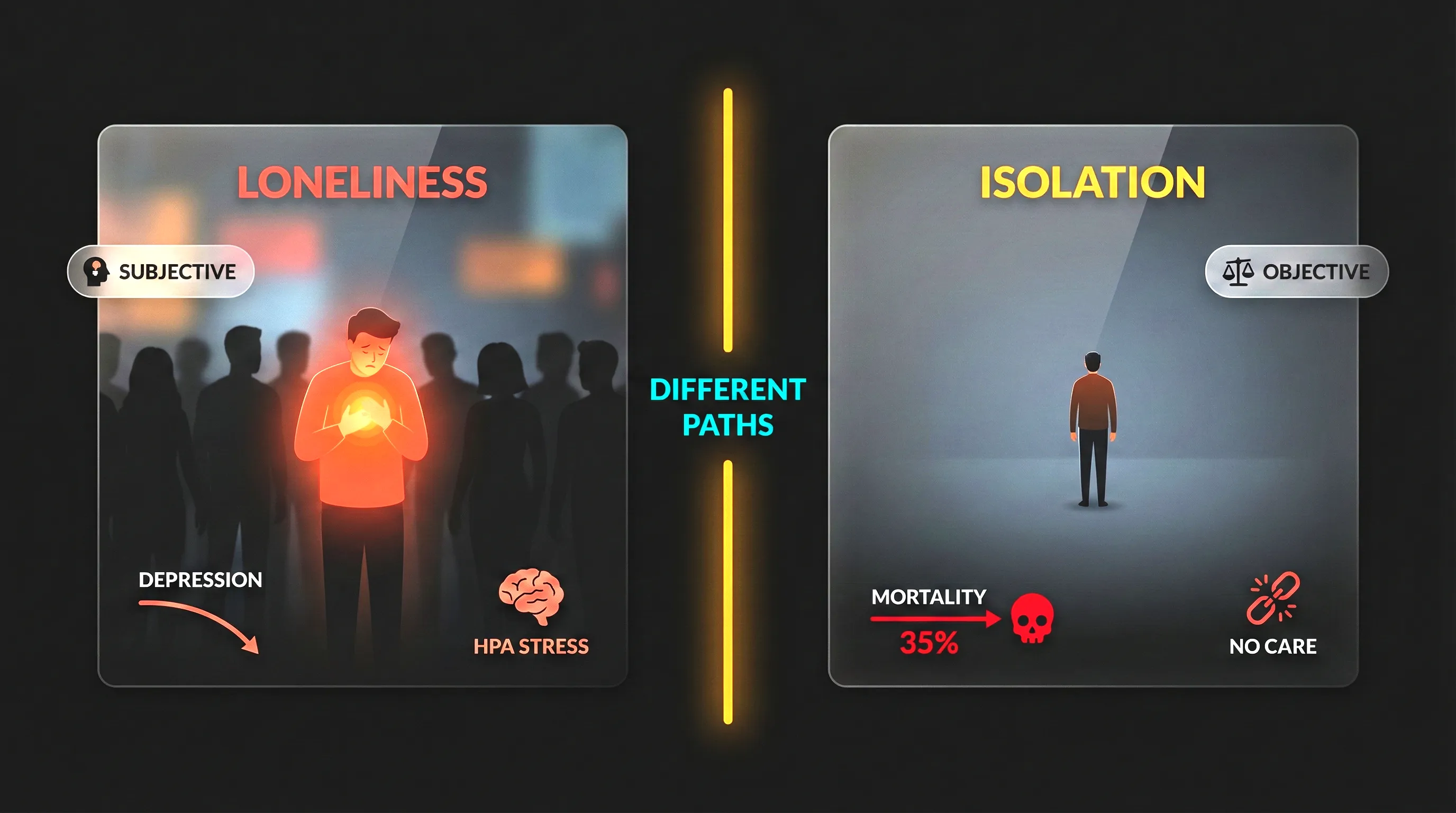
Loneliness is a subjective feeling. It’s the gap between the social connection you want and the connection you actually have. You can be surrounded by coworkers, family, and friends and still feel profoundly lonely.
Social isolation is an objective measure. It means you have few or no social contacts, limited participation in groups, and little community engagement. You can measure it by counting interactions.
Here’s the critical insight: you can be lonely without being isolated, and isolated without being lonely.[10]
They Damage Health Through Different Pathways
A 2023 longitudinal study published in SSM - Population Health found that loneliness and social isolation are only weakly to moderately correlated with each other.[10] More importantly, they affect your health through distinct biological mechanisms.
| Factor | Strongest Health Impact | Primary Pathway |
|---|---|---|
| Social isolation | All-cause mortality (HR 1.35) | Reduced access to resources, monitoring, and care |
| Loneliness | Depression and psychological distress | Chronic stress activation, HPA dysregulation |
| Living alone | Mortality in older adults (HR 1.21) | Combination of both pathways |
Social isolation is more predictive of dying early. Loneliness is a stronger predictor of mental health problems. Both are dangerous. But they require different solutions.[10]
Why This Matters for Treatment
If someone is socially isolated, the fix seems straightforward. Get them around more people. But if someone is lonely despite having a social life, simply adding more interactions won’t help. They need to address the quality and depth of their connections, not just the quantity.
This distinction also explains why social media often makes things worse. You can have 1,000 online friends and still feel deeply alone. The connections are wide but shallow.
“Loneliness is not about being alone. It is about feeling alone.” - Dr. Vivek Murthy[3]
Recommended read: How to Know a Person by David Brooks. A practical guide to the art of truly seeing others and building the kind of deep connections that protect against loneliness.
Who Is Most at Risk
Loneliness doesn’t discriminate. But some groups are hit harder than others.
Young Adults Are the Loneliest Generation
This surprises most people. We assume loneliness is an old person’s problem. The data says otherwise.
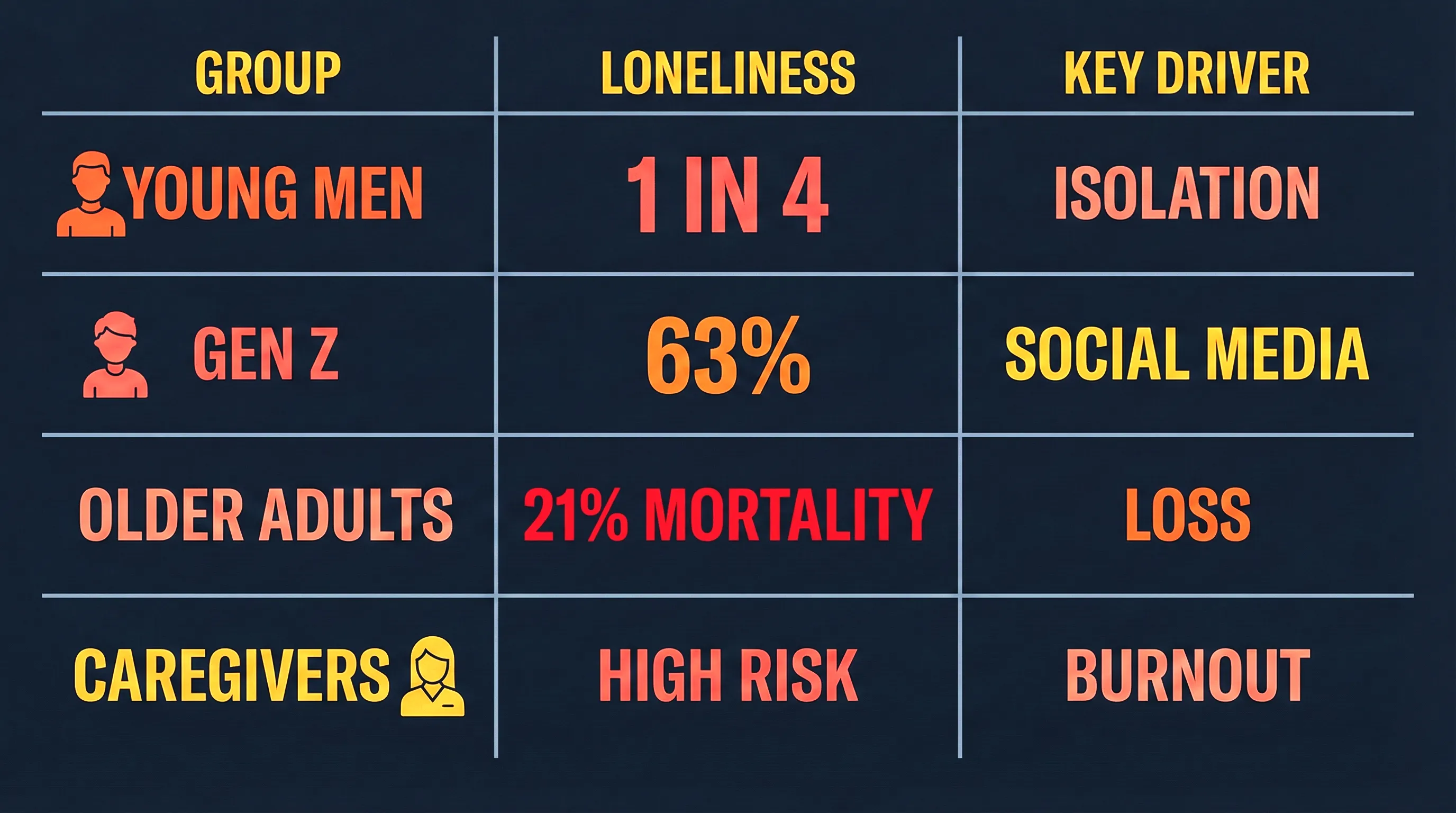
Young adults aged 18 to 34 report the highest rates of loneliness in the country.[5] A 2025 Gallup analysis found that U.S. men aged 15 to 34 are among the loneliest in the entire Western world. Nearly 1 in 4 young men said they felt lonely “a lot” the previous day.[5]
Several factors drive this:
- Delayed milestones. Fewer young adults are married, homeowners, or involved in religious communities compared to previous generations.
- Remote work. Working from home eliminates the casual social interactions that offices naturally provide.
- Social media paradox. More digital connection correlates with less in-person contact. 58% of Gen Z identify social media as a primary source of their loneliness.[4]
- Geographic mobility. Young people move more often for jobs, leaving friend networks behind.
Older Adults Face Structural Isolation
For older adults, loneliness often comes from loss. Spouses die. Friends pass away. Physical limitations make it harder to leave the house. Retirement strips away the daily social structure that work provided.
The 2025 meta-analysis found that older adults living alone face a 21% higher mortality risk.[1] And the risk compounds. Longer follow-up periods in the studies revealed even stronger mortality effects, suggesting that loneliness accumulates like compound interest in the wrong direction.
Other High-Risk Groups
- Caregivers who spend most of their time attending to someone else’s needs
- People with chronic illness who can’t maintain regular social activity
- Immigrants and refugees who lose their entire social network
- People who experienced childhood trauma, which can make trusting others feel unsafe
The common thread is not personality type. It’s circumstances that disrupt the social connections humans evolved to need.
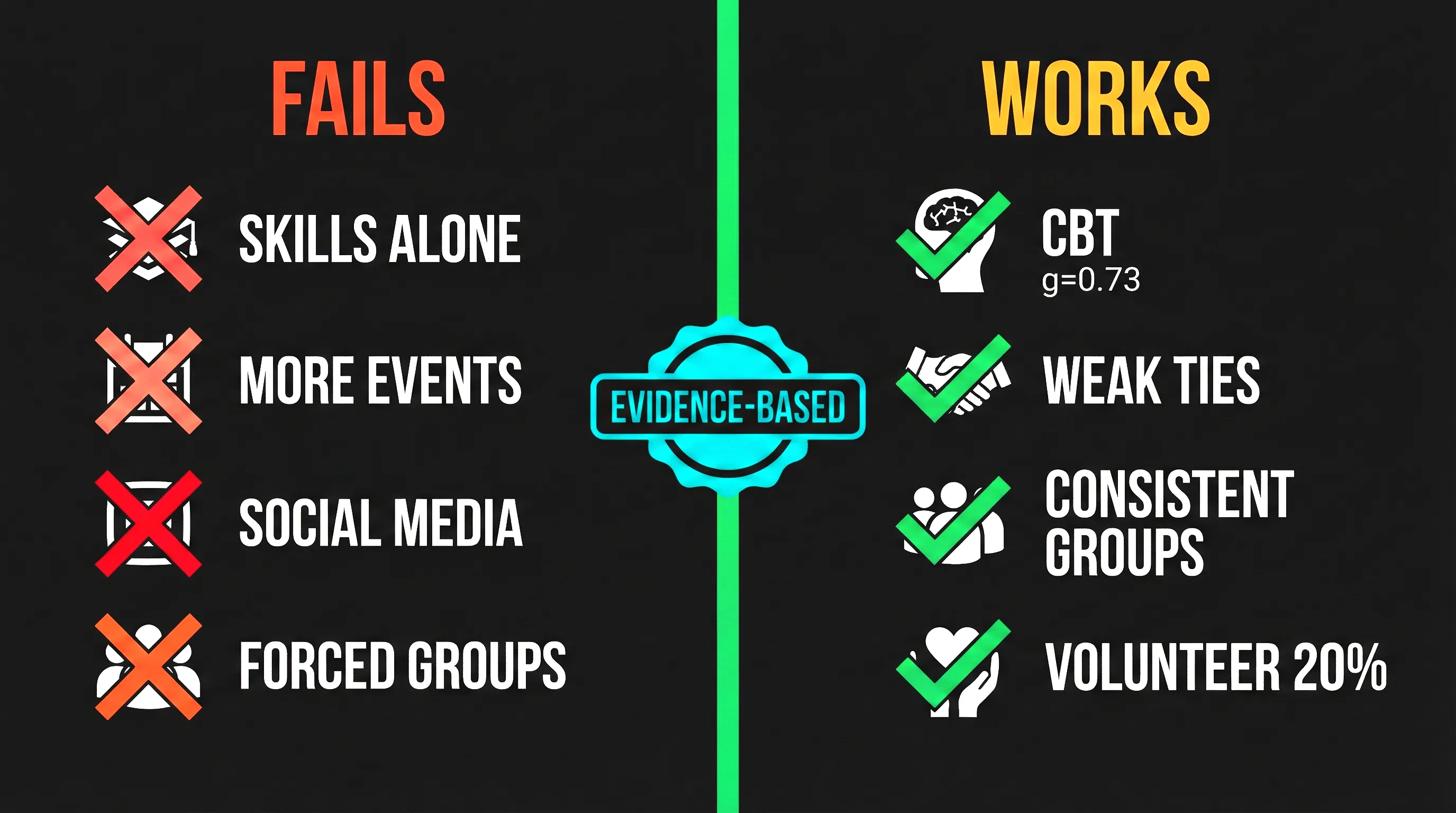
What Actually Works, According to Science
Knowing loneliness is dangerous only matters if you can do something about it. The good news is that researchers have tested dozens of interventions. Some work. Most don’t. Here’s what the evidence actually supports.
1. Fix the Thought Patterns First
The most effective loneliness intervention isn’t a social skills class or a networking event. It’s cognitive behavioral therapy (CBT).
A 2025 systematic review and meta-analysis found that CBT produces the largest effect size of any loneliness intervention, with a pooled effect of g = 0.73.[11] That’s a strong result by any clinical standard.
Why? Because chronic loneliness changes how you think. You start expecting rejection. You interpret neutral interactions as negative. You withdraw before anyone has a chance to let you down. CBT targets these distorted thought patterns directly.
Here’s what CBT for loneliness typically addresses:
- Hypervigilance to social threats. Lonely people scan conversations for signs of rejection and find them everywhere.
- Negative attribution bias. Assuming that a friend who didn’t text back is angry with you rather than just busy.
- Self-fulfilling withdrawal. Avoiding social situations to prevent rejection, which guarantees more isolation.
2. Build Weak Ties
You don’t need a best friend to fight loneliness. Research shows that weak ties, the brief interactions you have with baristas, neighbors, and coworkers, significantly reduce feelings of isolation.[12]
A simple “How’s your day going?” at the coffee shop isn’t trivial. These micro-interactions signal to your brain that you belong somewhere. That you’re part of a community.
Practical steps:
- Say hello to the same people at the gym, grocery store, or dog park
- Learn the names of people you interact with regularly
- Ask one follow-up question in casual conversations
3. Join Something, and Show Up Consistently
One-time social events don’t reduce loneliness. Consistency does. Research supports joining interest-based groups where repeated contact with the same people allows trust to develop naturally.[3]
The Surgeon General’s framework recommends:
- Community organizations like book clubs, sports leagues, or hobby groups
- Faith or spiritual communities (even secular ones)
- Volunteer organizations where you contribute alongside others
- Classes or workshops that meet on a regular schedule
The key is repetition. Sociologist Scott Feld found that friendships form most easily in settings where people interact regularly around a shared activity.[12] Showing up once doesn’t work. Showing up every week does.
4. Volunteer
Volunteering is one of the most underrated loneliness interventions. A 2024 study protocol for a dual randomized controlled trial found that volunteering directly targets loneliness, social health, and mental health in older adults.[12]
Why volunteering works so well:
- It gives you a sense of purpose, which combats the meaninglessness that loneliness creates
- It puts you in regular contact with the same group of people
- It shifts your focus outward, breaking the cycle of self-focused rumination
- It creates reciprocal relationships built on shared goals
“The most persistent threat to connection is the exhaustion of our emotional reserves. The most effective remedy is to invest those reserves in others.” - Jamil Zaki
Recommended read: Hope for Cynics by Jamil Zaki. A Stanford psychologist makes the case that trust in others is not naive but necessary, and shows how to rebuild it even after years of disconnection.
What Doesn’t Work
Not every approach has evidence behind it. Here’s what the research says to avoid:
- Social skills training alone shows limited effects unless combined with cognitive restructuring[11]
- Simply increasing social opportunities without addressing thought patterns rarely helps
- Social media as a substitute for in-person contact typically makes loneliness worse
- Forced socialization without personal choice or interest alignment backfires
The bottom line is that loneliness lives in your brain as much as in your environment. The most effective strategies address both.
Sources
The Loneliness Epidemic, by the Numbers
4. America’s Loneliness Crisis: 54% of Adults Feel Isolated (Cigna / Freedom for All Americans, 2025)
5. Younger Men in the U.S. Among the Loneliest in the West (Gallup, 2025)
How Loneliness Kills, the Biology
7. Social Connection as a Critical Factor for Mental and Physical Health (PMC, 2024)
8. The Neuroendocrinology of Social Isolation (Annual Review of Psychology, 2015)