Imagine taking one pill, sitting in a therapist’s office for six hours, and walking out with depression relief that lasts two years. No daily prescriptions. No refills. No side effects grinding away at you month after month.
That’s not a fantasy. It’s what happened to half the cancer patients in a 2025 clinical trial at Sunstone Therapies.[1]
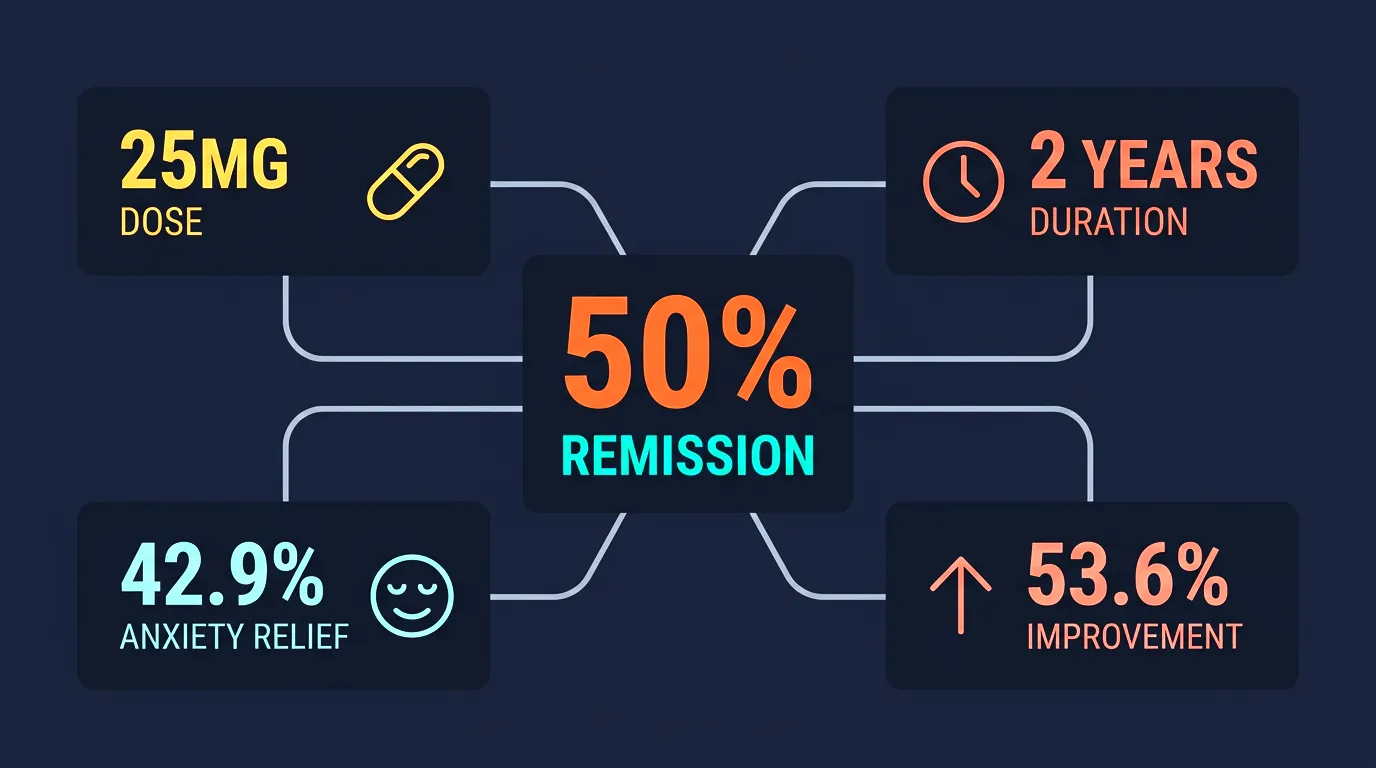
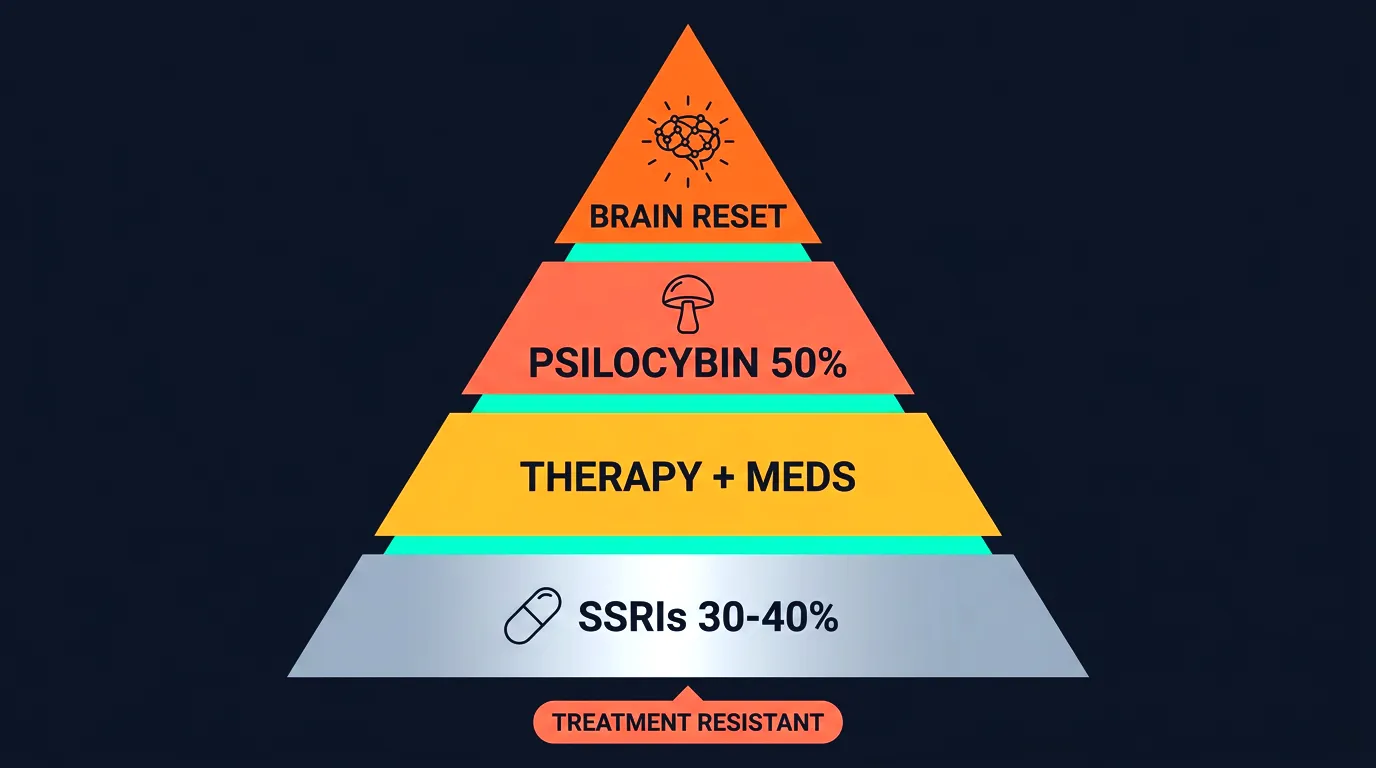
A single 25mg dose of psilocybin, the psychoactive compound in “magic mushrooms,” produced sustained depression remission in 50% of participants for over two years. And this wasn’t mild sadness. These were people battling major depressive disorder while simultaneously fighting cancer.
The results have caught the attention of the FDA, major pharmaceutical companies, and three U.S. states that have already legalized medical psilocybin. What was once dismissed as a fringe psychedelic is now one of the most promising depression treatments in modern psychiatry.
What the Science Actually Shows
The landmark 2025 study, published in the journal Cancer, followed 28 patients with cancer and major depressive disorder.[1] Each received a single 25mg dose of psilocybin alongside psychological support from trained therapists. The results at two years were striking.
- 53.6% of patients showed significant reduction in depression symptoms
- 50% achieved sustained remission lasting the full two years
- 42.9% experienced lasting anxiety relief
- The treatment involved just one dose with before and after therapy sessions
Dr. Manish Agrawal, who led the trial at Sunstone Therapies, put it simply. One dose of psilocybin with psychological support has a “long-term positive impact on relieving depression for as much as 2 years.”[1]
This wasn’t an isolated finding. A separate long-term follow-up from Johns Hopkins found that a single psilocybin dose eased depression in about two-thirds of participants for at least 4.5 years.[2] Earlier studies from NYU and Johns Hopkins had already shown sustained benefits at six months in patients whose brains were trapped in rigid thought loops.
Phase 3 Trials Confirm the Pattern
The evidence kept building into 2025 and 2026. COMPASS Pathways ran two Phase 3 trials of their synthetic psilocybin (COMP360) for treatment-resistant depression, the hardest form to treat.[3]
| Trial | Dose | Primary Endpoint | Result |
|---|---|---|---|
| COMP005 (2025) | Single 25mg vs placebo | MADRS score change at Week 6 | -3.6 points (p<0.001) |
| COMP006 (2026) | Two 25mg vs 1mg | MADRS score change at Week 6 | -3.8 points (p<0.001) |
Both trials hit their primary endpoints with high statistical significance. COMPASS plans to submit its FDA application between October and December 2026.[3]
A 2025 meta-analysis on medRxiv pooling data from multiple randomized controlled trials confirmed the pattern. Patients receiving psilocybin had significantly lower depression scores, higher response rates, and higher remission rates compared to placebo.[4] The effects were rapid and consistent over several weeks.
Recommended read: The Balanced Brain by Camilla Nord. A neuroscientist explains how your brain creates mental health and what happens when depression throws the system off balance.
How Psilocybin Rewires Your Brain
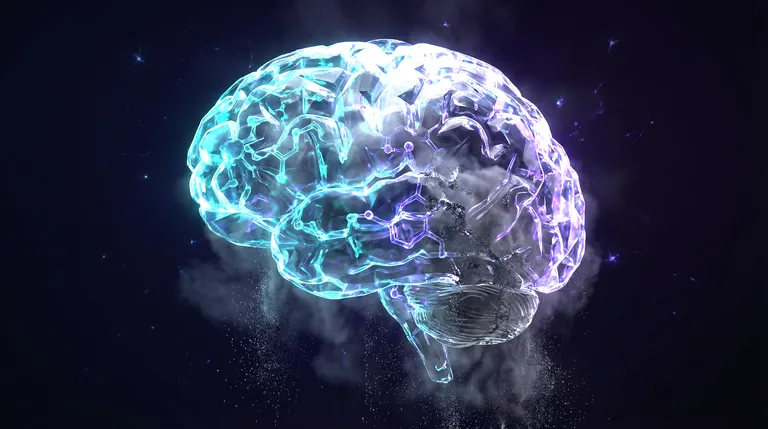
Traditional antidepressants like SSRIs adjust your serotonin levels and require daily dosing for weeks before you feel anything. Psilocybin does something fundamentally different. It physically rewires the connections between your neurons.
Once you swallow psilocybin, your body converts it into psilocin. This active molecule looks almost identical to serotonin and binds to your brain’s 5-HT2A receptors.[5] But instead of just adjusting chemical levels, it triggers a cascade of structural changes.
Your Brain Grows New Connections
A groundbreaking Yale study found that a single dose of psilocybin increased the number of dendritic spines, the tiny branches where neurons connect, by about 10% in the frontal cortex.[6] These new connections formed within 24 hours and were still there a month later.
Here’s what happens step by step.
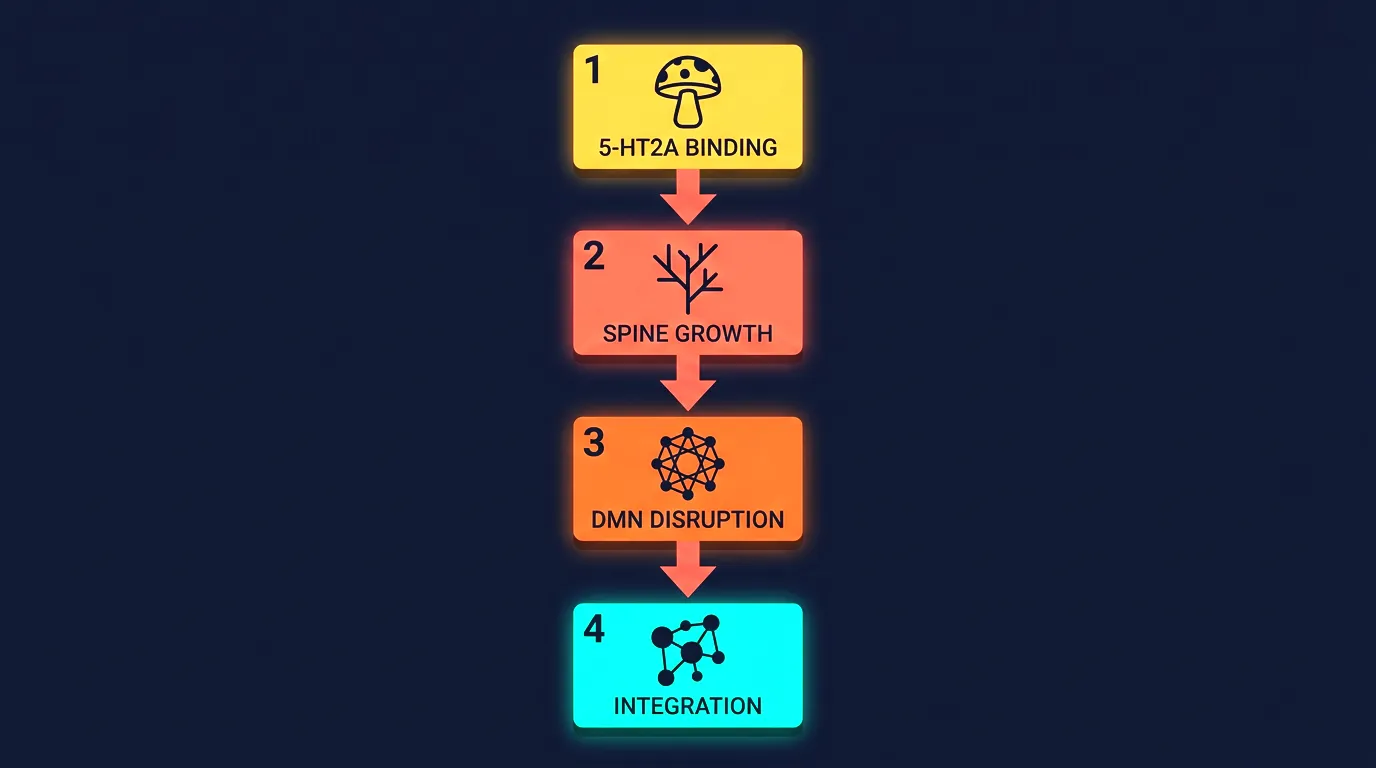
- Psilocin binds to 5-HT2A receptors. This activates pathways involving BDNF and mTOR signaling, which are known to drive neural growth.[5]
- New dendritic spines sprout. Within 24 hours, neurons in the frontal cortex grow new connection points. These are about 10% larger and stronger than before.
- The default mode network quiets down. Your DMN, the brain network responsible for self-referential thinking and rumination, gets disrupted.[7] Depression locks this network into rigid loops. Psilocybin breaks them open.
- Cross-network communication increases. Brain regions that normally operate in isolation start talking to each other. This “global integration” is directly linked to depression relief.[7]
This is the same kind of neuroplasticity that keeps your brain growing new neurons throughout life. But psilocybin accelerates the process dramatically.
Recommended read: Rewire by Nicole Vignola. A neuroscientist’s practical guide to how your brain builds and breaks neural pathways, the exact mechanism psilocybin turbocharges.
How Psilocybin Compares to Antidepressants
The comparison between psilocybin and traditional antidepressants is what makes this story so compelling. It’s not just a different drug. It’s a completely different model of treatment.
A head-to-head trial at Imperial College London compared two psilocybin sessions against six weeks of daily escitalopram, a common SSRI, in 59 people with moderate-to-severe depression.[8]
| Factor | Psilocybin | SSRIs (Escitalopram) |
|---|---|---|
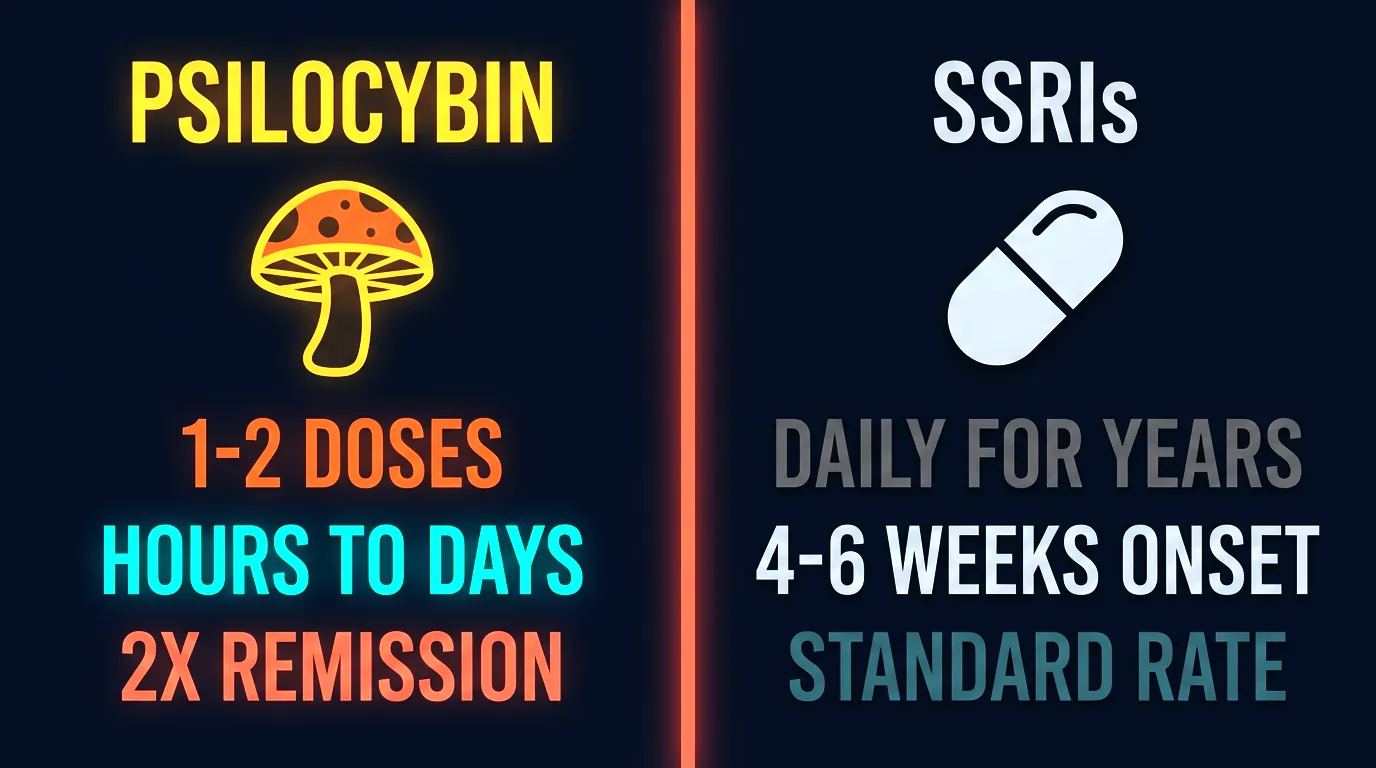
| Dosing | 1-2 sessions total | Daily pills for months or years |
| Onset of relief | Within hours to days | 4-6 weeks |
| Remission rate | 2x higher than SSRI group | Standard response |
| Duration after stopping | Months to years | Symptoms often return |
| Side effects | Headache, nausea (resolve in 24 hours) | Weight gain, sexual dysfunction, emotional blunting |
| Mechanism | Structural brain rewiring | Serotonin level adjustment |
The psilocybin group showed faster and larger reductions in depression scores. Remission rates were twice as high. And brain imaging revealed something the SSRI group didn’t show. Increased connectivity between large-scale brain networks, suggesting psilocybin works through a mechanism SSRIs simply don’t reach.[8]
As Stanford psychiatrist Anna Lembke explains in Dopamine Nation, the brain operates on a pleasure-pain balance. Depression pushes that balance toward constant pain. SSRIs try to nudge it back by adjusting chemistry. Psilocybin appears to reset the entire system by physically rebuilding the connections that depression destroys.
The Safety Question
The most common side effects of psilocybin in clinical trials include headache, nausea, anxiety, and visual disturbances.[9] But here’s the key detail. In COMPASS Pathways’ trials, 66% of all adverse events happened on the day of dosing, and 88% resolved within 24 hours.[3]
Compare that to SSRIs, where side effects like weight gain, sexual dysfunction, and emotional numbing can persist for years. The independent safety board reviewing the COMPASS data found no unexpected safety concerns and no significant increase in suicidal thoughts between the treatment and placebo groups.[3]
That said, psilocybin is not risk-free. People with a personal or family history of psychosis or bipolar disorder are typically excluded from trials. The treatment requires supervised clinical settings with trained therapists. This is not something you do alone.
Where Psilocybin Therapy Is Legal Right Now
The legal landscape for psilocybin therapy has shifted faster than almost anyone predicted. Three U.S. states have now legalized supervised access, and FDA approval could come as early as 2027.
Oregon, Colorado, and New Mexico
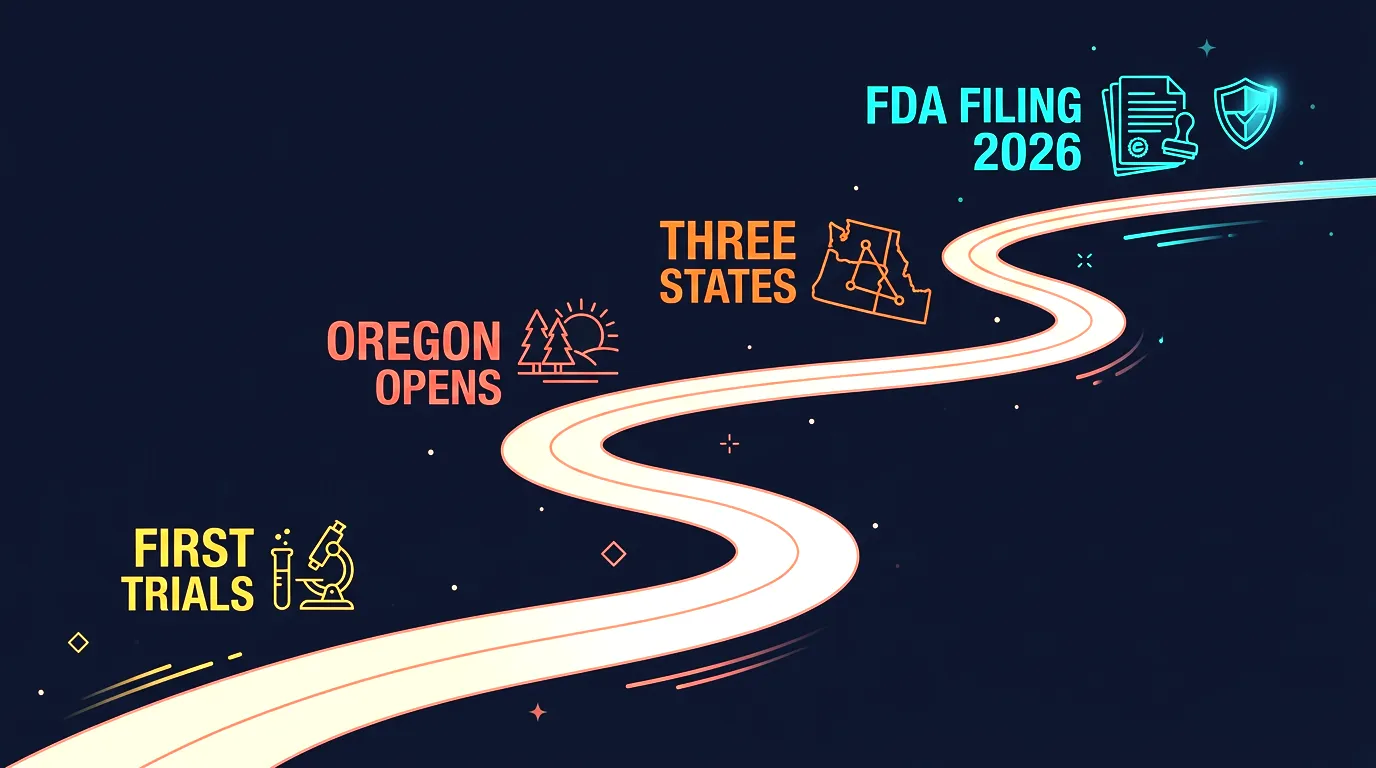
- Oregon (2023): First state to open licensed psilocybin service centers. Anyone over 21 can access supervised sessions without a diagnosis. Sessions cost $1,000 to $3,000 out of pocket. About a third of licensed centers have since closed due to high costs and limited demand.[10]
- Colorado (2025): Licensed its first psilocybin healing center in April 2025. Colorado allows dual licensure, meaning existing therapists can also offer psilocybin services. This could help keep costs lower than Oregon.
- New Mexico (2025): Governor Michelle Lujan Grisham signed the Medical Psilocybin Act in April 2025, making it the third state and the first to legalize through legislation rather than ballot measure.[11] The program covers treatment-resistant depression, PTSD, substance use disorders, and end-of-life care. It includes an equity fund for low-income patients.
The FDA Path
COMPASS Pathways plans to file its New Drug Application with the FDA between October and December 2026.[3] If approved, COMP360 would become the first FDA-approved psilocybin medication, making it available by prescription across all 50 states.
This could change everything. Rather than traveling to Oregon or waiting for state legislation, patients with treatment-resistant depression could access psilocybin therapy through their existing psychiatrist.
A 2025 review in Brain and Behavior highlighted the global potential. Researchers argued that psychedelic therapy could address the massive treatment gap in mental health care, particularly in regions where traditional treatments are either unavailable or ineffective.[12]
What This Means for the Future of Depression Treatment
We’re witnessing a genuine shift in how psychiatry thinks about depression. For decades, the standard model was simple. Depression equals low serotonin. Take a pill daily to raise it. But that model has serious limitations that even placebos have exposed.
- SSRIs work for roughly 30-40% of people with major depression
- About a third of patients have treatment-resistant depression, meaning multiple medications have failed them
- Patients who stop SSRIs frequently relapse within months
- Side effects drive many patients to quit treatment entirely
Psilocybin offers a completely different approach. Instead of managing symptoms indefinitely, one or two supervised sessions could produce lasting structural changes in the brain. The 50% remission rate at two years in the Sunstone cancer study isn’t just good. For treatment-resistant depression, it’s extraordinary.[1]
The Road Ahead
A few important caveats remain. The meta-analysis authors on medRxiv noted that placebo arms in psilocybin trials may underperform compared to traditional antidepressant trials, potentially inflating the apparent effect size.[4] Blinding is difficult when one group has a psychedelic experience and the other doesn’t.
The science is also still young. Most studies have small sample sizes. The COMPASS Phase 3 trials are the largest to date, but long-term data beyond two years remains limited. Researchers are actively studying who responds best, with early evidence suggesting that people who have spiritual or personally meaningful experiences during dosing tend to have better outcomes.[13]
But the trajectory is clear. Psilocybin is not a miracle drug. It doesn’t work for everyone. But for millions of people trapped in depression that nothing else has touched, a single supervised trip might offer something no daily pill ever could. A genuine reset.
Recommended read: Dopamine Nation by Anna Lembke. A Stanford psychiatrist explores how your brain’s reward system drives depression and addiction, and why resetting the balance is the key to recovery.
Sources
What the Science Actually Shows
1. Long-term benefits of single-dose psilocybin in depressed patients with cancer (Cancer, 2025)
How Psilocybin Rewires Your Brain
5. Emerging mechanisms of psilocybin-induced neuroplasticity (Trends in Pharmacological Sciences, 2025)
How Psilocybin Compares to Antidepressants
8. Trial of Psilocybin versus Escitalopram for Depression (New England Journal of Medicine, 2021)
Where Psilocybin Therapy Is Legal Right Now
10. A third of Oregon’s licensed psilocybin service centers have closed (OPB, 2026)
12. Psychedelic therapy for global mental health (Brain and Behavior, 2025)