In 2002, surgeon Bruce Moseley did something that sounds almost criminal. He brought 180 patients into an operating room for knee surgery. He sedated them. He made small cuts on their knees. Then, for a third of them, he did absolutely nothing else.
No scope. No repair. No cleaning out damaged cartilage. Just incisions, a few minutes of waiting, and stitches.
Two years later, those patients reported the same pain relief as the ones who got real surgery.[1] The $5,000 procedure performed over a million times a year in the U.S. was no better than pretend.
Your Brain Builds Its Own Medicine Cabinet
The placebo effect isn’t about gullibility. It’s about biology. When you expect relief, your brain doesn’t just sit around hoping. It gets to work.
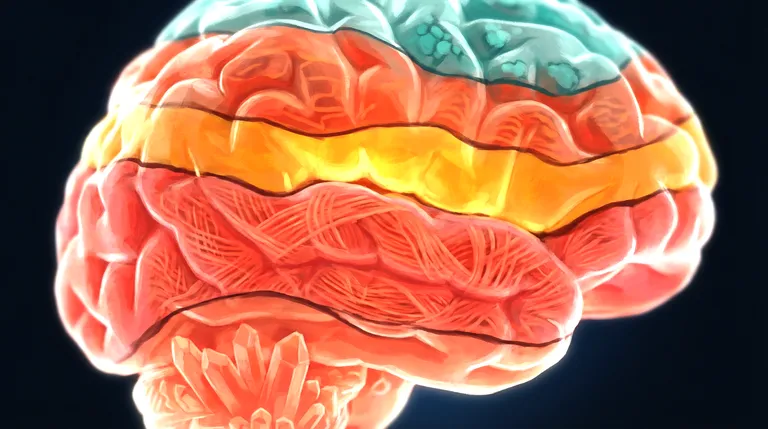
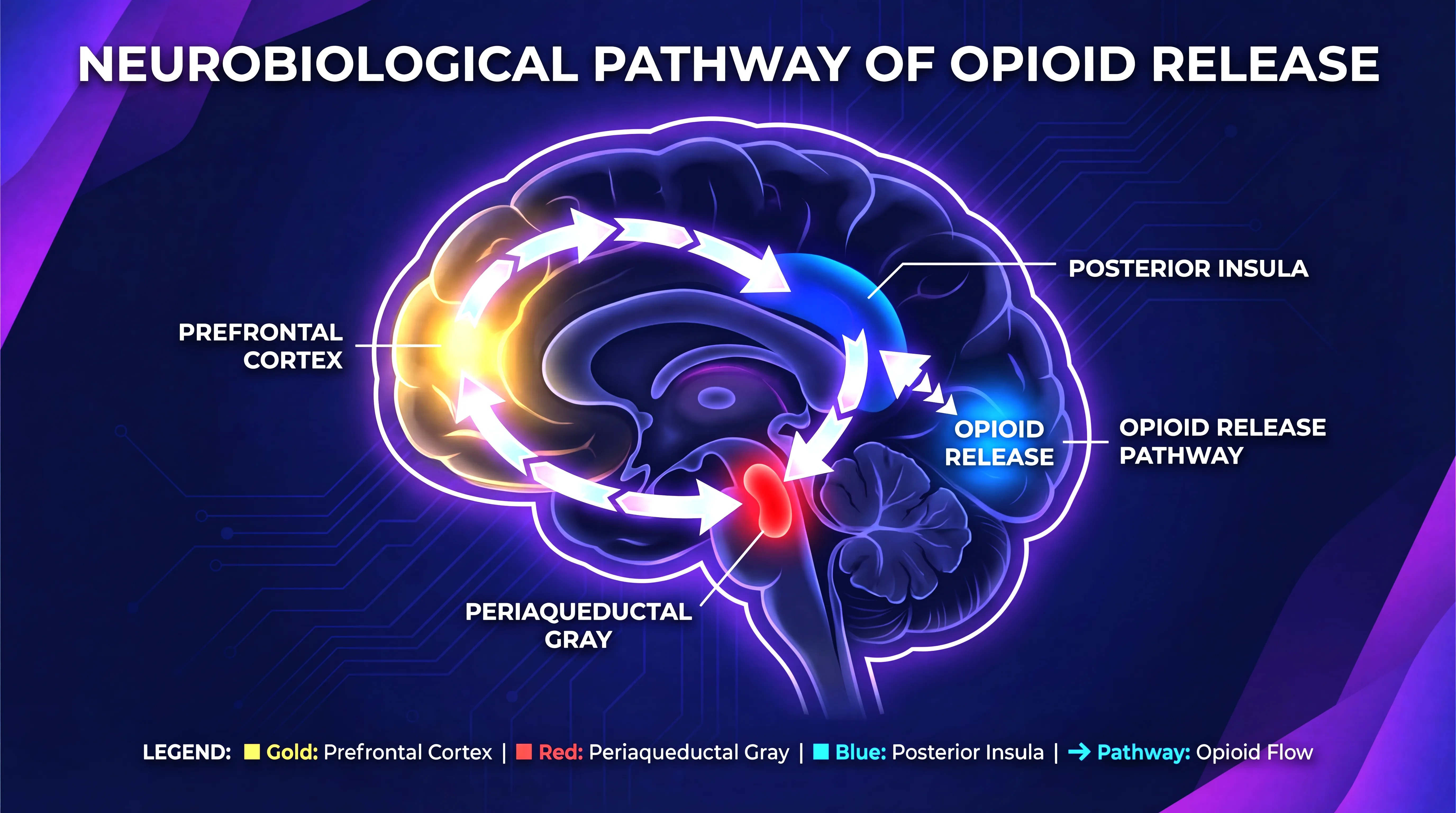
fMRI studies show that placebo treatments activate the prefrontal cortex, the brain region responsible for generating and maintaining expectations.[2] That activation doesn’t stop at “positive thinking.” It triggers a cascade of real neurochemical events.
Here’s what actually happens inside your skull when you take a sugar pill you believe is medicine:
- Your prefrontal cortex generates an expectation of pain relief
- That signal travels to the periaqueductal gray in the midbrain
- Your brain releases its own endogenous opioids, the same class of chemicals as morphine
- Activity drops in the posterior insula, the region that constructs your pain experience
- The thalamus and basal ganglia show reduced pain signaling
This isn’t metaphorical. Researchers proved it by giving placebo responders naloxone, an opioid blocker. The placebo effect vanished.[3] Your brain was literally manufacturing its own painkillers.
“Placebos can cause central opioid release in the cortex, nucleus accumbens, and periaqueductal gray.” - Journal of Neuroscience [3]
The same expectation machinery that makes you misremember events with total confidence also builds real chemical responses to fake treatments. Your brain doesn’t distinguish between “real” and “expected.” It just responds.
The Honest Placebo Paradox
Here’s where things get strange. The traditional explanation for placebos required deception. You had to believe the pill was real. But a wave of research on open-label placebos has blown that assumption apart.
In open-label placebo studies, researchers tell patients something like this: “This pill has no active ingredient. It’s a placebo. But research shows placebos can trigger real healing responses in the body.”
Then the patients take the sugar pills anyway. And they still get better.
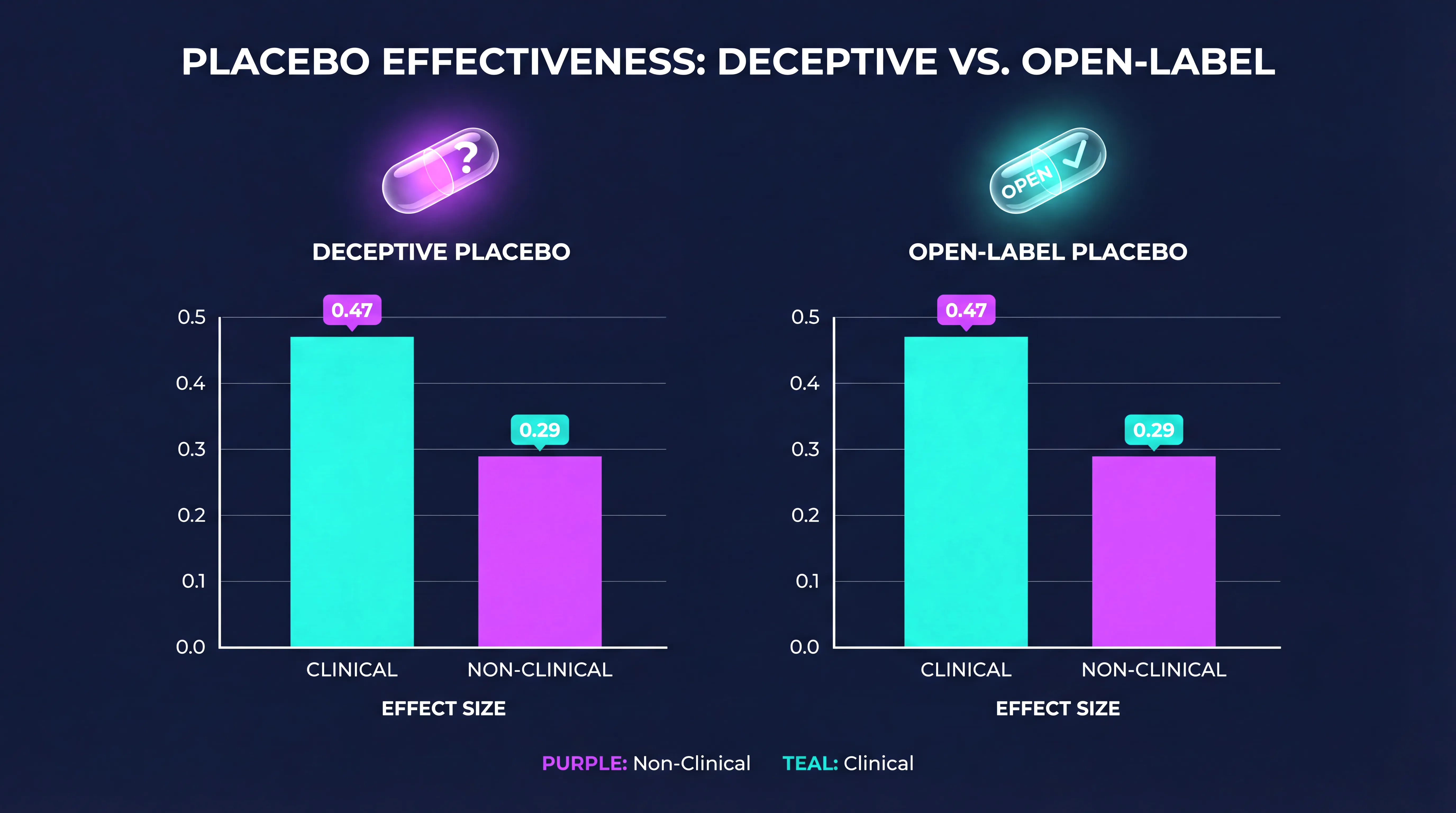
A 2025 meta-analysis published in Scientific Reports analyzed 63 studies involving 4,554 participants.[4] The results were clear.
| Condition | Finding |
|---|---|
| Open-label placebos overall | Significant positive effect (SMD = 0.35) |
| Clinical populations | Stronger effect (SMD = 0.47) |
| Non-clinical populations | Moderate effect (SMD = 0.29) |
| Self-reported outcomes | Larger improvements |
| Objective measurements | Smaller but still present effects |
People who knew they were taking fake pills still experienced real relief. Not as much as those who were deceived. But enough to matter.
Recommended read: Suggestible You by Erik Vance. A fascinating journey through the science of placebos, false memories, and hypnosis that shows just how powerful your brain’s suggestion machinery really is.
Why Does Honesty Still Work?
Researchers think open-label placebos tap into something deeper than conscious belief. The act of taking a pill, visiting a clinic, and going through a treatment ritual activates conditioned responses your body learned over a lifetime of real medical care.
You’ve swallowed thousands of pills. Many of them made you feel better. Your body learned the pattern. Now the ritual alone is enough to trigger the response, even when your conscious mind knows better.
It’s similar to how your mouth waters when you smell food cooking, even if you just ate. The conscious knowledge that you’re full doesn’t override the conditioned response. Your body responds to cues, not logic.
The Placebo Effect Keeps Getting Stronger
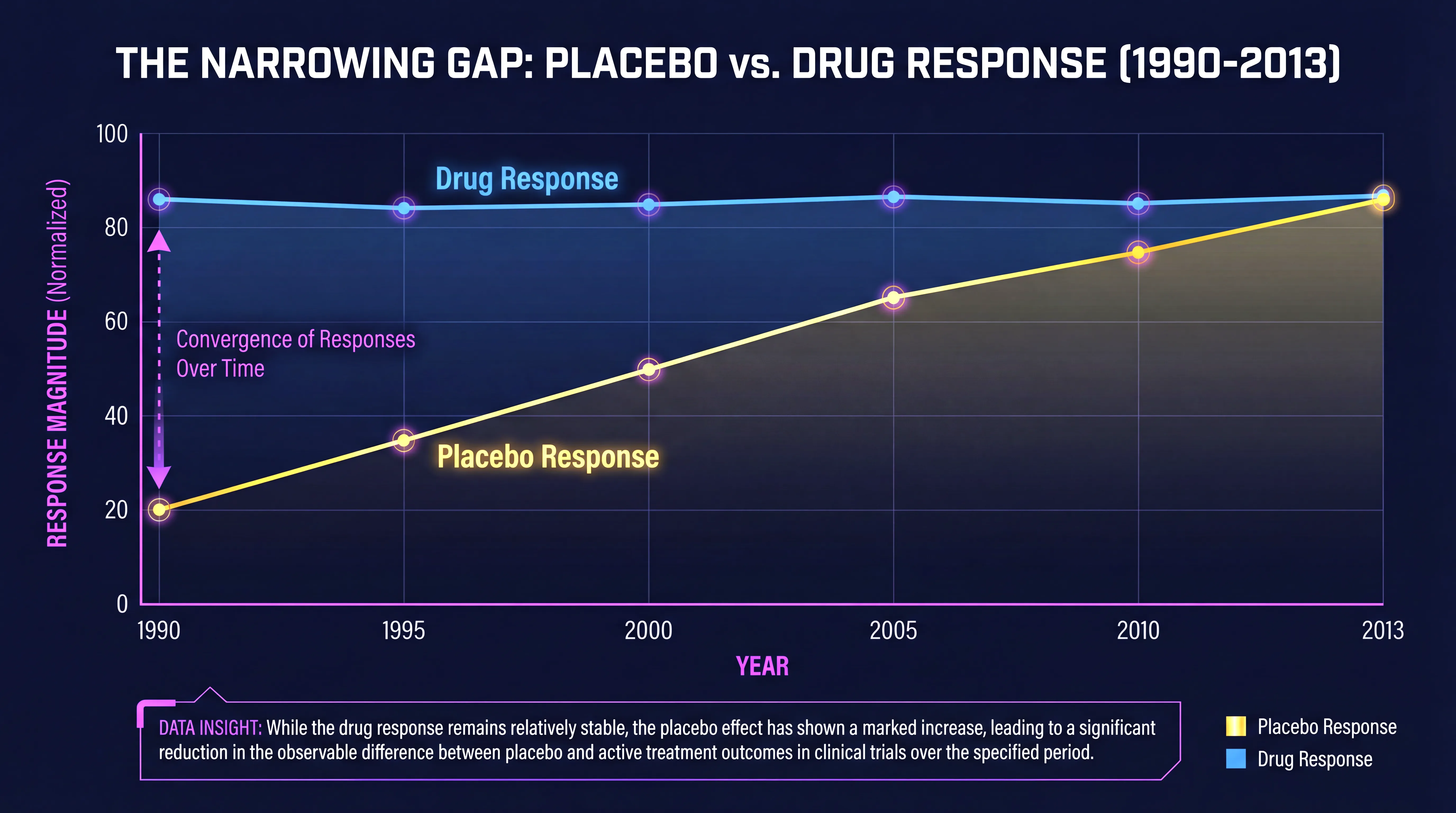
Something bizarre is happening in clinical drug trials. The placebo effect is growing.
An analysis of neuropathic pain trials from 1990 to 2013 found that placebo responses increased dramatically over time.[5] But the actual drug responses stayed flat. The gap between “real treatment” and “sugar pill” is shrinking, and it’s not because the drugs are getting worse.
This trend is concentrated in the United States. European and Asian trials show stable placebo responses.[5] Something about American clinical trials is amplifying the effect.
Researchers point to several possible explanations:
- U.S. trials have grown larger and longer, giving patients more contact with medical professionals
- Direct-to-consumer drug advertising raises patient expectations
- Clinical trial environments have become more comfortable and attentive
- Cultural emphasis on pharmaceutical solutions may prime stronger expectation
The practical consequence is alarming. Pain medications that probably work are failing clinical trials because the placebo group keeps improving. Many researchers in the pain field believe effective drugs are being shelved because trials can’t demonstrate an advantage over sugar pills.
Recommended read: Cure by Jo Marchant. An award-winning science journalist explores the frontiers of mind-body medicine, from placebos to meditation to virtual reality pain treatment.
This isn’t just an abstract problem. It means potentially useful treatments never reach patients. The placebo effect, once dismissed as noise in the data, has become powerful enough to derail pharmaceutical development. The same brain systems that make you chase losses at a casino are shaping which drugs make it to market.
How to Use the Placebo Effect in Your Own Life
You can’t cure cancer with positive thinking. Placebos work best on subjective symptoms like pain, nausea, fatigue, anxiety, and depression. They don’t shrink tumors or fight infections.
But within those limits, you can harness your brain’s expectation machinery. Here are evidence-backed strategies:
-
Take your real medications with intention. Don’t mindlessly swallow pills. Pay attention to the act. Research shows that the ritual of treatment amplifies drug effectiveness. The same medication works better when a doctor administers it than when a hidden pump delivers it.
-
Choose providers you trust. A 2025 study found that leaders who demonstrate trust- and empathy-building behaviors see outcomes improve by up to 40%. The same applies to doctors. Your relationship with your healthcare provider is itself a form of treatment.
-
Create healing rituals. Consistent routines around self-care activate conditioned responses. The cup of herbal tea before bed, the stretching routine after waking, the breathing exercise before a stressful meeting. Rituals tell your brain “relief is coming,” and your brain obliges.
-
Label your emotions precisely. A January 2026 study by Dr. David Burns at Stanford used structural equation modeling to measure the placebo effect in depression treatment. He found that cognitive change, specifically identifying and challenging distorted thoughts, produced far larger improvements than placebo expectations alone. Naming what you feel is the first step to changing it.
-
Don’t dismiss supplements you believe in. If you take a vitamin and feel better, some of that benefit may be placebo. That doesn’t make it fake. The relief is neurochemically real. As long as the supplement isn’t harmful, the placebo component is a bonus, not a reason to stop.
Recommended read: You Are the Placebo by Dr. Joe Dispenza. A deep dive into documented cases of remarkable recoveries and the neuroscience of how belief reshapes biology.
The Line Between Belief and Biology Is Thinner Than You Think
The placebo effect reveals something uncomfortable about human consciousness. We like to believe we’re rational. That our bodies respond to chemistry, not stories. That knowing the truth protects us from illusion.
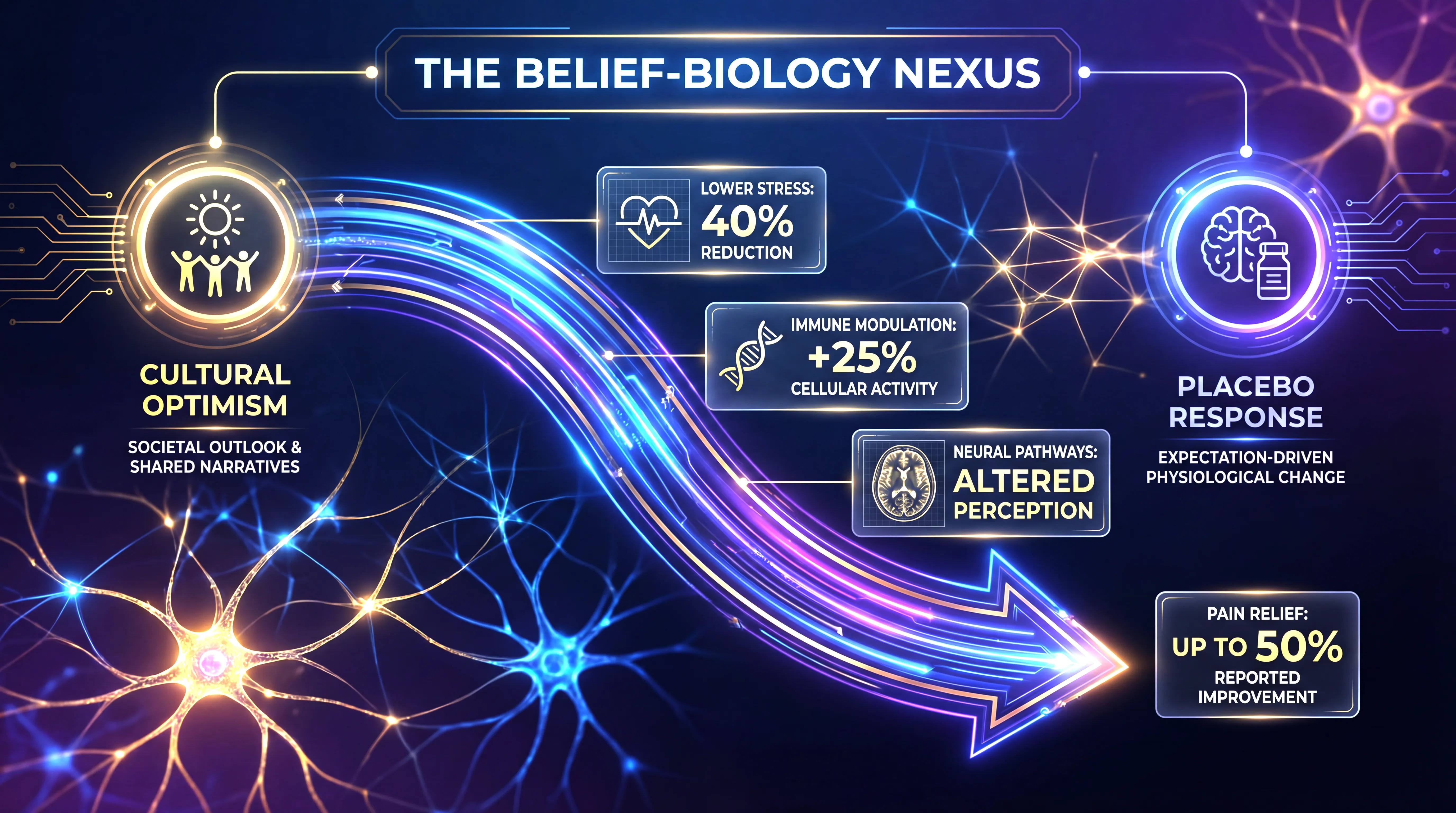
But your brain doesn’t care about truth. It cares about prediction. When it predicts relief, it manufactures relief. When it predicts pain, it amplifies pain through the same mechanisms that amplify craving and reward.
The 2025 Frontiers in Psychology study on the “emotional recession” found that global emotional intelligence scores dropped 5.79% from 2019 to 2024.[6] Optimism fell 8.04%. As collective belief in recovery weakens, so does the machinery that makes recovery possible. The placebo effect isn’t just individual. It’s cultural.
Sham knee surgeries work. Sugar pills reduce pain. Honest placebos still heal. Your brain is the most sophisticated pharmacy ever built. The question isn’t whether the placebo effect is real. It’s whether you’re using it or letting it use you.
Recommended read: Placebos by Kathryn Hall. An MIT Press exploration of the science, history, and ethics of placebos that separates the hype from the genuinely remarkable evidence.
Sources
Your Brain Builds Its Own Medicine Cabinet
2. Neurobiological Mechanisms of the Placebo Effect (Journal of Neuroscience, 2005)
The Honest Placebo Paradox
The Placebo Effect Keeps Getting Stronger
5. Increasing Placebo Responses over Time in U.S. Clinical Trials of Neuropathic Pain (Pain, 2015)
The Line Between Belief and Biology Is Thinner Than You Think
6. The Emotional Recession: Global Declines in Emotional Intelligence (Frontiers in Psychology, 2025)