Imagine solving a math problem in your sleep. Not in a dream about school. In an actual experiment, while scientists watch your brain on a monitor.
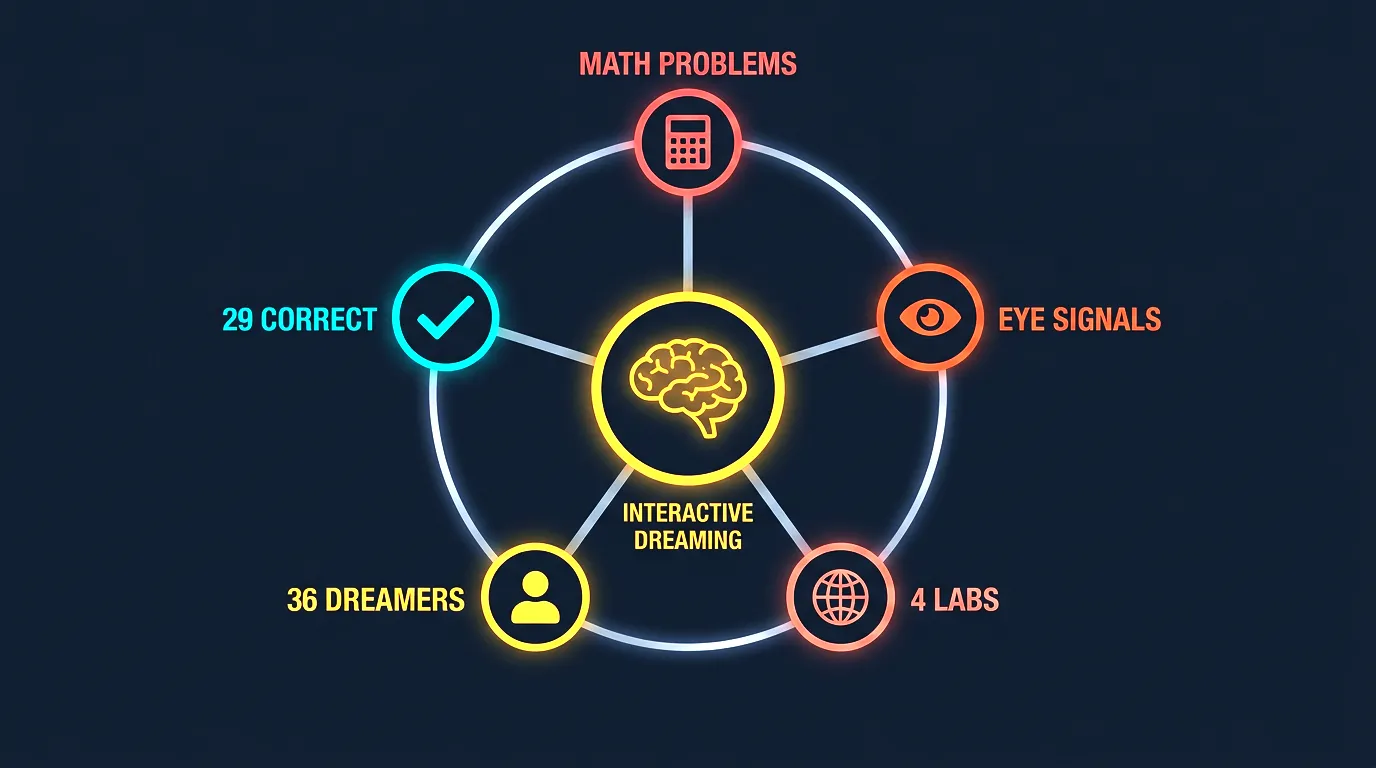
That’s exactly what happened in a lab at Northwestern University. A sleeping participant heard a researcher’s voice ask “What is eight minus six?” The dreamer answered correctly. Two. They signaled the answer using eye movements. While still asleep. While still dreaming.[1]
This wasn’t science fiction. It was a peer-reviewed study published in Current Biology. And it’s just the beginning of a revolution in dream science that’s rewriting everything we thought we knew about consciousness, sleep, and the hidden power of the dreaming brain.
Your Brain Has a Secret Chat Mode
For most of human history, dreams were a one-way street. You dreamed. You woke up. You forgot most of it. Scientists could study brain waves during sleep, but they couldn’t actually talk to someone inside a dream.
In 2021, Karen Konkoly and a team of researchers from four independent labs in the United States, France, Germany, and the Netherlands changed that forever.[1] They recruited 36 people, including experienced lucid dreamers, novices, and a patient with narcolepsy. Then they asked them questions during REM sleep.
The results were staggering:
- Dreamers correctly answered spoken questions 29 times across 6 participants
- They solved simple math problems while fully asleep
- They responded using pre-arranged eye movements and facial muscle contractions
- All four labs independently replicated the findings
“These repeated observations of interactive dreaming demonstrate that phenomenological and cognitive characteristics of dreaming can be interrogated in real time.” — Karen Konkoly, Northwestern University
The key ingredient? Lucid dreaming. That’s when you become aware that you’re dreaming while you’re still asleep. Your brain’s metacognition system switches back on during REM sleep. That’s the part that lets you think about your own thoughts. And once it does, two-way communication becomes possible.
About 55% of people have experienced at least one lucid dream in their lifetime.[2] Around 23% have them monthly. But only about 1 in 1,000 people experience them regularly without any special training.[3]
What Happens in Your Brain When You Go Lucid
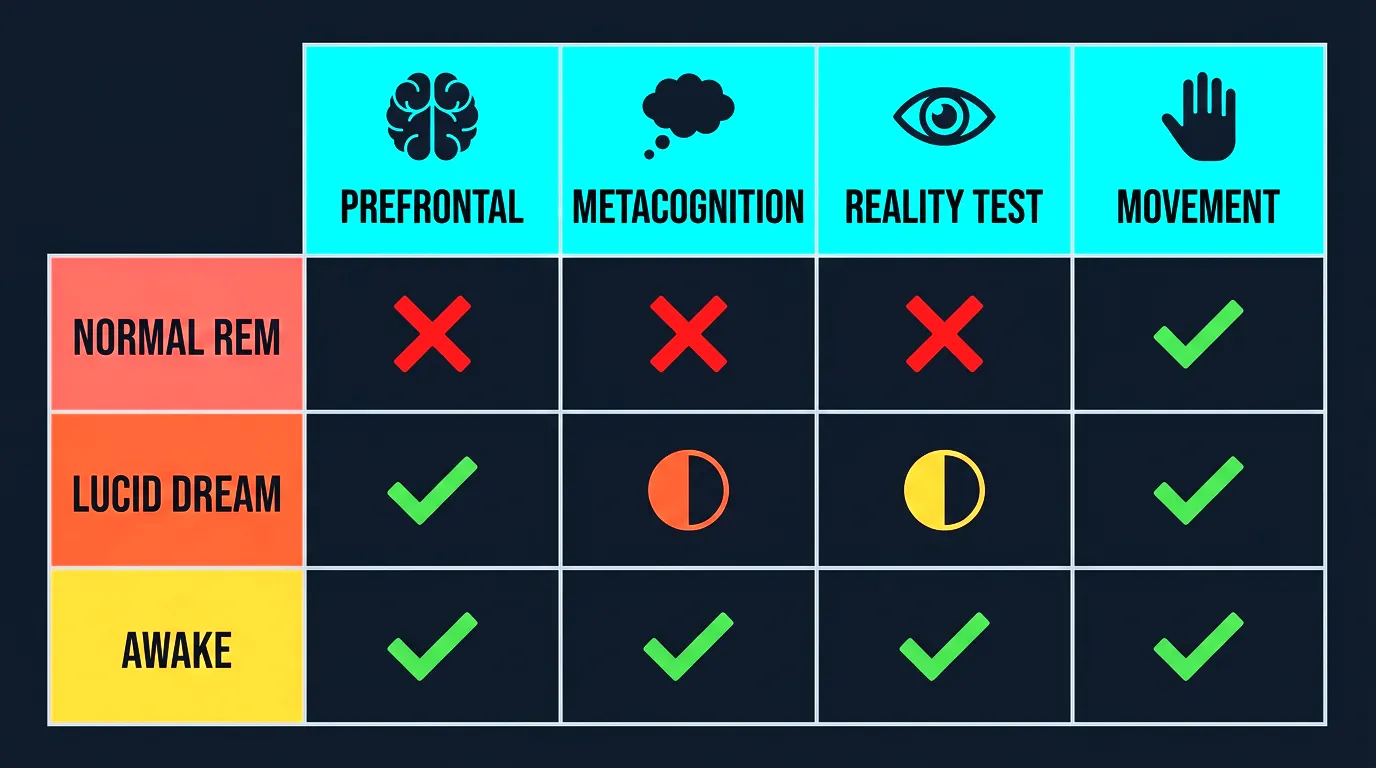
Normal dreaming is chaotic. Your prefrontal cortex, the brain region responsible for logic, self-awareness, and critical thinking, goes mostly offline during REM sleep. That’s why dreams feel so real. You don’t question why you’re flying or why your dog is giving a business presentation.
Lucid dreaming flips that switch back on. In a 2025 study published in the Journal of Neuroscience, Çağatay Demirel’s team used EEG data pooled from multiple labs worldwide to map what happens in the brain during lucid dreaming.[4]
They found:
- Heightened alpha wave connectivity in posterior brain regions
- Widespread communication across brain areas that normally go quiet during REM
- Beta power reductions in right central and parietal areas, suggesting a unique hybrid state
This builds on Martin Dresler’s landmark 2012 study, the only fMRI ever performed on an actively lucid dreaming brain.[3] His team confirmed that regions typically silent during REM sleep, including the prefrontal cortex and precuneus, light up during lucid dreams.
| Brain State | Prefrontal Cortex | Metacognition | Reality Testing | Muscle Control |
|---|---|---|---|---|
| Normal REM Sleep | Mostly offline | Off | Off | Paralyzed |
| Lucid Dreaming | Partially active | On | On | Paralyzed (except eyes) |
| Waking | Fully active | On | On | Full control |
Benjamin Baird’s 2018 fMRI study of 14 frequent lucid dreamers found something else remarkable.[3] Even while awake, these people showed stronger neural connections between their prefrontal cortex and higher-order processing regions. Their brains had what researchers called “a more tight-knit community of higher-order association hubs.”
In other words, frequent lucid dreamers don’t just have different dreams. They have structurally different brains.
Recommended read: The Experience Machine by Andy Clark — a deep dive into how your brain constructs reality, and why lucid dreaming challenges everything we think perception means.
From Nightmares to Breakthroughs, What Lucid Dreams Can Do
Lucid dreaming isn’t just a cool party trick. It’s becoming a serious clinical tool.
Treating PTSD and Nightmares
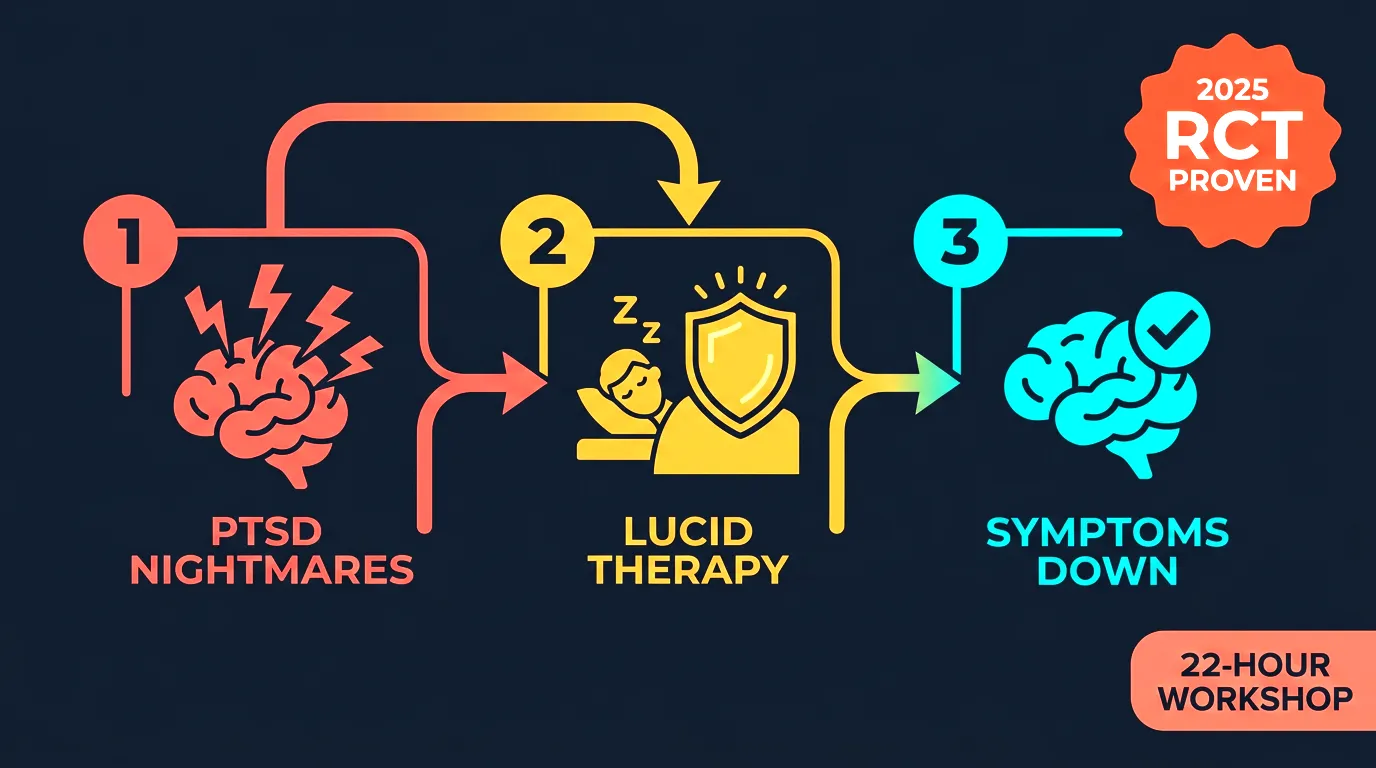
In 2018, the American Academy of Sleep Medicine officially recommended lucid dreaming therapy for nightmare disorders.[5] A 2025 randomized controlled trial took this further. Participants attended a 22-hour workshop over six days where they learned lucid dreaming techniques to transform their nightmares.[6]
The results were clear:
- Significant reductions in PTSD symptoms compared to controls
- Decreased nightmare distress
- Improved well-being and fewer negative emotions
- Benefits sustained at one-month follow-up
The science behind it makes sense. REM sleep naturally provides a low-noradrenaline environment perfect for emotional processing. Lucid dreaming lets you revisit traumatic content with your rational mind partially online. It’s like exposure therapy that happens while you sleep.
Athletic Training
Athletes have also discovered lucid dreaming. Research shows that practicing motor skills during lucid dreams improves real-world performance.[7] In one study, participants practiced a finger-tapping task through either physical practice, mental rehearsal while awake, or practice during lucid dreams. All three groups improved significantly over controls. The lucid dream group performed almost as well as the physical practice group.
Expanding Consciousness
A 2025 proof-of-concept study from Northwestern University combined VR with lucid dreaming to push the boundaries of consciousness research.[8] Four frequent lucid dreamers experienced “Ripple,” a VR program designed to blur self-other boundaries and induce a sense of oneness. That night, researchers played sounds from the VR experience during their REM sleep.
Three of four dreamers had lucid dreams that incorporated the VR experience, confirmed in real time by pre-arranged eye movement signals. This opens a door nobody expected. Engineers can now design waking experiences that carry over into the dream world.
Recommended read: Why We Remember by Charan Ranganath — explains how memory consolidation during sleep shapes everything from learning to emotional processing.
How to Train Your Brain to Dream Lucidly
You don’t need special equipment or a lab. Most lucid dreaming techniques are free and backed by research.
The MILD Technique
The Mnemonic Induction of Lucid Dreams (MILD) method, developed by Stephen LaBerge at Stanford, is the most studied induction technique. Here’s how it works:
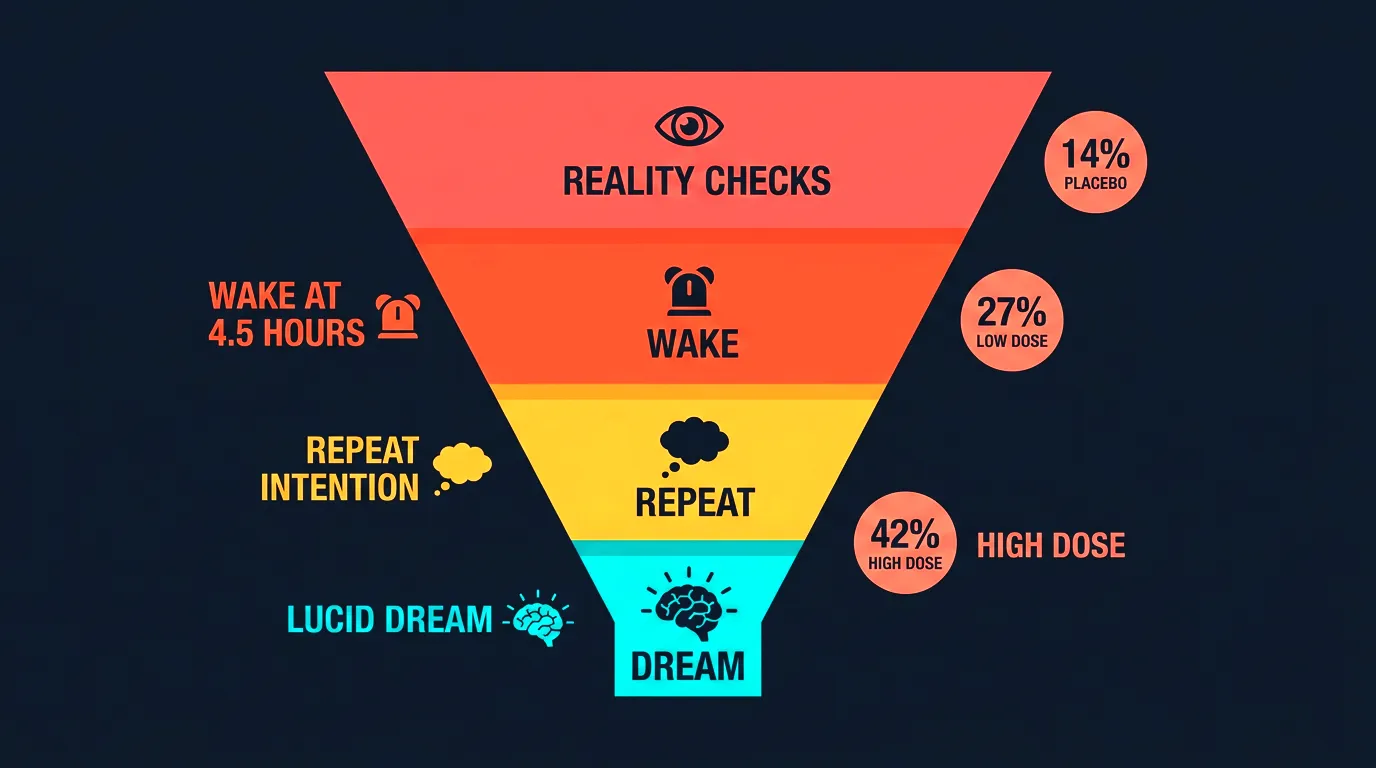
- Set an alarm for 4.5 hours after falling asleep. Wake up and recall any dream you were having.
- As you fall back asleep, repeat: “Next time I’m dreaming, I will remember I’m dreaming.”
- Visualize yourself becoming lucid in the dream you just recalled.
- Perform reality checks throughout the day. Look at your hands, read text twice, or try pushing a finger through your palm. These habits carry into dreams.
The Galantamine Boost
A 2018 double-blind, placebo-controlled study tested an unexpected ally: galantamine, an Alzheimer’s medication that boosts acetylcholine levels.[9] Of 121 participants using the MILD technique combined with galantamine:
- 14% had lucid dreams on placebo
- 27% had lucid dreams on 4 mg galantamine
- 42% had lucid dreams on 8 mg galantamine
The drug also increased dream vividness, sensory detail, and complexity. Acetylcholine is a key neurotransmitter for REM sleep, and boosting its levels appears to push the sleeping brain toward the hybrid state that lucid dreaming requires.
Meditation
Long-term meditators show increased lucid dream frequency.[3] The connection makes sense. Both meditation and lucid dreaming require metacognitive awareness, the ability to observe your own mind from a step back. Tibetan dream yoga specifically targets this overlap, combining daytime mindfulness exercises with sleep-time awareness practices.
| Method | Success Rate | Time to Learn | Cost | Notes |
|---|---|---|---|---|
| MILD technique | 20-30% on any given night | 2-4 weeks | Free | Most studied method |
| MILD + galantamine | Up to 42% | Same night | Low | Requires medical guidance |
| Meditation practice | Gradual increase | Months to years | Free | Best for long-term practice |
| Commercial headsets | Variable | Immediate | High | Limited peer-reviewed evidence |
Recommended read: The Suggestible Brain by Amir Raz — explores how attention, suggestion, and altered states reshape your brain’s perception of reality.
The Future of Dream Science Is Already Here
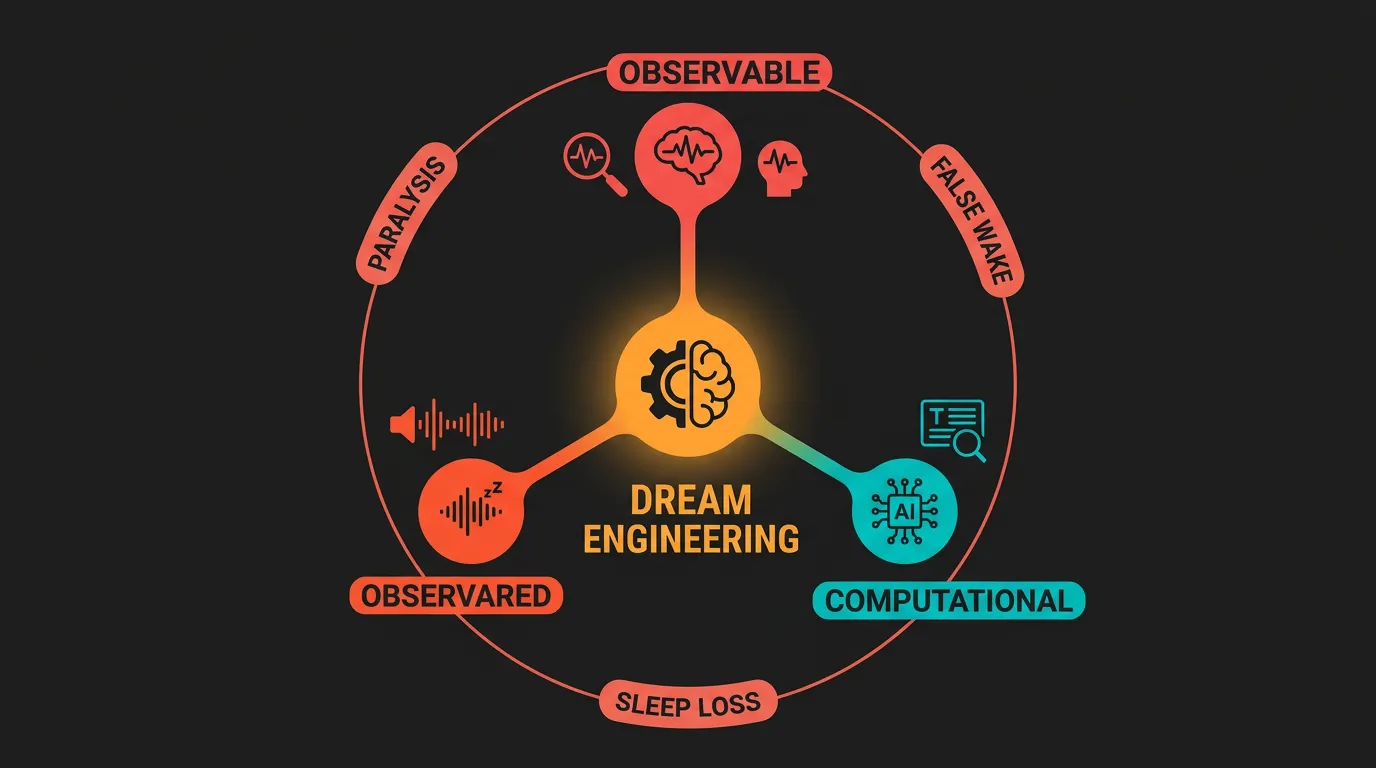
We’re living in the early days of what researchers call dream engineering. The ability to deliberately shape, guide, and interact with dreams while they happen.
A 2024 review outlined three new methodological frameworks reshaping the field:[10]
- Observable dreaming. Neural decoding and real-time reporting let scientists “see” dream content through brain activity patterns.
- Dream engineering. Targeted stimulation, auditory cues, and lucidity techniques allow researchers to guide dream content from outside.
- Computational dream analysis. AI and natural language processing analyze thousands of dream reports to find patterns invisible to the human eye.
The implications go far beyond the lab. Lucid dreaming is already being explored for boosting creativity, strengthening memory recall, and treating insomnia alongside nightmares.
The Risks Worth Knowing
Lucid dreaming isn’t for everyone. The potential downsides include:
- Sleep paralysis. Temporary inability to move when waking up. Harmless but frightening.
- False awakenings. Believing you’ve woken up when you’re still dreaming. Disorienting.
- Disrupted sleep quality. Induction techniques can fragment sleep if overused.
- Not recommended for people prone to delusions or hallucinations without medical guidance.
But for most people, the science is clear. Your sleeping brain is far more capable than anyone imagined a decade ago. It can solve problems, communicate with the outside world, process trauma, and rehearse skills. The question isn’t whether dream science will change psychology. It’s how fast.
Sources
Your Brain Has a Secret Chat Mode
1. Real-time dialogue between experimenters and dreamers during REM sleep (Current Biology, 2021)
What Happens in Your Brain When You Go Lucid
3. The Fascinating Neuroscience of Lucid Dreaming (BrainFacts.org, 2025)
From Nightmares to Breakthroughs, What Lucid Dreams Can Do
5. The clinical neuroscience of lucid dreaming (Neuroscience and Biobehavioral Reviews, 2025)
How to Train Your Brain to Dream Lucidly
The Future of Dream Science Is Already Here
10. New strategies for the cognitive science of dreaming (PMC, 2024)