In 2003, NBC news anchor Brian Williams was in Iraq. A military helicopter in a convoy ahead of him took a direct hit from a rocket-propelled grenade. All three helicopters made emergency landings. Williams’s helicopter arrived about an hour later, and a sandstorm stranded everyone together for days.
Twelve years later, Williams told the story at a hockey game. But now HE was in the helicopter that got hit. He remembered the RPG. He remembered the fear. He remembered details that belonged to soldiers he had met afterward.
Was he lying? Maybe. But memory science suggests something stranger. His brain may have genuinely rewritten the event. It stitched his experience together with the soldiers’ stories until he could not tell the difference. Neuroscientist Charan Ranganath calls this kind of error “an imaginative reconstruction gone awry.”
Williams lost his anchor chair over it. But the science says his brain was doing exactly what all of our brains do. Just louder.
Your Brain Does Not Record Anything
Most people think memory works like a camera. You see something, your brain records it, and later you hit playback. A 2011 survey found that large portions of the public still believe memories are permanent and cannot be changed.
They are wrong. Not even close.
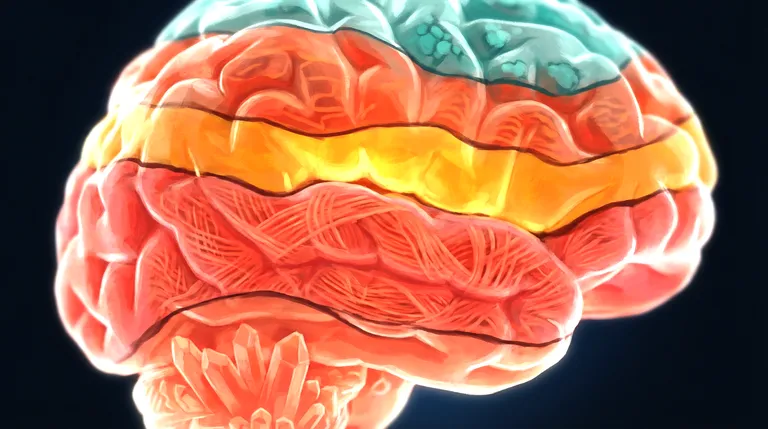
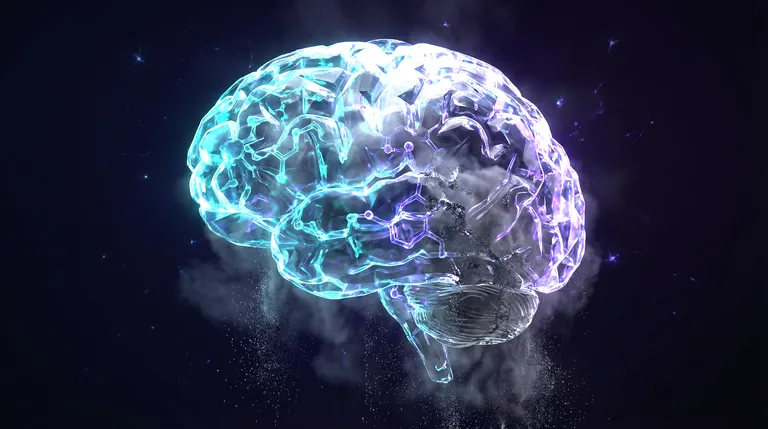
Reconstructive memory is what scientists call the real process. Every time you remember something, your brain rebuilds the memory from scratch. It pulls up a few fragments, fills in the gaps with your general knowledge and expectations, and assembles a story that feels complete.
Psychologist Frederic Bartlett proved this back in the 1930s. He had British students read a Native American folk story called “The War of the Ghosts.” When they retold it later, they did not just forget details. They changed them. Canoes became boats. Seal hunting became fishing. They rewrote the entire story to match their own cultural expectations.[1]
Here is how your brain actually handles a memory:
- Your hippocampus stores something like an index, not the memory itself
- When you remember, it points your brain toward scattered cell assemblies that were active during the original event
- Your brain uses schemas to stitch those fragments into a narrative
- Schemas capture what typically happens, not what actually happened
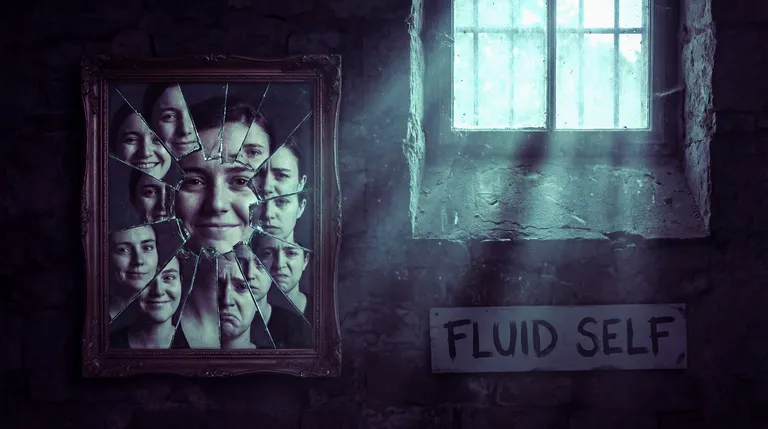
The result? A story that feels real but may be partly fiction. Your brain fills the gaps so smoothly that you never notice the seams. This is the same reconstructive machinery that makes glitches in your perception of reality feel so convincing.
“Remembering is not the re-excitation of innumerable fixed, lifeless and fragmentary traces. It is an imaginative reconstruction.” - Frederic Bartlett
Recommended read: Why We Remember by Charan Ranganath. A neuroscientist’s deep dive into why memory works the way it does and what that means for how we understand ourselves.
Your Brain Builds Memories That Never Happened
If memory is reconstruction, then sometimes that reconstruction goes completely off the rails. Scientists can implant false memories in perfectly healthy people. It is disturbingly easy. Research on hypnosis shows how vulnerable the process is: hypnotic suggestion alone can cause people to “remember” events that never occurred, with the same confidence and emotional detail as genuine memories.[10]
The Lost in the Mall Study
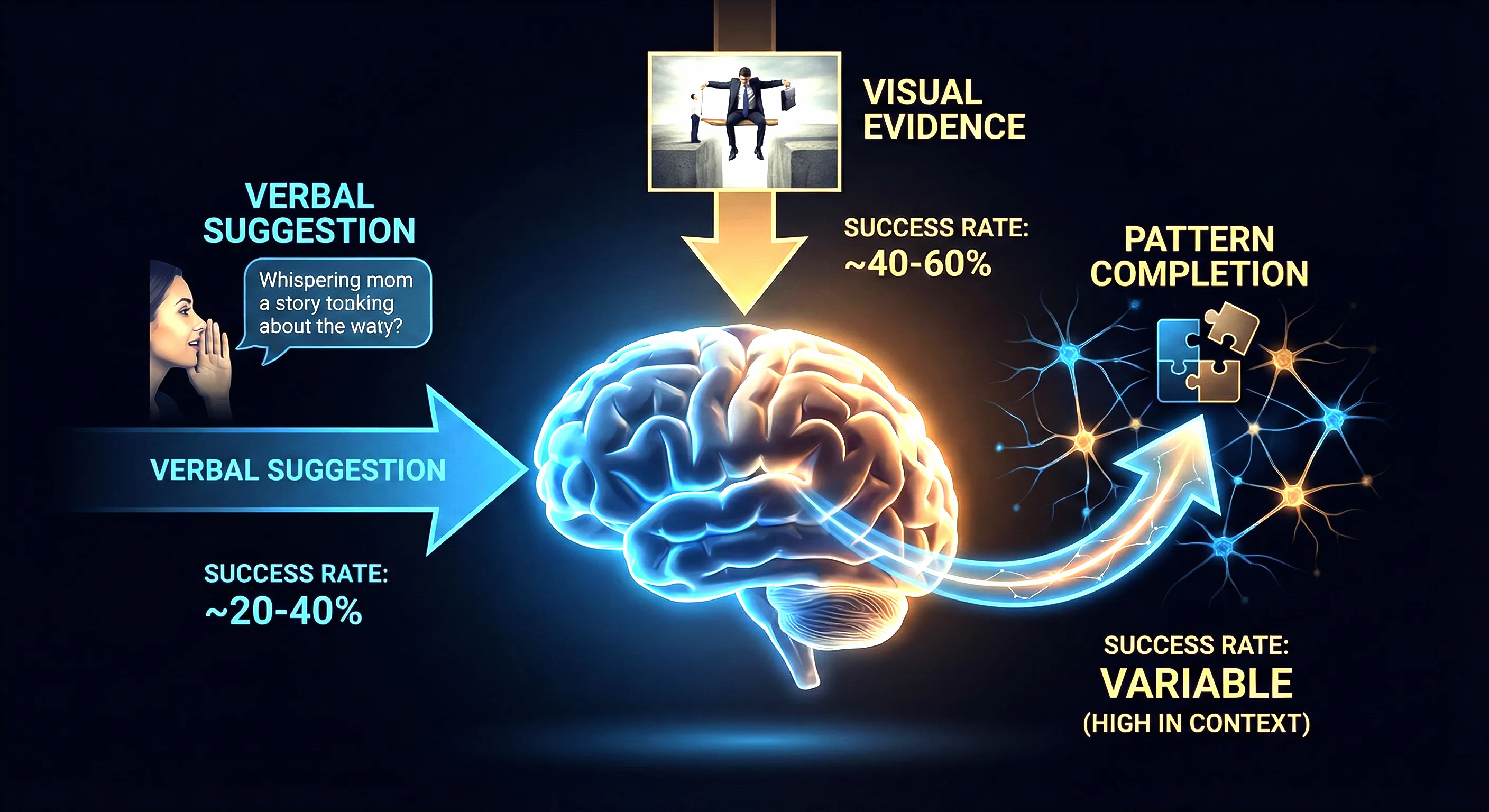
In the 1990s, Elizabeth Loftus had a simple idea. What if you told someone a made-up story about their childhood and presented it alongside real ones? She had family members tell participants about the time they got lost in a shopping mall as a child. It never happened.
The results were startling:
- 25% of participants developed partial or full memories of the fake event
- They added details that were not in the original story
- They described emotions they felt during the non-event
- Even when told it was false, some participants insisted the memory was real[2]
A later meta-analysis by Wade and Garry across 10 studies found a weighted mean of 37% of participants developing false memories through suggestive techniques. The number keeps climbing as researchers refine their methods.[3]
A Photograph Makes It Worse
Researcher Kimberly Wade took this further. She showed people doctored photographs of themselves in a hot air balloon. They had never taken a balloon ride.
By the third interview, 50% of participants claimed to remember details of the ride. One described the cost of the ticket, the height, and who else was there. All of it fabricated by their own brain, triggered by a single fake photo.[4]
A 2025 MIT Media Lab study extended this finding into the AI era. Researchers found that AI-edited images and videos could implant false memories and distort recollection just as powerfully as doctored photographs. The technology has scaled the problem.[9]
Your Brain Does This Without Any Help
You do not even need an outside prompt. Try this word list experiment from Roediger and McDermott. Read these words: FEAR, TEMPER, HATRED, FURY, HAPPY, ENRAGE, EMOTION, RAGE, HATE, MEAN, IRE, MAD, WRATH, CALM, FIGHT.
Now. Was the word ANGER on that list?
Most people say yes. It was not. Your brain noticed the pattern, generated the concept of “anger,” and filed it right alongside the real words. You did not just forget something. You remembered something that was never there.
| False Memory Method | Success Rate | Key Finding |
|---|---|---|
| Lost in the mall (verbal suggestion) | 25-37% developed false memories | Simple family testimony was enough |
| Doctored photographs | 50% developed false memories | Visual evidence dramatically increases vulnerability |
| DRM word list (no external prompt) | Equal to real word recall | Your brain generates false memories spontaneously |
| AI chatbot misinformation (2025 study) | Significant increase vs. control | Conversational AI can plant false memories |
A 2025 study by Pataranutaporn and colleagues, including Loftus herself, found something alarming for our digital age. AI chatbots that subtly inject misinformation into conversations significantly increase false memory formation. Misleading chatbots produced the strongest effect. This means the same vulnerability that makes you misremember a word list can be exploited by the technology you talk to every day.[5]
Recommended read: Memory Lane by Ciara Greene and Gillian Murphy. A fascinating look at why our memories are perfectly imperfect and what that means for everyday life.
Every Time You Remember, You Change the Memory
Neuroscientist Steve Ramirez puts it bluntly. “Whatever is remembered gets changed.”
This is not a metaphor. It is biology. When you pull up a memory, your hippocampus faces a problem. You are not in the same place or the same mental state as when the event happened. So it updates the memory to match your current context. And if that hippocampus was shaped by childhood trauma that physically rewired your brain, the distortions can be even more severe.
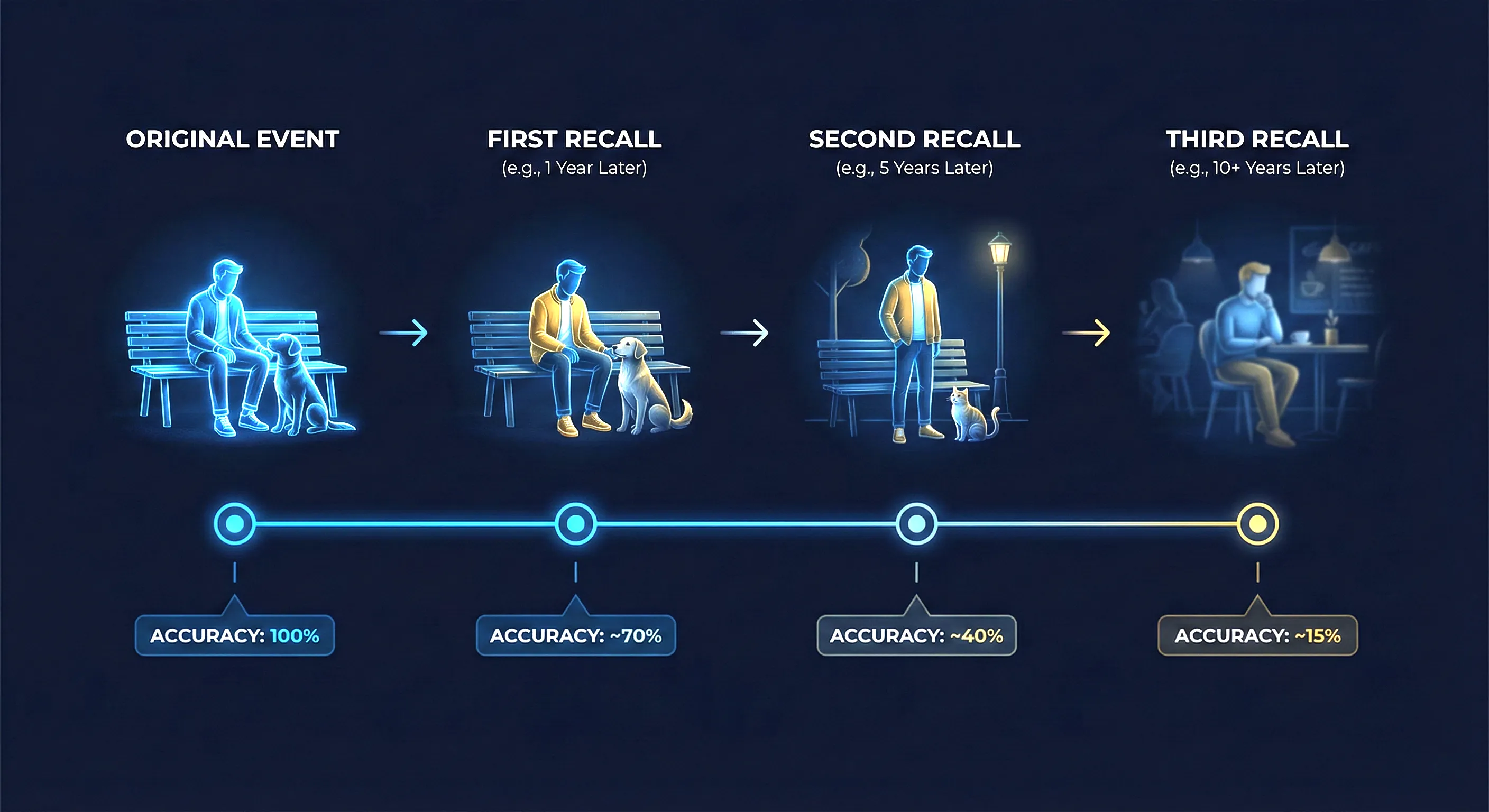
Computer simulations by Ranganath’s team show how this works:
- The first time you recall an event, it is mostly accurate
- Each recall incorporates a little of your current state
- Over many retellings, the memory accumulates updates
- Eventually, the story can drift far from reality
Your Ego Rewrites Your Past
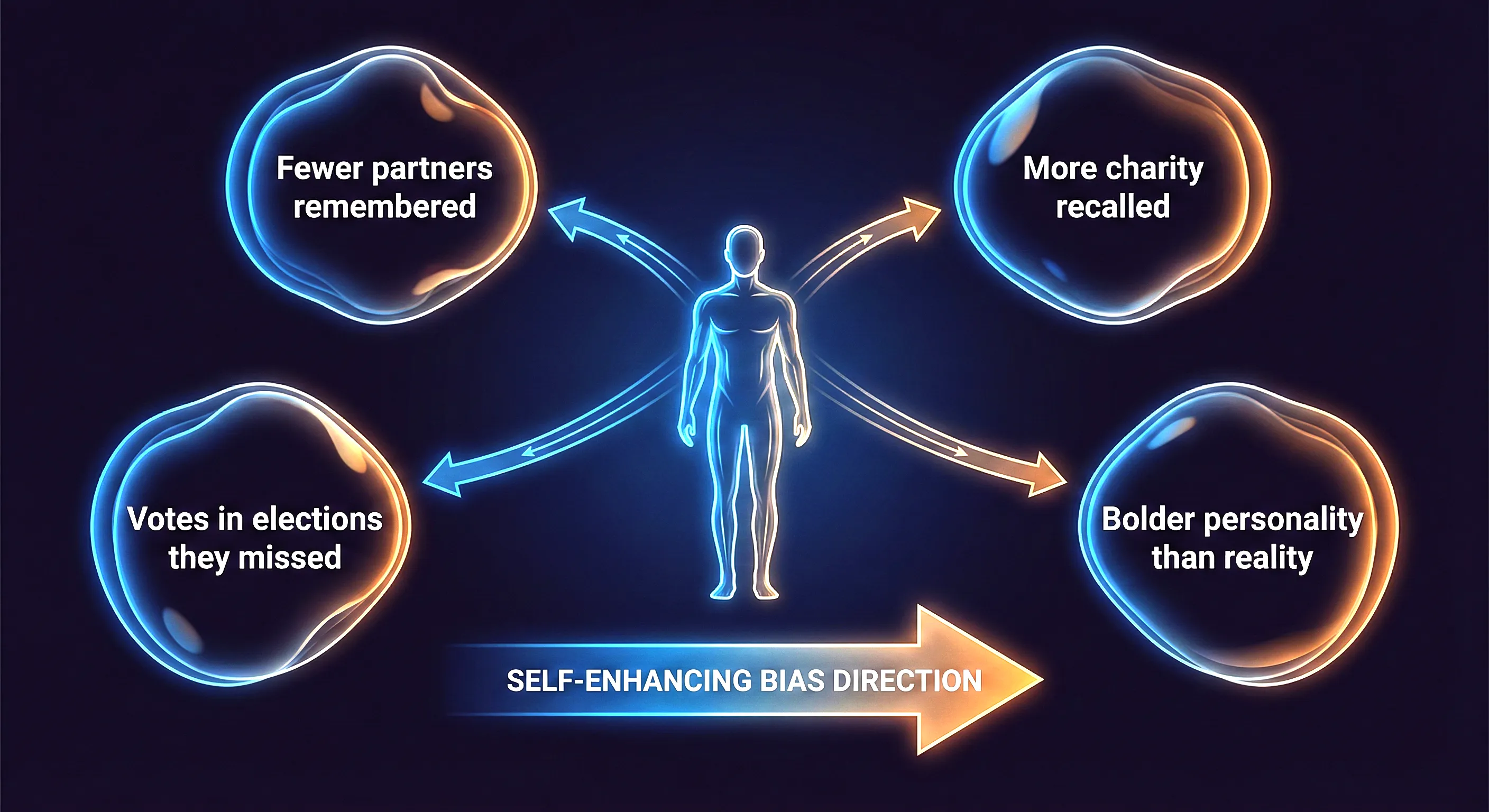
The most consistent direction of memory drift? It makes you look better.
Psychologists Carol Tavris and Elliot Aronson documented this pattern across dozens of studies. Your current self-concept acts like a filter, reshaping memories to match who you think you are now.
Psychiatrist Daniel Offer interviewed 73 teenage boys, then re-interviewed them 34 years later. Their ability to recall what they had said as teenagers was no better than chance.[6]
- Men who remembered themselves as bold, outgoing teens had actually described themselves as shy at age 14
- Nearly half remembered being sexually liberal as teenagers. Only 15% actually were
- People remember voting in elections they never voted in
- People remember giving more to charity than they really gave
- People remember using protection more often than they actually did
Your brain is not making random errors. It is protecting your self-image. This process is so gradual that it can be a genuine shock to encounter evidence of who you actually were. It is the same self-justification machinery that makes people refuse to change their political beliefs even when confronted with hard evidence.
“A few years back I found a diary that I wrote as a teen. It was filled with insecurity and anger. I was shocked to read that I had ever felt that way.” - Letter to Dear Amy advice column
Recommended read: Mistakes Were Made (But Not by Me) by Carol Tavris and Elliot Aronson. A brilliant look at how self-justification warps memory and decision-making without us noticing.
Nobody Is Immune, Not Even Memory Champions
Here is the part that should make you pause. People with Highly Superior Autobiographical Memory (HSAM) can recall what they ate for lunch on a random Tuesday seven years ago. They remember dates, events, and details that most of us lose within hours. Only about 100 people in the world have been identified with this ability.
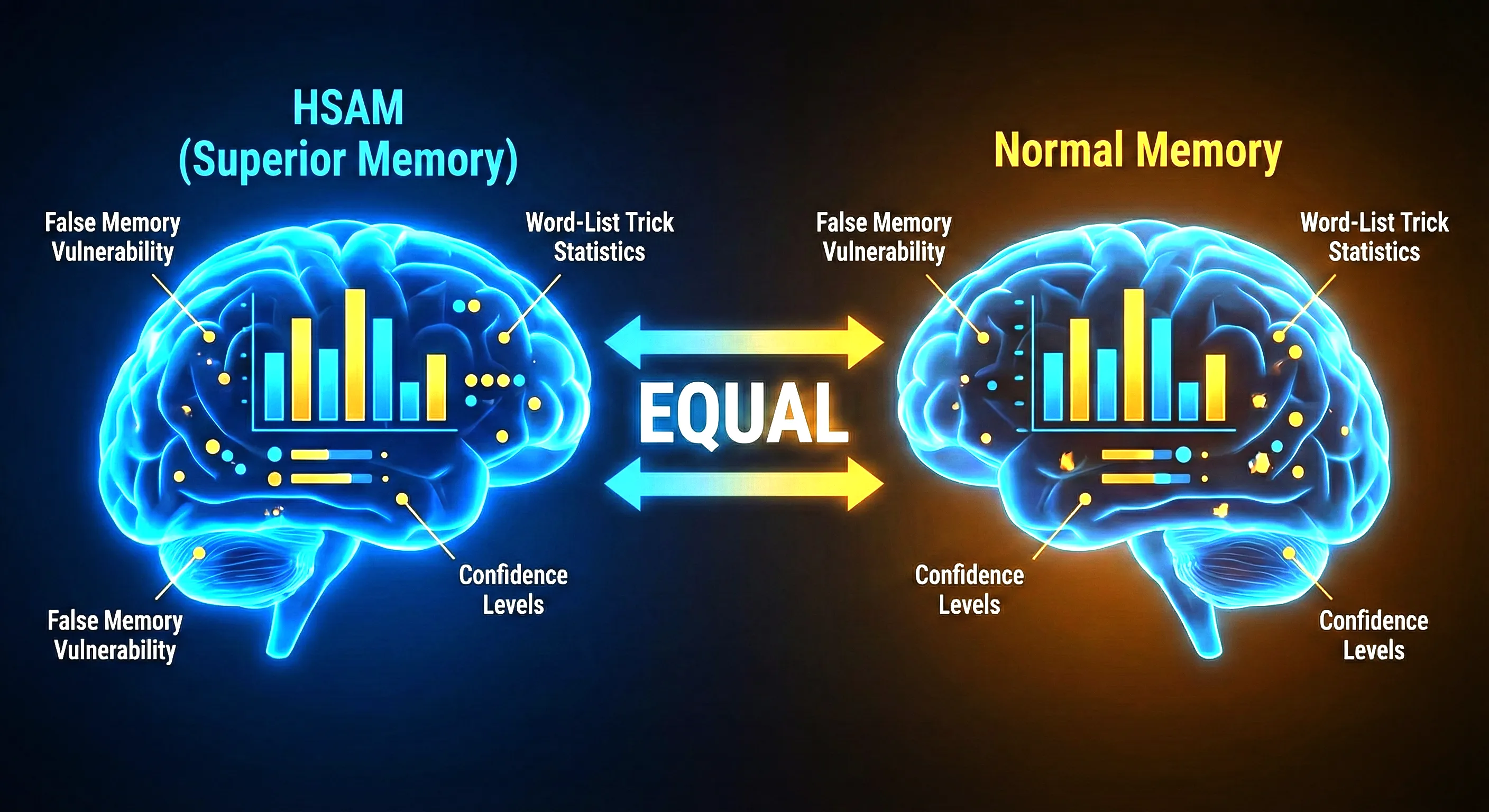
But when researchers at UC Irvine tested HSAM individuals for false memory susceptibility, the results were remarkable. These memory champions were just as vulnerable to false memories as everyone else.
The PNAS study found:
- HSAM individuals fell for the same word-list tricks as controls
- In misinformation tasks, HSAM participants actually showed higher overall false memory rates than controls
- They were equally likely to report seeing nonexistent news footage of a plane crash
- Their confidence in false memories was just as high as their confidence in true ones[7]
A 2024 systematic review confirmed these findings. HSAM individuals maintain and retrieve extraordinary amounts of autobiographical information. But they do not excel at encoding new information. Their superior recall appears to come from obsessive rehearsal and calendar pattern recognition, not from a fundamentally different memory system.[8]
This matters because it destroys the most common defense people use. “I remember it clearly, so it must be true.” Clarity, vividness, and confidence have almost nothing to do with accuracy.
| What You Think Means a Memory Is Real | What Research Actually Shows |
|---|---|
| “I remember it vividly” | False memories can be just as vivid as real ones |
| “I feel strongly about it” | Emotional intensity is equal for true and false memories |
| “I’m very confident” | Confidence does not correlate with accuracy |
| “I have great memory overall” | HSAM individuals are equally susceptible |
| “Multiple people remember it the same way” | Groups often converge on shared false memories |
The mechanisms that produce memory distortions are fundamental to how the human brain works. Having a better memory does not protect you. It just means you have more material for your brain to remix. And if the serotonin system your brain depends on for encoding memories is physically damaged by substances like MDMA, the problem compounds. These same cognitive biases sabotaging your decisions every day also warp what you remember about the past.
Recommended read: You Are Not So Smart by David McRaney. A witty tour of 48 ways your brain deceives you, including the many ways memory tricks you into false confidence.
How to Work With a Memory You Cannot Fully Trust
The researchers who study false memories do not want you to distrust everything you remember. As Greene and Murphy point out, “most of the time, our memory systems serve us very well.” The problem is not that memory is broken. It is that we expect it to work like a recording device when it is actually more like a painting.
Why Your Imperfect Memory Is Actually Useful
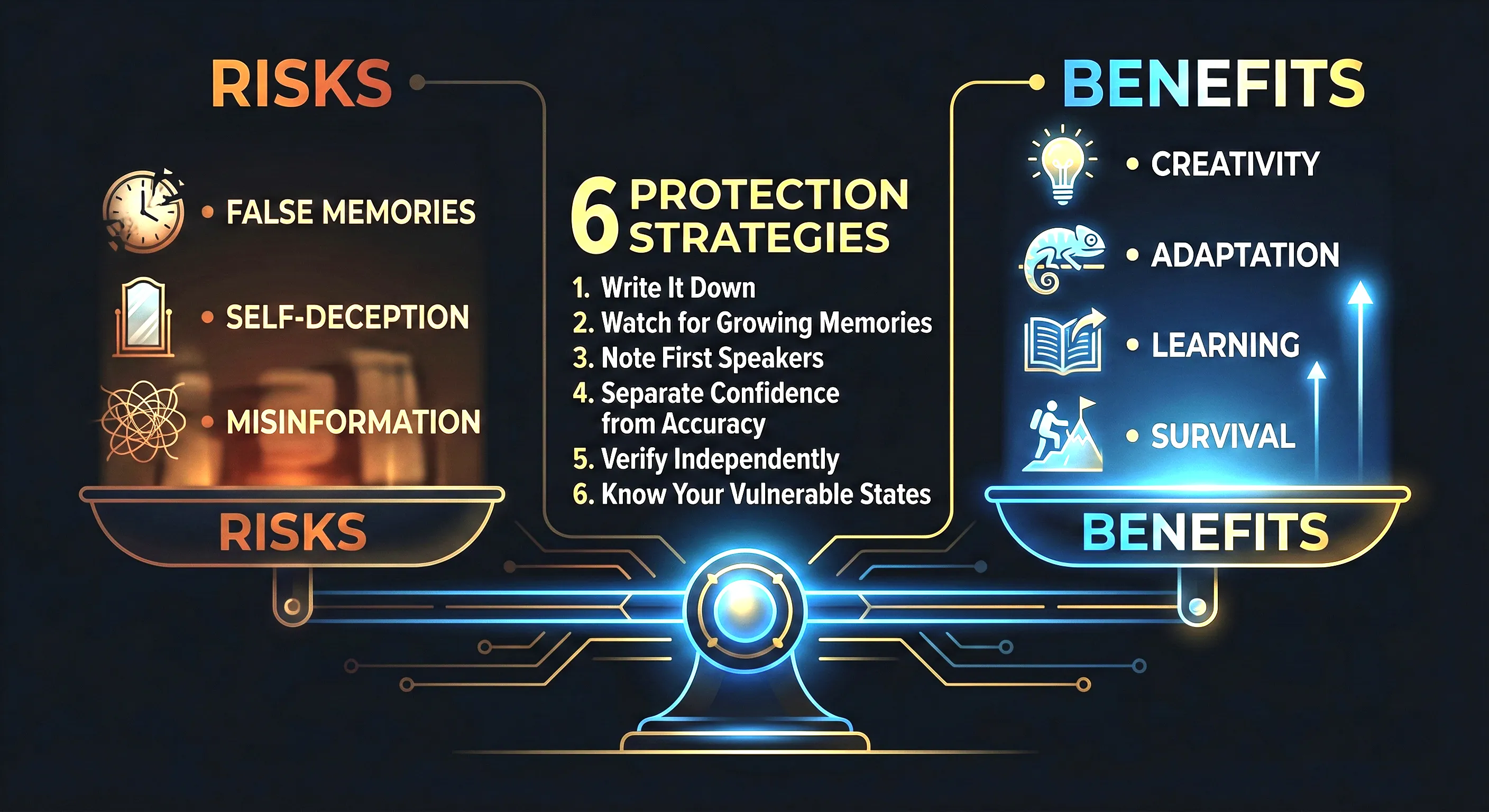
Your brain did not evolve to store perfect records. It evolved to help you survive. That means:
- Forgetting clears out irrelevant information so you can focus on what matters
- Updating keeps your memories aligned with your current reality
- Generalizing lets you apply lessons from one experience to new situations
- Creativity is directly linked to the same reconstructive process that creates false memories
Research has found that people who make more constructive memory errors also score higher on creative thinking tests. Your flexible memory is the same system that lets you imagine the future, solve novel problems, and recognize when your thinking is going sideways.
Practical Steps to Protect Your Memory
-
Write it down immediately. The closer to the event, the more accurate your record. Do not rely on memory for anything important.
-
Be skeptical of memories that grow. Real memories tend to lose detail over time. If a memory is getting MORE vivid and detailed with each retelling, that is a red flag.
-
Watch the first storyteller. Research shows that whoever speaks first about a shared event sets the anchor for everyone else’s memory. This is the same anchoring effect that influences your everyday decisions.
-
Separate confidence from accuracy. Just because you are certain does not mean you are right. This is the hardest habit to build, but the most important.
-
Seek independent verification. For anything that matters, check your memory against records, documents, or other evidence. As Loftus says, “We need independent corroboration.”
-
Be careful with AI conversations. The 2025 research on chatbot-induced false memories is a warning. If an AI tells you something happened differently than you remember, do not automatically update your memory. Verify first.
Your memory is not a flaw to fix. It is a tool to understand. Once you stop expecting it to be perfect, you can start working with it instead of being fooled by it.
Sources
Your Brain Does Not Record Anything
1. Remembering: A Study in Experimental and Social Psychology (Cambridge University Press, 1932)
Your Brain Builds Memories That Never Happened
2. The Formation of False Memories (Psychiatric Annals, 1995)
Every Time You Remember, You Change the Memory
6. Accuracy of Adult Memories of Childhood Is No Greater Than Chance (ScienceDaily, 2000)
Nobody Is Immune, Not Even Memory Champions
7. False Memories in Highly Superior Autobiographical Memory Individuals (PNAS, 2013)
8. Highly Superior Autobiographical Memory: A Systematic Review (PMC, 2024)