
Your brain has been shrinking since your 30s. Every year, it loses a little more volume. Processing speed drops. Names slip away. Multitasking gets harder.
And yet something strange happens as people get older. They get happier.
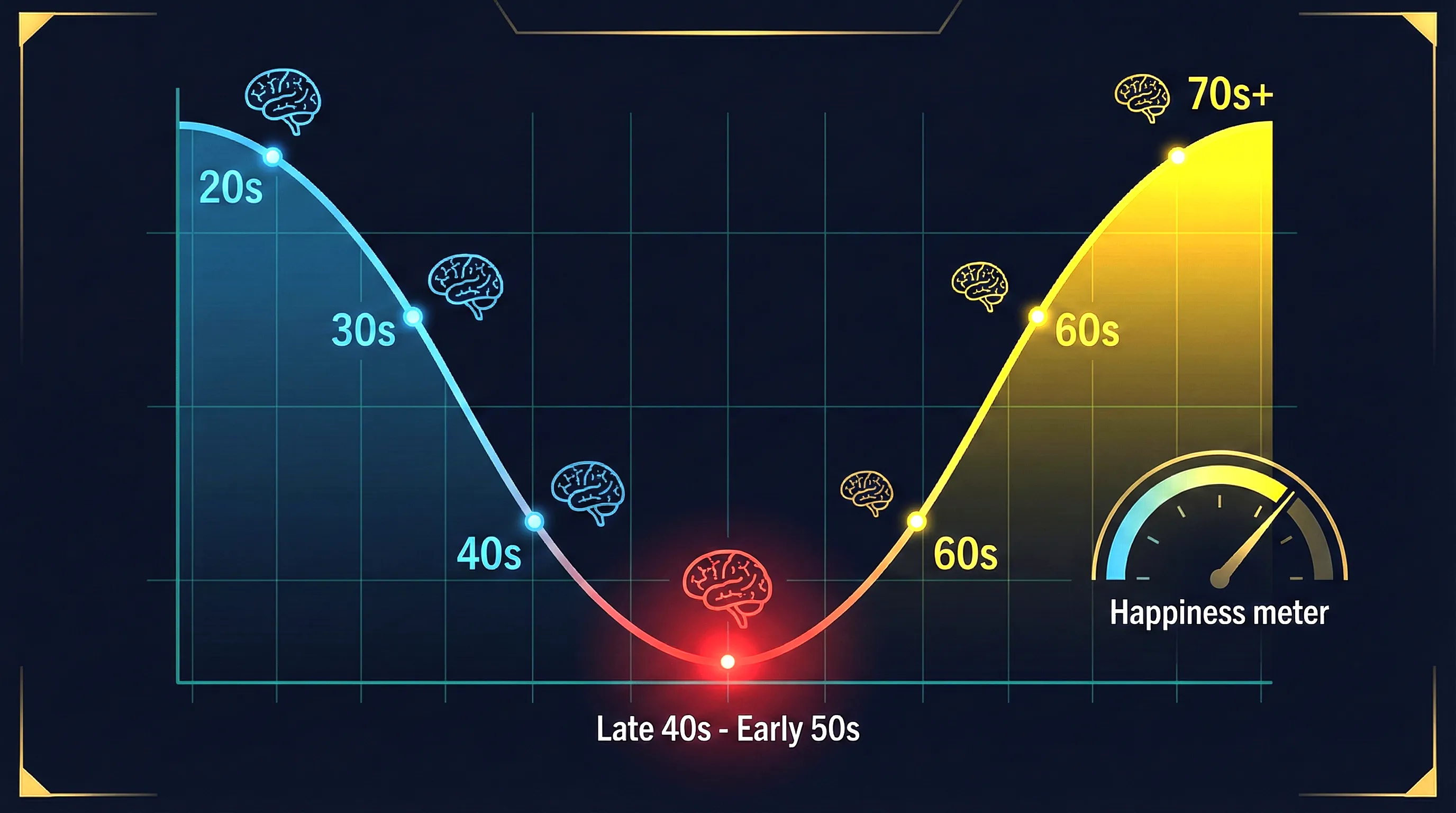
This isn’t wishful thinking. A landmark study of over 500,000 people across dozens of countries found that happiness follows a U-shaped curve.[1] It dips through your 20s, bottoms out around your late 40s, and then climbs steadily into old age. By their 70s and 80s, most people report higher life satisfaction than they did in their youth.[11]
Your brain is physically declining. But your experience of life is actually improving.
The Happiness Paradox of Aging
Economists David Blanchflower and Andrew Oswald uncovered this pattern in 2008. Using data from 500,000 randomly sampled Americans and Europeans, they found that happiness reaches its minimum in the late 40s for women and early 50s for men.[1] After that low point, satisfaction rises.
A 1995 Fordham University study backed this up. Researchers found that 38% of adults aged 68 to 77 reported being “very happy.” Younger groups were significantly less likely to say the same.
This makes no sense on paper. Here’s what’s physically happening to your brain after 40:
- Brain volume starts shrinking, with the rate accelerating after 60
- Processing speed drops in a nearly linear decline from early adulthood
- Working memory weakens, making it harder to hold new information
- Dopamine and serotonin production decreases
- The prefrontal cortex, hippocampus, and cerebellum show the biggest structural losses
| What Declines With Age | What Stays or Improves |
|---|---|
| Processing speed | Vocabulary and word knowledge |
| Working memory | Emotional regulation |
| Ability to multitask | General knowledge |
| Name and number recall | Abstract reasoning |
| New information encoding | Social decision making |
So your hardware is getting worse. But your experience of life is getting better. The question is why.
“People think of old age as a time of loss. But there is so much that is gained.” - Laura Carstensen, Stanford psychologist
Why Older Brains Filter Out the Negative
Stanford psychologist Laura Carstensen spent decades studying what she calls the positivity effect.[2] It’s one of the most replicated findings in aging research. And it changes everything we think about getting older.
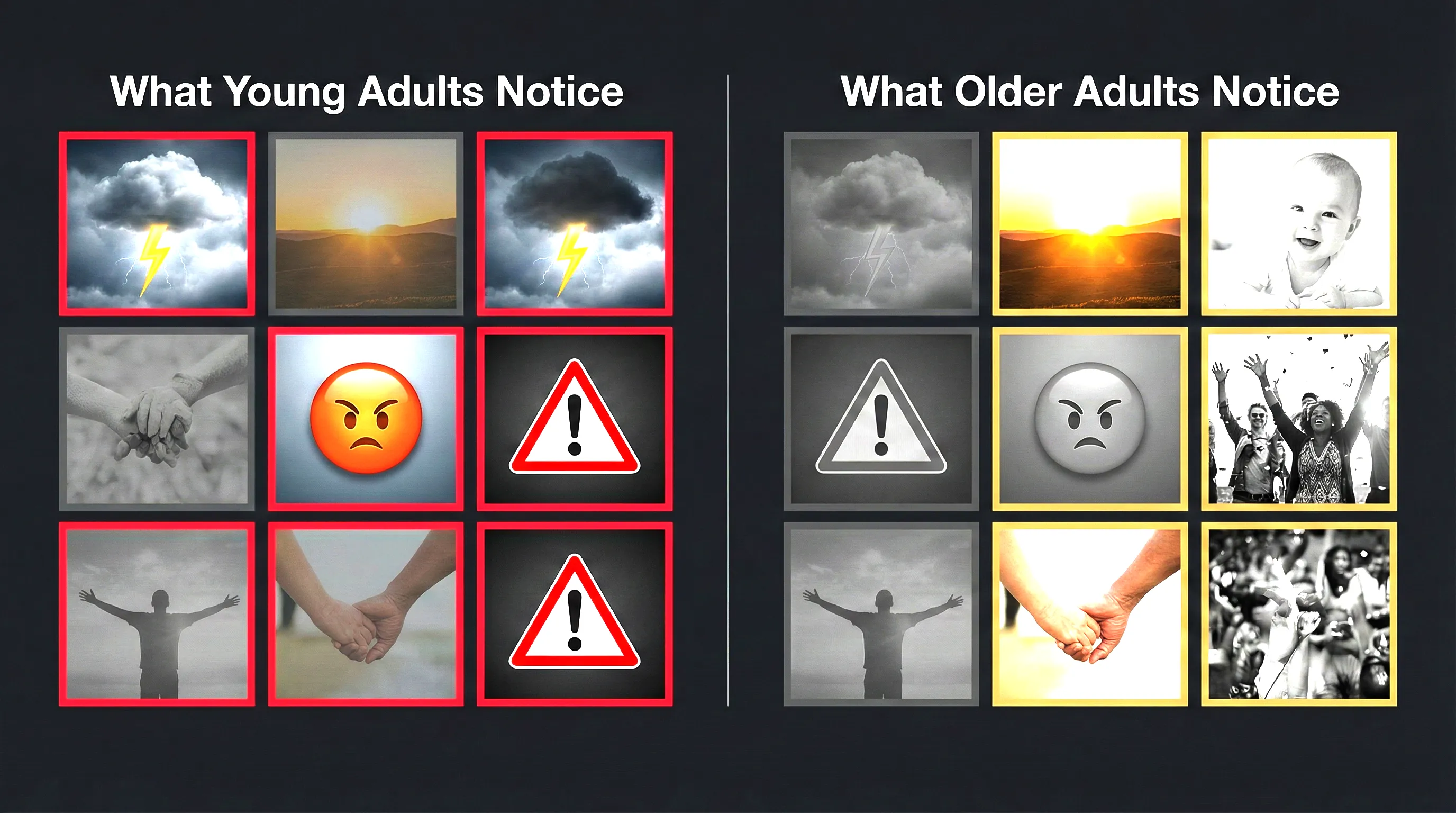
Here’s what happens. As people age, their brains shift attention toward positive information and away from negative information. Show a 25-year-old and a 70-year-old the same set of images. The younger person will fixate on threats and negative scenes. The older person will spend more time looking at babies, celebrations, and peaceful landscapes.
This isn’t just attention. It rewires memory too. Older adults’ memories are more likely to consist of positive information. They’re also more likely to be distorted in a positive direction. Your brain literally edits your past to make it sunnier.
The mechanism runs deep. Brain imaging studies by Mara Mather and colleagues found that the amygdala, your brain’s emotional alarm system, becomes less reactive to negative stimuli with age.[4] But it maintains or even increases its reactivity to positive information. Your brain isn’t going numb. It’s becoming selective.
Why Time Changes Everything
Carstensen’s explanation is elegant. She calls it socioemotional selectivity theory.[2] [3] When you’re young, time feels unlimited. You explore. You take risks. You prioritize learning and novelty.
But as you perceive time running short, your goals change. You stop chasing status and start chasing meaning. You drop draining friendships and invest in the relationships that actually make you feel something.
This doesn’t just apply to aging. Researchers found the same pattern in younger people facing serious illness or geographic relocation. Anyone who senses an ending shifts their priorities toward emotional fulfillment.
- Older adults maintain fewer but deeper relationships
- They spend less time with acquaintances and more with close family and friends
- They report less regret about past decisions
- They experience fewer negative emotions daily
The positivity effect isn’t a coping strategy. People don’t report trying to focus on the positive. It operates subconsciously, at the level of attention and memory. A meta-analysis of 100 empirical studies confirmed that the effect is reliable and increases in magnitude as people get older.[5]
Recommended read: Look Again by Tali Sharot and Cass Sunstein. Explores how habituation shapes attention and why seeing the world with fresh eyes matters at every age.
The Wisdom Your Brain Builds Over Time
Your brain loses speed. But it gains something harder to measure. Researchers now call it wisdom. And it’s not just a nice word for experience.
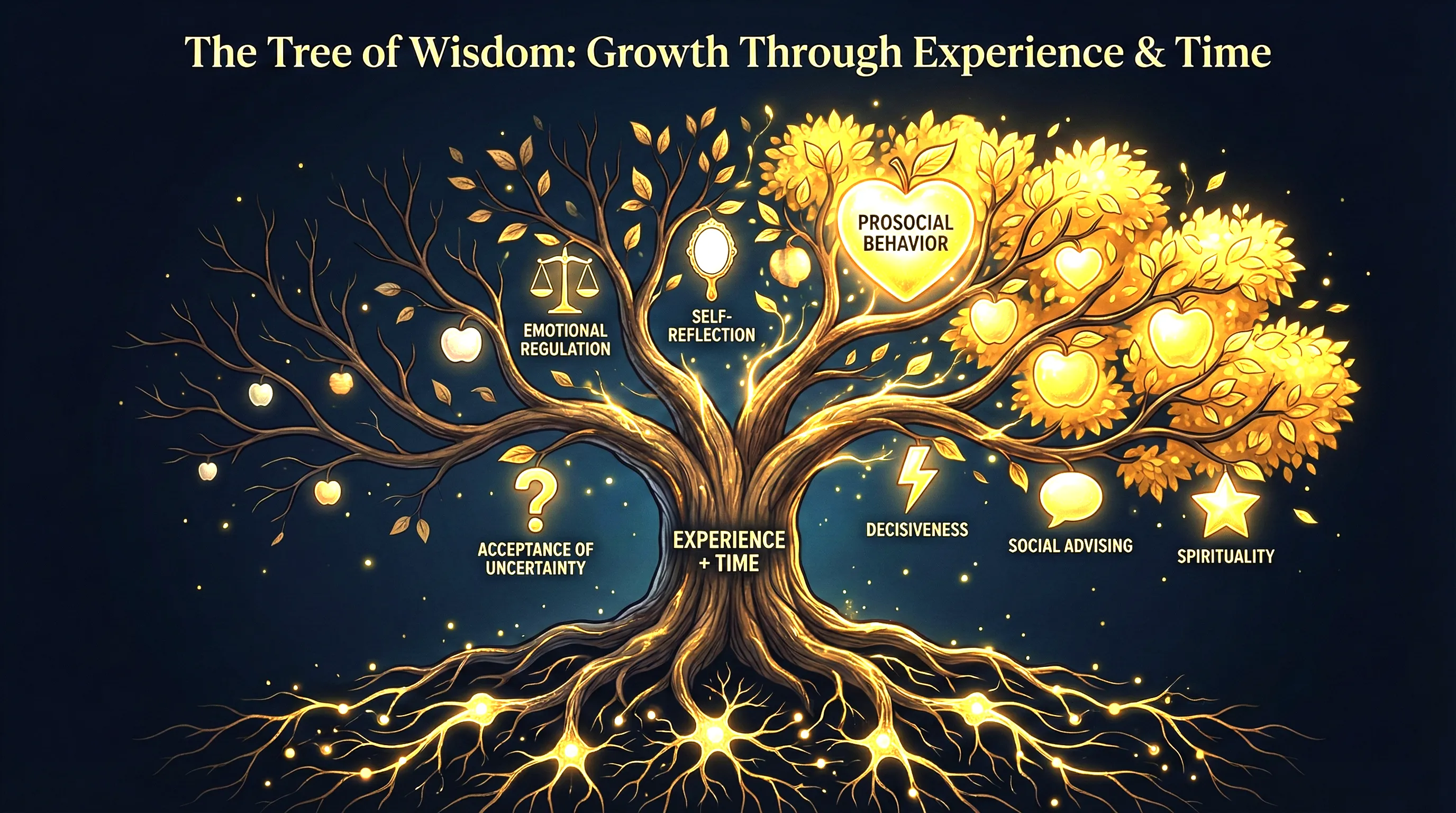
Psychiatrist Dilip Jeste at UC San Diego identified seven measurable components of wisdom:[6]
- Prosocial behavior. Empathy and compassion for others. This is the single most important component.
- Emotional regulation. The ability to manage your emotional responses.
- Self-reflection. Understanding your own thoughts and motivations.
- Acceptance of uncertainty. Comfort with not knowing.
- Decisiveness. The ability to act despite incomplete information.
- Social advising. Helping others navigate problems.
- Spirituality. A sense of connection to something larger.
Most of these components improve with age. The prefrontal cortex drives several wisdom subcomponents through top-down regulation of emotional and reward centers. And while it physically shrinks, the neural networks supporting these functions become more refined through decades of practice.
Crystallized vs. Fluid Intelligence
Psychologists split intelligence into two types. Fluid intelligence handles novel problem solving, pattern recognition, and working memory. It peaks in your 20s and declines steadily.
Crystallized intelligence stores everything you’ve learned. Vocabulary. General knowledge. Spatial perception. It keeps growing into your 60s and 70s.
This is why an older doctor might be slower to learn a new software system but better at diagnosing a rare condition. The raw speed is gone. But the accumulated pattern library is massive.
- Older adults have larger vocabularies and deeper word knowledge
- They show better judgment in social situations
- They’re less impulsive in decision making
- They recognize complex patterns that younger brains miss entirely
Recommended read: Hope for Cynics by Jamil Zaki. A compelling look at how prosocial behavior and trust, key components of wisdom, can be developed at any age.
How Your Brain Compensates for Its Own Decline
Your brain doesn’t just accept decline. It fights back. Neuroscientists have identified specific compensation mechanisms that older brains use to maintain function despite physical losses.
The most fascinating is called PASA, the Posterior-Anterior Shift in Aging.[7] As processing in the back of the brain weakens, the front of the brain picks up the slack. Your brain literally reroutes its operations.
This compensation isn’t subtle. Brain scans show older adults recruiting additional frontal regions during tasks that younger adults handle with posterior regions alone. It’s like your brain opening new lanes on a highway when the old ones get congested.
Super-Agers Prove What’s Possible
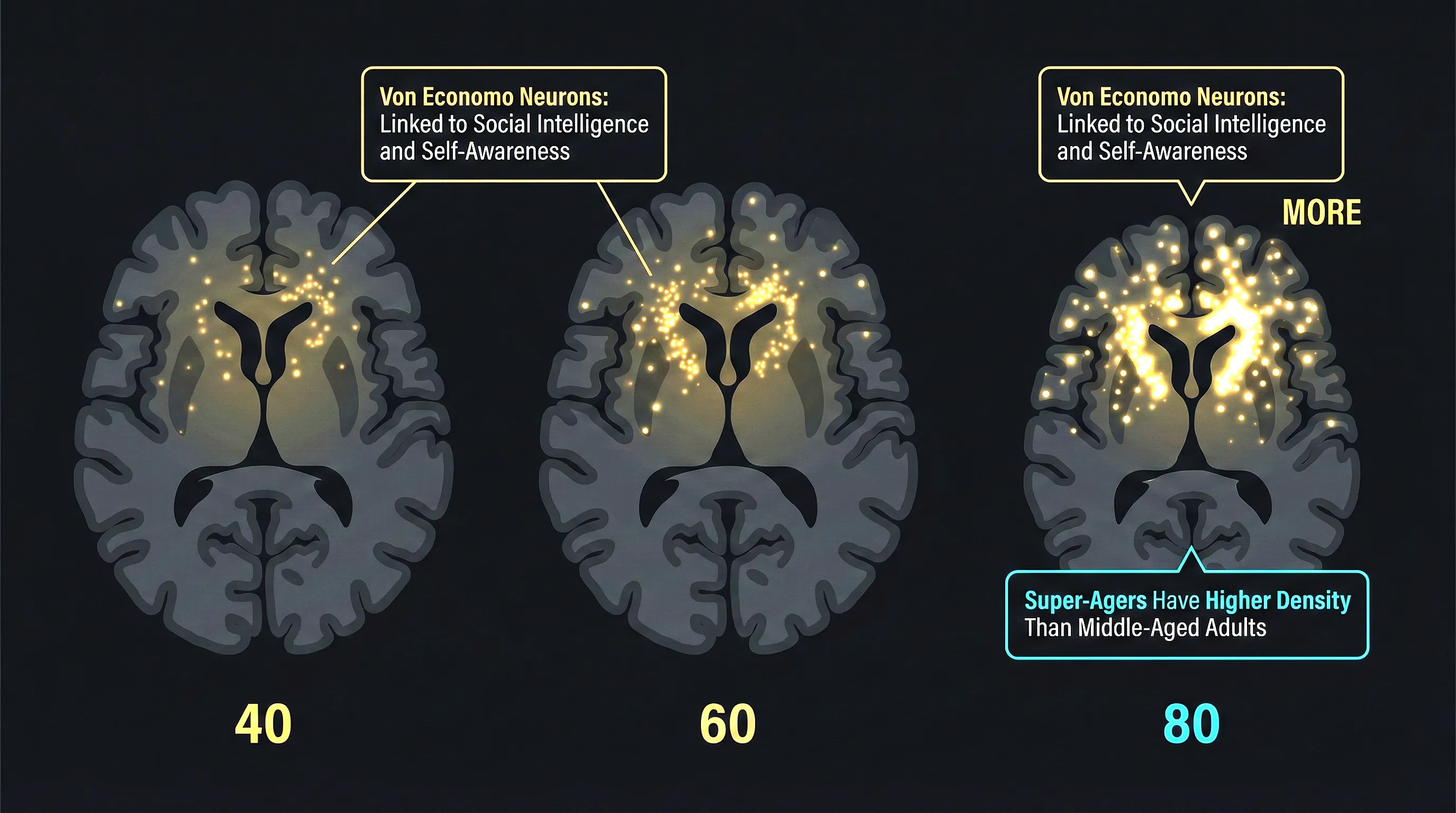
Then there are the cognitive super-agers. Researchers at Northwestern University define them as people aged 80 and older who perform on memory tests at levels comparable to people in their 50s.[8]
Their brains are different in specific, measurable ways:
- A region of the anterior cingulate cortex is significantly thicker than average. Even thicker than in middle-aged brains.
- They have a much higher density of von Economo neurons. These specialized cells are linked to social intelligence and self-awareness.
- Their brains shrink at roughly 1% per year, compared to 2.24% in typical older adults.
Northwestern’s SuperAging Program published updated findings in 2025 confirming that these biological advantages combine with behavioral traits.[8] Super-agers maintain strong social networks, stay physically active, and continue challenging themselves mentally.
The lesson isn’t that some people get lucky. It’s that the brain has far more capacity for resilience than we assumed. Even at 80, new neurons can form. A 2025 study found neurogenesis in adults as old as 78.
Recommended read: The Balanced Brain by Camilla Nord. A neuroscientist explains how brain health connects to happiness and well-being across the lifespan.
How to Help Your Aging Brain Thrive
The science is clear. Your brain will change as you age. But you have enormous influence over how it changes. And the research on what works has never been stronger.
A 2025 NIH study found that a cognitive speed training program was associated with a 25% lower rate of dementia diagnosis over decades of follow-up. Another study of over 2,100 people in their 60s and 70s showed that combining diet, exercise, and brain training improved cognitive abilities and slowed typical age-related decline.[10]
Here are the strategies with the strongest evidence:
- Move your body regularly. Aerobic exercise promotes neurogenesis and increases hippocampal blood flow. Even starting from zero makes a difference.
- Eat a Mediterranean-style diet. The MIND diet is associated with brains that appear 7.5 years younger.[9] Focus on vegetables, fish, healthy fats, and vitamin E.
- Stay socially connected. People with larger social networks show less mental decline. Loneliness physically accelerates brain aging.
- Challenge your brain. Learning new skills builds cognitive reserve. The novelty matters more than the difficulty.
- Manage your blood pressure. Keeping it under 130/80 mm Hg significantly lowers dementia risk.
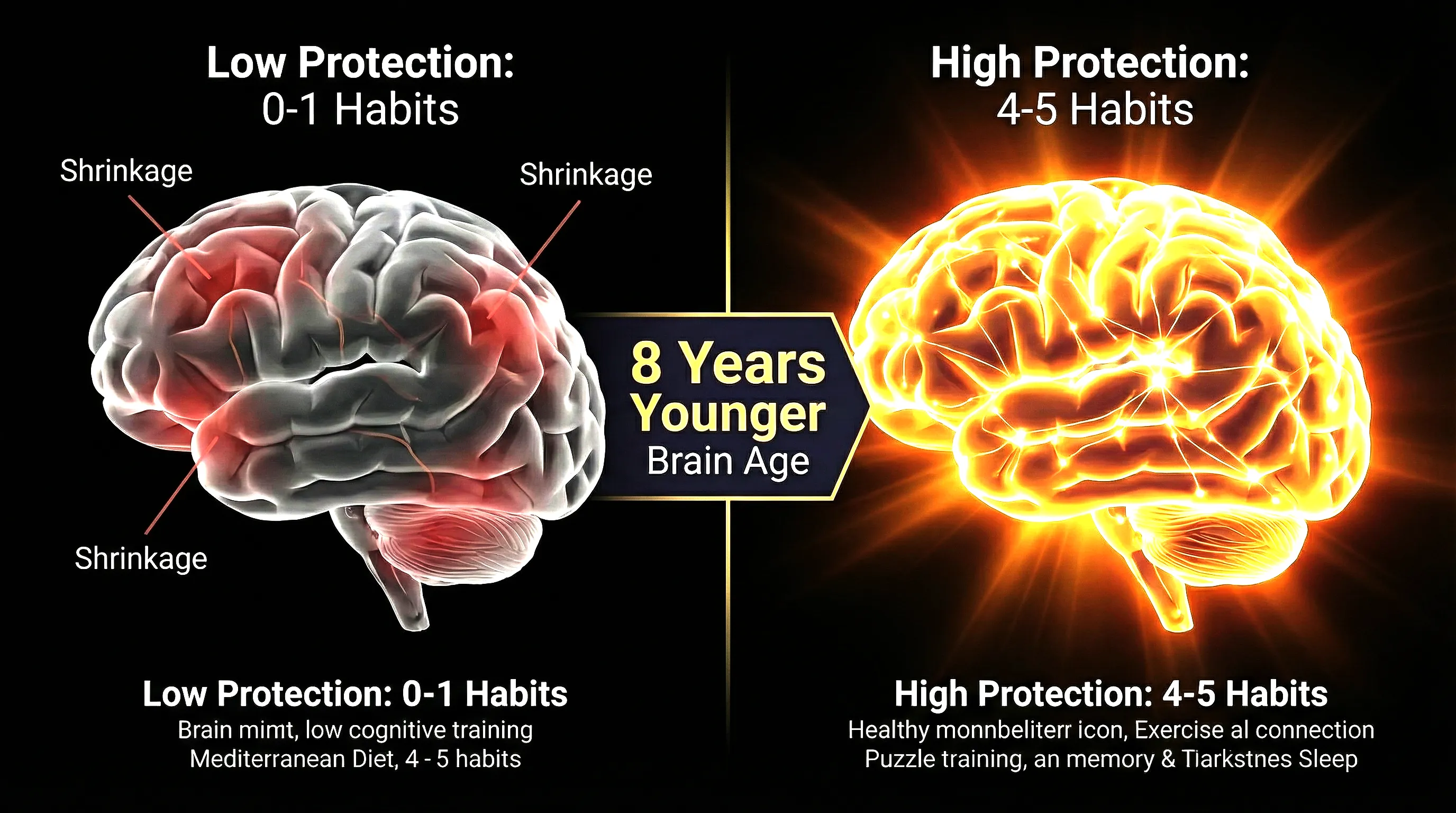
A 2025 University of Florida study found that participants who maintained the most protective habits had brains that looked eight years younger than their actual age.
| Strategy | Key Benefit | Evidence Strength |
|---|---|---|
| Aerobic exercise | Promotes new neuron growth | Very strong |
| Mediterranean/MIND diet | Brain appears 7.5 years younger | Strong |
| Social engagement | Buffers against cognitive decline | Strong |
| Cognitive speed training | 25% lower dementia risk | Strong |
| Blood pressure management | Reduces vascular damage to brain | Very strong |
The biggest takeaway is that no single intervention works alone. A combination of healthy habits and personality shifts produces the most powerful effects. People who maintained four or five protective behaviors had up to 60% lower risk of developing Alzheimer’s disease.
You can’t stop your brain from aging. But you can shape what kind of aging brain you end up with. And the science says the outcome can be far better than most people expect.
Recommended read: Rewire by Nicole Vignola. A practical guide to neuroplasticity that shows your brain can keep adapting well into old age.
Sources
The Happiness Paradox of Aging
1. Is Well-Being U-Shaped over the Life Cycle? (Social Science and Medicine, 2008)
Why Older Brains Filter Out the Negative
4. The Affective Neuroscience of Aging (Annual Review of Psychology, 2016)
5. Meta-Analysis of the Age-Related Positivity Effect (Psychology and Aging, 2014)
The Wisdom Your Brain Builds Over Time
How Your Brain Compensates for Its Own Decline
7. Que PASA? The Posterior-Anterior Shift in Aging (Cerebral Cortex, 2008)
How to Help Your Aging Brain Thrive
9. MIND Diet Slows Cognitive Decline with Aging (Alzheimer’s and Dementia, 2015)