
A guy walks into a bar wearing a wedding ring. He’s not married. He’s not even close to being in a relationship. But something strange happens. Women notice him more. They laugh at his jokes a little longer. They lean in a little closer.
This isn’t just a pickup artist myth. Psychologists have studied this exact scenario for over two decades. And the results might change how you think about attraction forever.
The Wedding Ring Effect Is Real
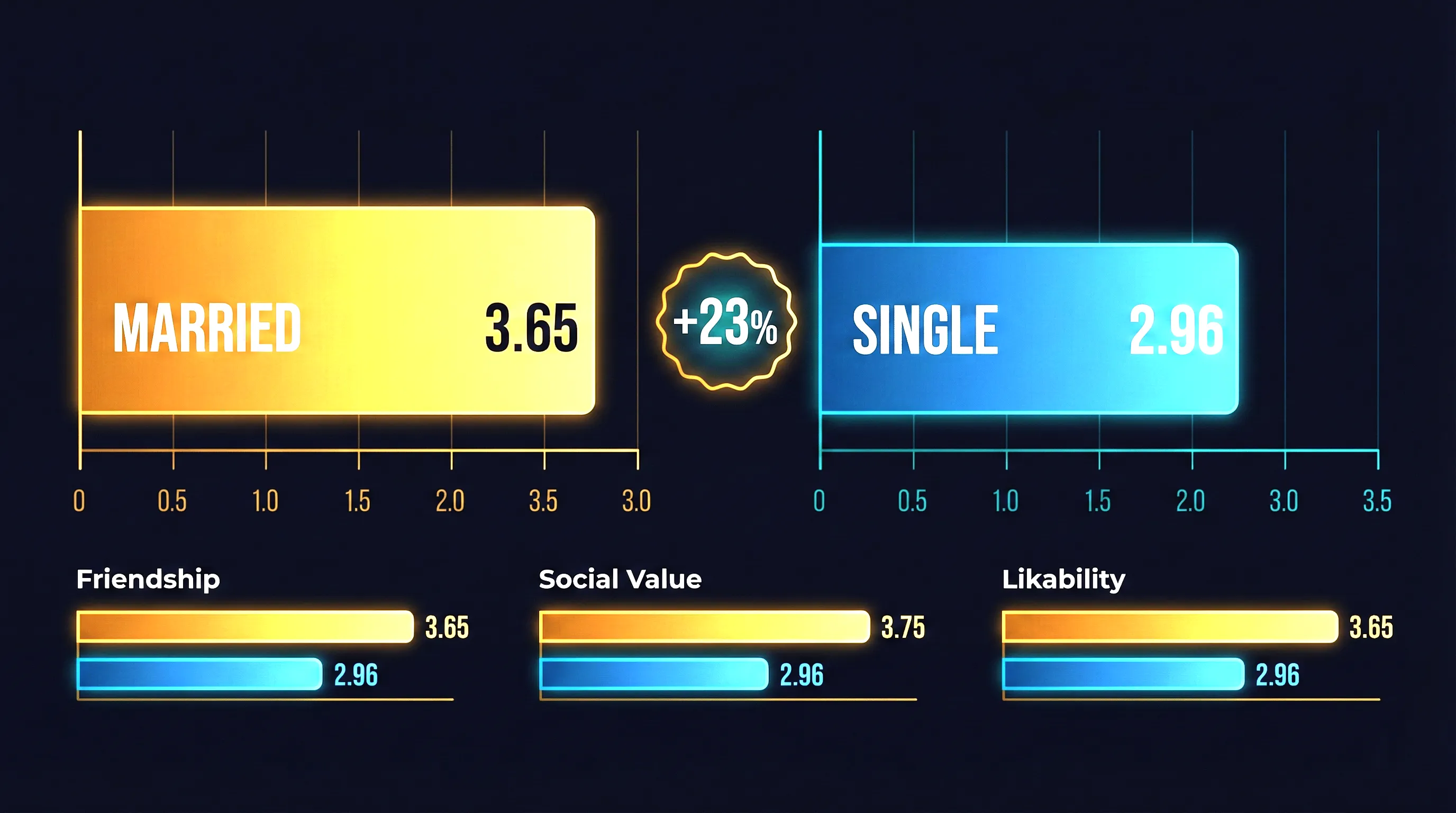
In 2006, researchers Eva and Wood ran a simple experiment. They showed 38 women photos of the same men. Half the time, the men were labeled “married.” The other half, they were labeled “single.”[1]
The results were striking. Married-labeled men scored 3.65 on attractiveness out of 7. Single-labeled men scored just 2.96. That’s a 23% jump from changing just one word on a label. The difference was statistically significant at p < 0.001. Not even close to random chance.[1]
But attractiveness wasn’t the only thing that shifted. Women also rated the “married” men higher on:
- Desirability as friends (4.86 vs 4.54)
- Perceived social value (consistent increase across measures)
- Overall likability (even when controlling for physical appearance)
The researchers called this the wedding ring effect. A simple gold band on the left hand changed everything about how women perceived these men. Not because the men looked different. They were the exact same photos. The only thing that changed was one word.[1]
“Males were rated as more attractive when labelled ‘married,’ thereby suggesting that human females are indeed sensitive to information provided by the choices of other females.” — Eva and Wood, 2006
Recommended read: Influence: The Psychology of Persuasion by Robert Cialdini — The classic book on social proof and why we follow the choices of others.
Mate-Choice Copying Is Your Brain’s Dating Shortcut
The wedding ring effect is actually part of something much bigger. Evolutionary psychologists call it mate-choice copying. It’s the idea that females copy the mate preferences of other females.
And humans aren’t the only ones who do it. Scientists first observed this in guppies. Female guppies strongly preferred males that other females had already chosen. The same pattern showed up in grouse, quail, and dozens of other species.[2] If one female picks a male, other females suddenly want him too.
Why Would Evolution Build This Into Our Brains?
Think about it from a survival perspective. Choosing a mate is one of the highest-stakes decisions any animal makes. Pick wrong and your genes might not survive.
Mate-choice copying solves a real problem. Evaluating a potential partner takes time and energy. You have to figure out if they’re healthy, reliable, and capable. But if another woman already picked this guy? She did the homework for you.
Psychologists David Buss and David Schmitt proposed the sexual strategies theory in the 1990s.[3] They argued that women evolved specific strategies to identify men willing to commit to long-term relationships. A wedding ring is the ultimate commitment signal. It says another woman evaluated this man and decided he was worth keeping.
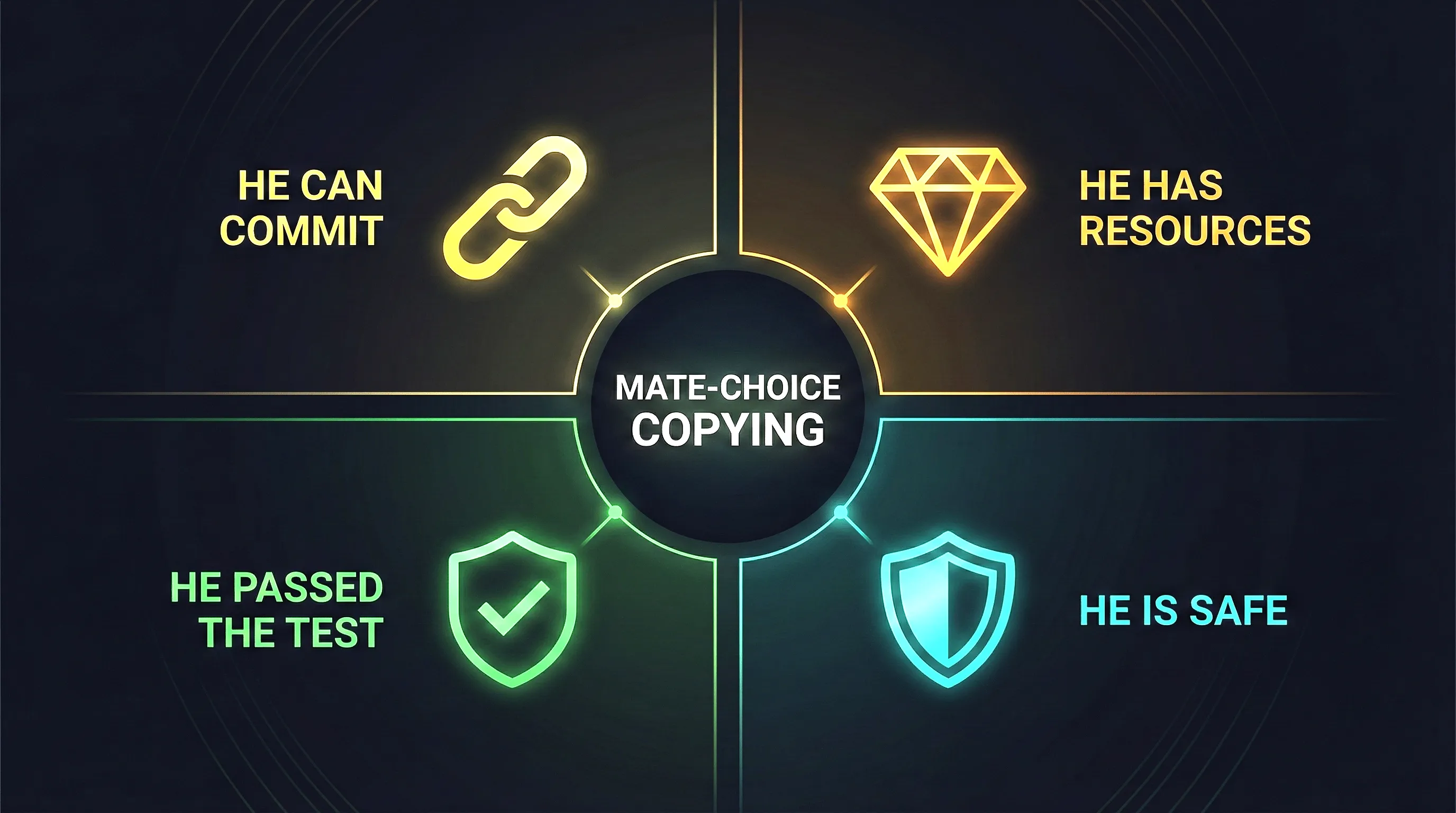
Here’s what mate-choice copying actually signals:
- He can commit. Someone already trusted him enough to say yes.
- He has resources. Marriage signals financial and emotional stability.
- He passed the test. Another woman screened him and approved.
- He’s not dangerous. Partnered men are perceived as safer and more predictable.
This isn’t a conscious calculation. Your brain processes these signals automatically. You don’t think “he’s married, so he must be a good provider.” You just feel a pull toward him that you can’t quite explain.
What the Studies Actually Found
Here’s where things get interesting. The research on the wedding ring effect is not as simple as “ring equals more attractive.” Different studies found very different results depending on how they tested it.
| Study | Method | Key Finding |
|---|---|---|
| Eva & Wood (2006)[1] | Photos with “married” or “single” labels | Married-labeled men rated 23% more attractive |
| Uller & Johansson (2003)[4] | Live interactions with/without rings | No significant difference in attractiveness |
| Deng & Zheng (2015)[5] | Photos with model women present | Coupled women increased ratings. Single women decreased them |
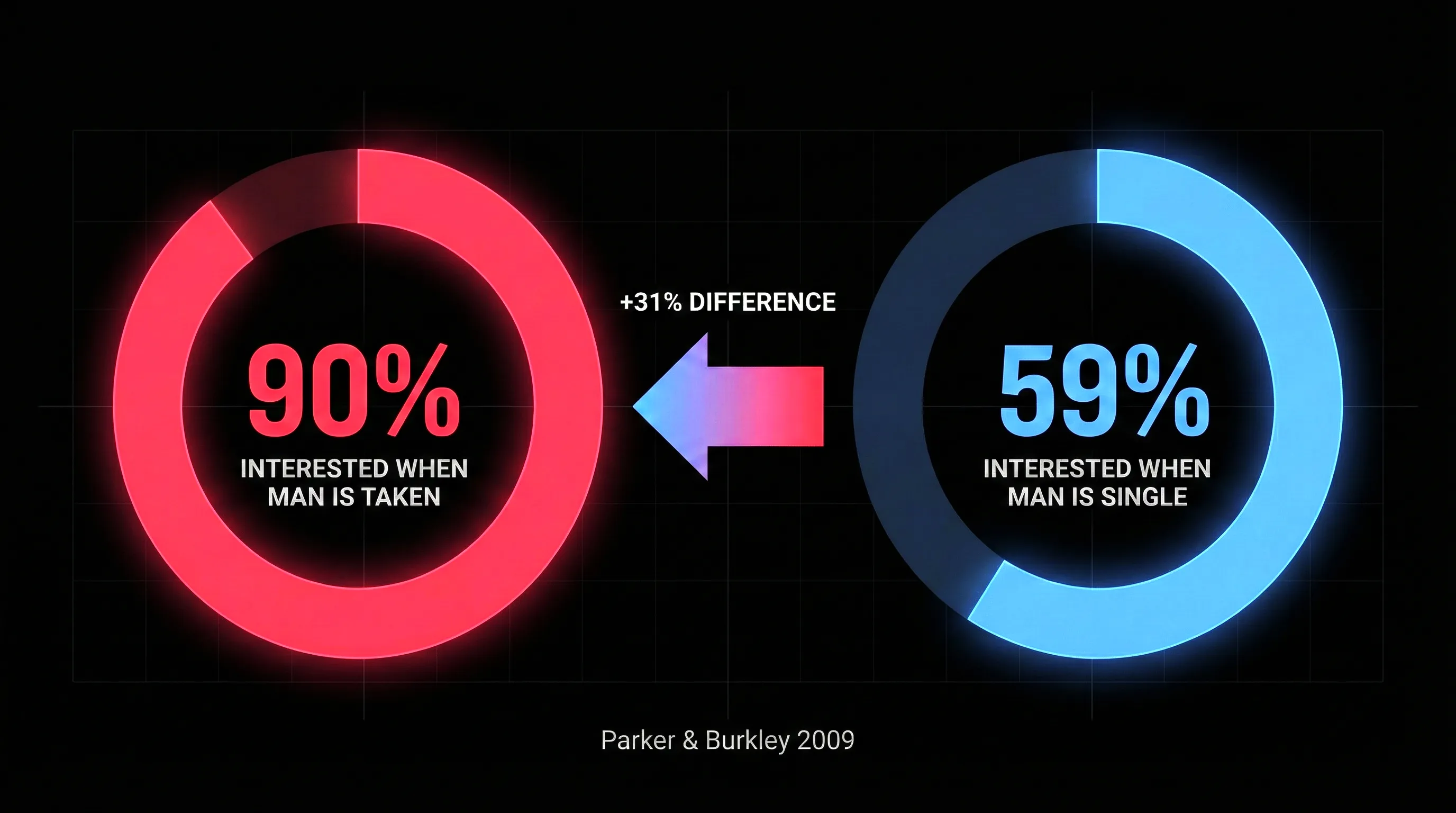
| Parker & Burkley (2009)[6] | Hypothetical dating scenarios | 90% of single women interested when man was taken vs 59% when single |
The Eva and Wood study used photos. Uller and Johansson used real live interactions. That difference matters a lot.
The Photo vs. Real Life Gap
When women see a photo of a man and learn he’s married, they rate him higher. But when they meet a man in person and notice a wedding ring? The effect mostly disappears. Uller and Johansson found women rated ringed and unringed men as equally desirable in face-to-face settings.[4]
Why the gap? In person, women have access to way more information. They can read body language, hear tone of voice, and pick up on dozens of micro-signals that photos can’t capture. The wedding ring becomes just one data point among hundreds.
The Single vs. Coupled Split
The 2015 study by Deng and Zheng added another twist.[5] They tested whether a woman’s own relationship status changed her response.
Coupled women increased their attractiveness ratings by 0.41 points when they saw a man paired with another woman. Single women actually decreased their ratings by 0.15 points.[5]
This flips the popular narrative. Single women, the ones who could actually pursue these men, found them less attractive when they saw competition. It was coupled women, the ones not actively looking, who found them more desirable. Intrasexual competition plays a key role here. A 2025 study found that androstadienone, a chemical signal, actually reduces mate-choice copying in women by moderating intrasexual competitive drives.[8] And a separate 2025 study showed that the financial status of both the model woman and the target man further shapes how strongly women copy each other’s mate preferences.[9]
Recommended read: Cues: Master the Secret Language of Charismatic Communication by Vanessa Van Edwards — Learn how subtle social signals shape attraction and first impressions.
The Forbidden Fruit and Scarcity Effect
Mate-choice copying isn’t the only psychological force at work here. Two other powerful effects make taken men seem more appealing.
Psychological Reactance
In the 1960s, psychologist Jack Brehm discovered psychological reactance.[7] When someone tells you that you can’t have something, your desire for it increases. Your brain rebels against the restriction. You want it more precisely because it’s off limits.
A wedding ring is a giant “not available” sign. And for some people, that restriction triggers a spike in desire. It’s the same reason teenagers want whatever their parents forbid. The Romeo and Juliet effect is a well-documented version of this. When parents disapprove of a relationship, the couple’s feelings actually intensify.
The Scarcity Principle
Robert Cialdini identified scarcity as one of the six core principles of influence. We assign more value to things that are rare or hard to get. A single man is available to anyone. A married man is scarce. And scarcity makes things feel more valuable.
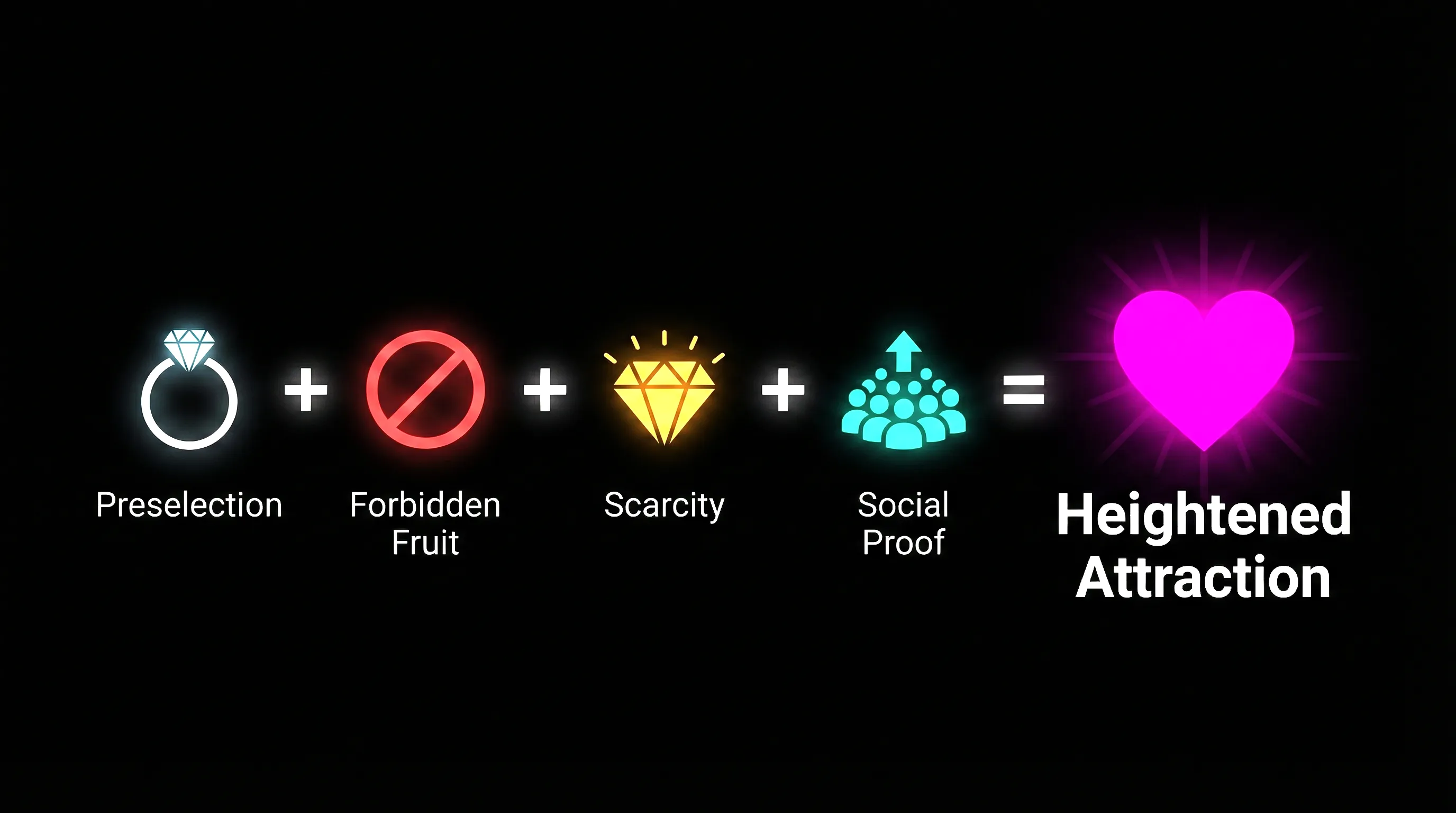
Here’s how these four forces combine to increase attraction:
- Mate-choice copying says: “He’s been pre-approved by another woman.”
- Reactance says: “You can’t have him, which makes you want him more.”
- Scarcity says: “He’s rare and valuable because he’s already taken.”
- Social proof says: “If she chose him, he must be worth choosing.”
All four psychological forces point in the same direction. They all make taken men seem more desirable than available ones. And they all operate below conscious awareness. You don’t decide to find married men attractive. Your brain does it for you.
“We want things we can’t have, or at least think we won’t be able to have if we don’t act quickly.” — Robert Cialdini
What This Really Tells Us About Attraction
So does this mean single guys should run out and buy wedding rings? Not exactly. The research tells a more complicated story than that.
It’s About Perceived Quality, Not Poaching
The wedding ring effect isn’t really about wanting someone else’s partner. It’s about using other people’s choices as information. When a man wears a ring, women unconsciously think: “Someone already vetted this person.” It’s a quality signal, not a poaching instinct.
This is the same reason restaurants with long lines seem better. Or why books with “bestseller” stickers sell more copies. We use social proof as a shortcut for quality everywhere in our lives.
The Effect Has Limits
Remember those studies. Photos showed the effect. Live interactions mostly didn’t. That means the wedding ring effect works best when women have limited information about a man. In real conversations, personality, humor, confidence, and actual compatibility quickly override the ring signal.
Here are the real takeaways from this research:
- Social proof matters in first impressions. Being seen with women or appearing “chosen” increases initial attraction.
- The effect fades with more information. Once someone gets to know you, the ring stops mattering.
- Single women aren’t the ones most affected. Coupled women show stronger mate-choice copying than single women.
- Commitment signals are powerful. Women value signs that a man can commit, whether that’s a ring or a stable relationship history.
- Context is everything. A ring on a dating app photo might help. A ring at a bar might just signal you’re genuinely unavailable.
The real lesson here isn’t about tricking anyone. It’s about understanding how deeply social proof shapes our choices. Your brain constantly scans the environment for clues about who is valuable, trustworthy, and worth your time. A wedding ring happens to be one of the most visible clues it can find.
Recommended read: The Like Switch: An Ex-FBI Agent’s Guide to Influencing, Attracting, and Winning People Over by Jack Schafer — Practical strategies for making yourself more attractive and likable using behavioral science.

Sources
The Wedding Ring Effect Is Real
1. Are All the Taken Men Good? An Indirect Examination of Mate-Choice Copying in Humans (CMAJ, 2006)
Mate-Choice Copying Is Your Brain’s Dating Shortcut
3. Sexual Strategies Theory: An Evolutionary Perspective on Human Mating (Psychological Review, 1993)
What the Studies Actually Found
4. Human Mate Choice and the Wedding Ring Effect (Human Nature, 2003)
5. Mate-Choice Copying in Single and Coupled Women (Evolutionary Psychology, 2015)
The Forbidden Fruit and Scarcity Effect
7. A Theory of Psychological Reactance (Academic Press, 1966)