
You just made a decision. Maybe it was what to eat for lunch. Maybe it was whether to click on this article. And your brain is totally convinced that you chose logically.
Here’s the thing. You almost certainly didn’t.
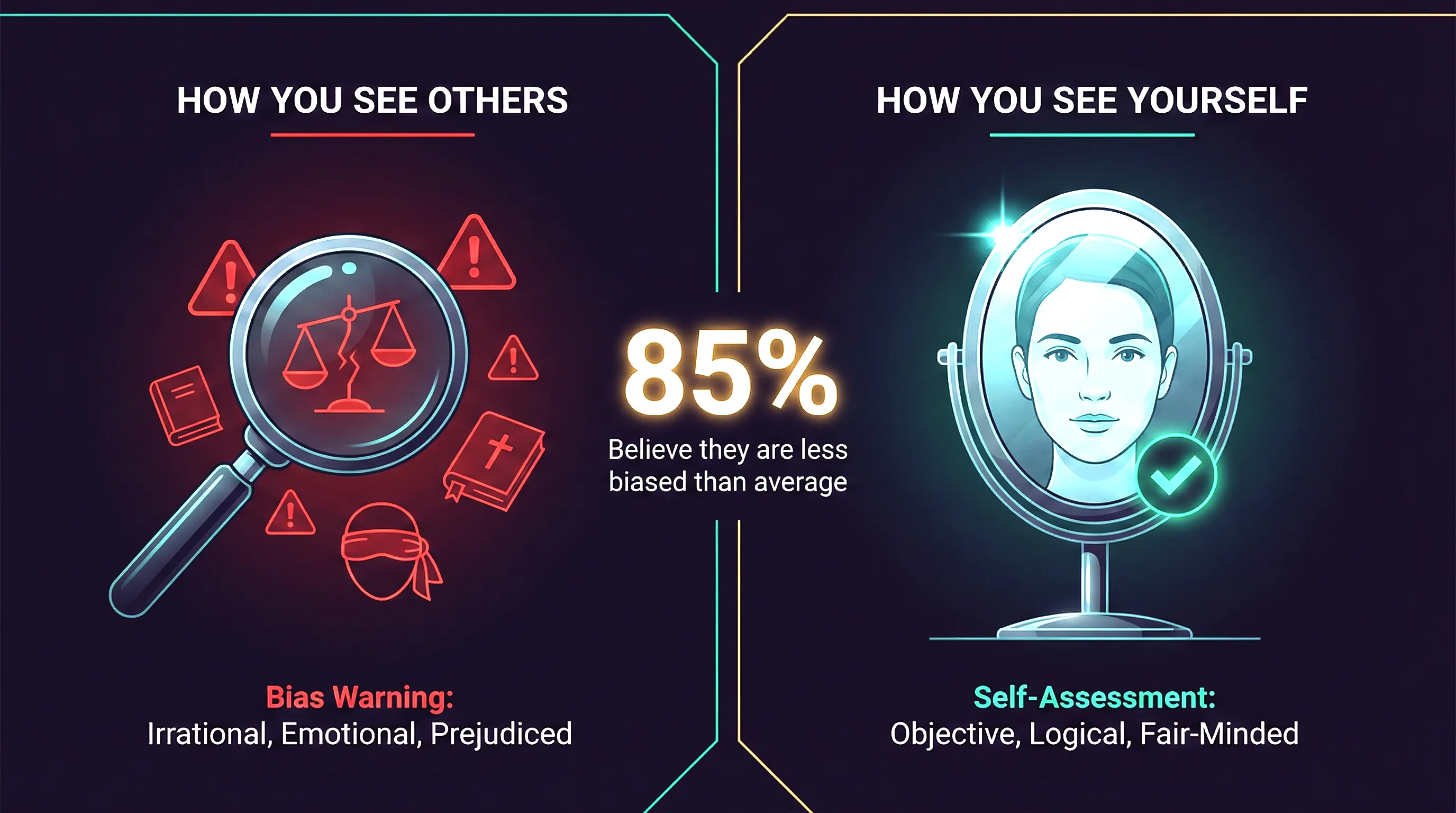
Over 85% of people believe they’re less biased than the average person, according to Princeton psychologist Emily Pronin.[1] Think about that for a second. Mathematically, most of those people are wrong. And the scariest part? The smarter you are, the better you become at convincing yourself your thinking is sound.
The Rationality Illusion, Why Your Brain Lies to You
Your brain has a built-in PR team. It spins every decision you make into a story that sounds reasonable. Psychologists call this the bias blind spot. It’s the tendency to see biases in everyone else while believing you’re immune.
Emily Pronin’s landmark 2002 study at Princeton revealed something uncomfortable. When participants were shown a list of common cognitive biases, they readily spotted these biases in others. But when asked about themselves? They claimed to be significantly less affected.
The Introspection Trap
Here’s why this happens. When you judge other people, you look at their behavior. When you judge yourself, you look inward at your thoughts and feelings. You search your mind for biased motives and don’t find any. So you conclude you must be objective.
But biases don’t announce themselves. They operate below conscious awareness. Your brain doesn’t send you a notification that says “Warning: cognitive bias detected.” It just quietly nudges your thinking in a direction that feels completely rational.
“People tend to think they see the world objectively. When others disagree, they assume those others must be the biased ones.” - Emily Pronin, Princeton University
This illusion runs deep. In Pronin’s follow-up research, even after participants learned about the bias blind spot, they still believed they were less susceptible to it than other people. Knowing about the trap doesn’t help you escape it.
- 85% of people think they’re less biased than average
- Learning about biases doesn’t automatically fix them
- The smarter you think you are, the more confident you become in your “rationality”
- Your brain treats its own biased conclusions as objective facts
Your Brain’s Shortcut Factory
Your brain processes roughly 11 million bits of information every second. But your conscious mind can only handle about 50 bits per second. That’s a massive gap. So your brain takes shortcuts.
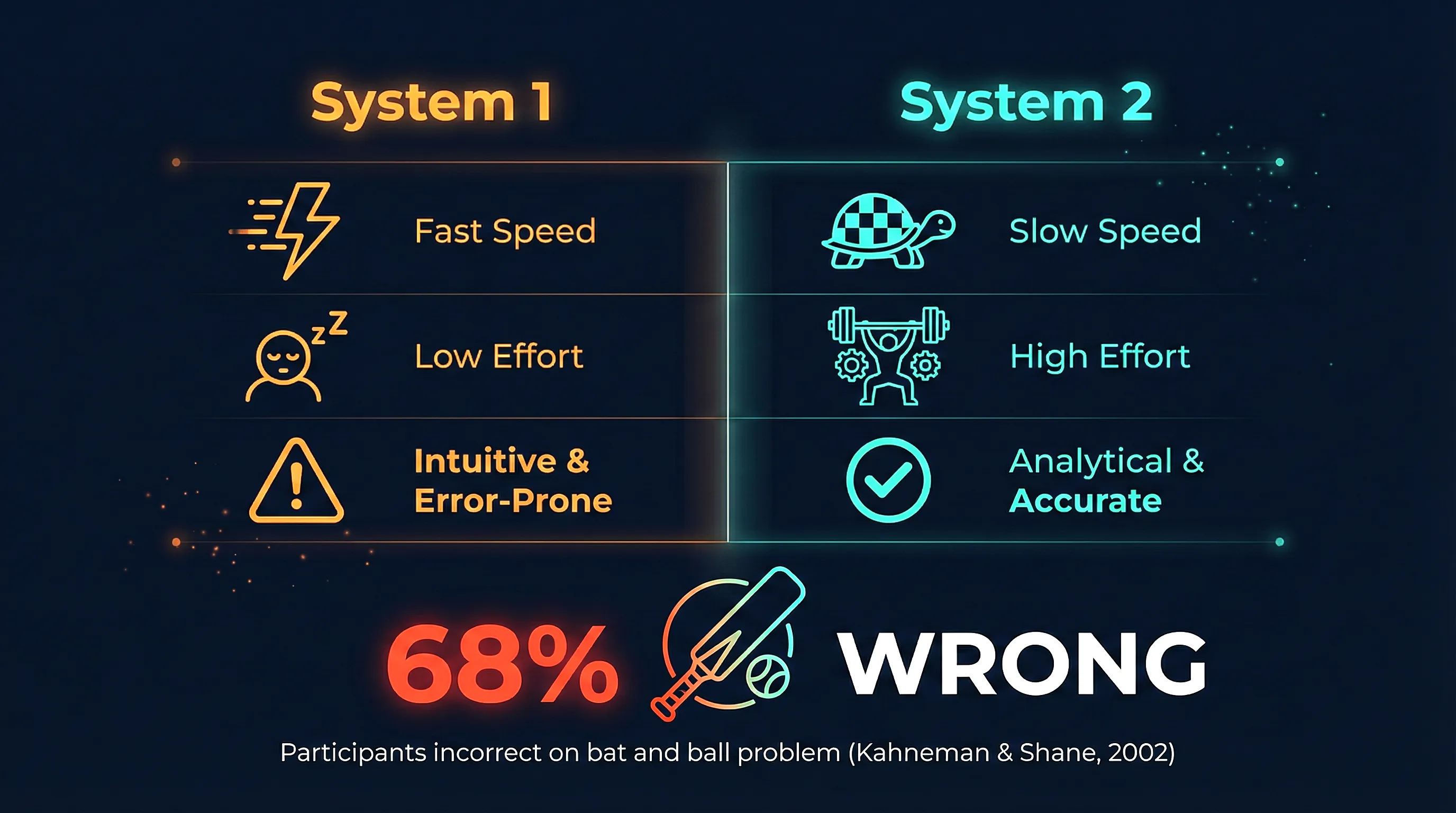
Psychologist Daniel Kahneman split the mind into two systems. System 1 is fast, automatic, and emotional. It handles most of your daily thinking without you even noticing. System 2 is slow, deliberate, and logical. It’s what you think is running the show. It usually isn’t.[2][9]
The Bat and Ball Test
Here’s a quick test. A bat and a ball cost $1.10 together. The bat costs $1.00 more than the ball. How much does the ball cost?
If you said 10 cents, you’re in good company. About 68% of people get this wrong, including students at Harvard, MIT, and Princeton. The correct answer is 5 cents. Your System 1 jumped to 10 cents because it felt right. And your System 2 was too lazy to check.
This is called the Cognitive Reflection Test, developed by Shane Frederick.[3] Only 17% of participants answer all three questions correctly. The vast majority of people consistently trust their gut over actual math.
| Thinking System | Speed | Effort | Accuracy |
|---|---|---|---|
| System 1 | Instant | None | Often wrong |
| System 2 | Slow | High | Usually right |
| What you think you use | System 2 | Deliberate | Always right |
| What you actually use | System 1 | Automatic | Depends |
Heuristics are the mental shortcuts System 1 uses to make quick decisions. They work great for simple problems. But they create predictable errors in complex situations.[10] Your brain mistakes speed for accuracy. It confuses confidence for correctness. And as the day grinds on, decision fatigue pushes your brain deeper into shortcut mode.
Recommended read: Predictably Irrational by Dan Ariely - a fascinating look at the systematic ways your brain makes irrational choices, from pricing to dating.
The same cognitive biases that sabotage your everyday decisions are running constantly in the background. You just don’t notice because System 1 makes everything feel intentional.
Why Emotions Run the Show, Not Logic
Here’s a twist that surprises most people. Removing emotions from decisions doesn’t make you more rational. It makes you worse at deciding.
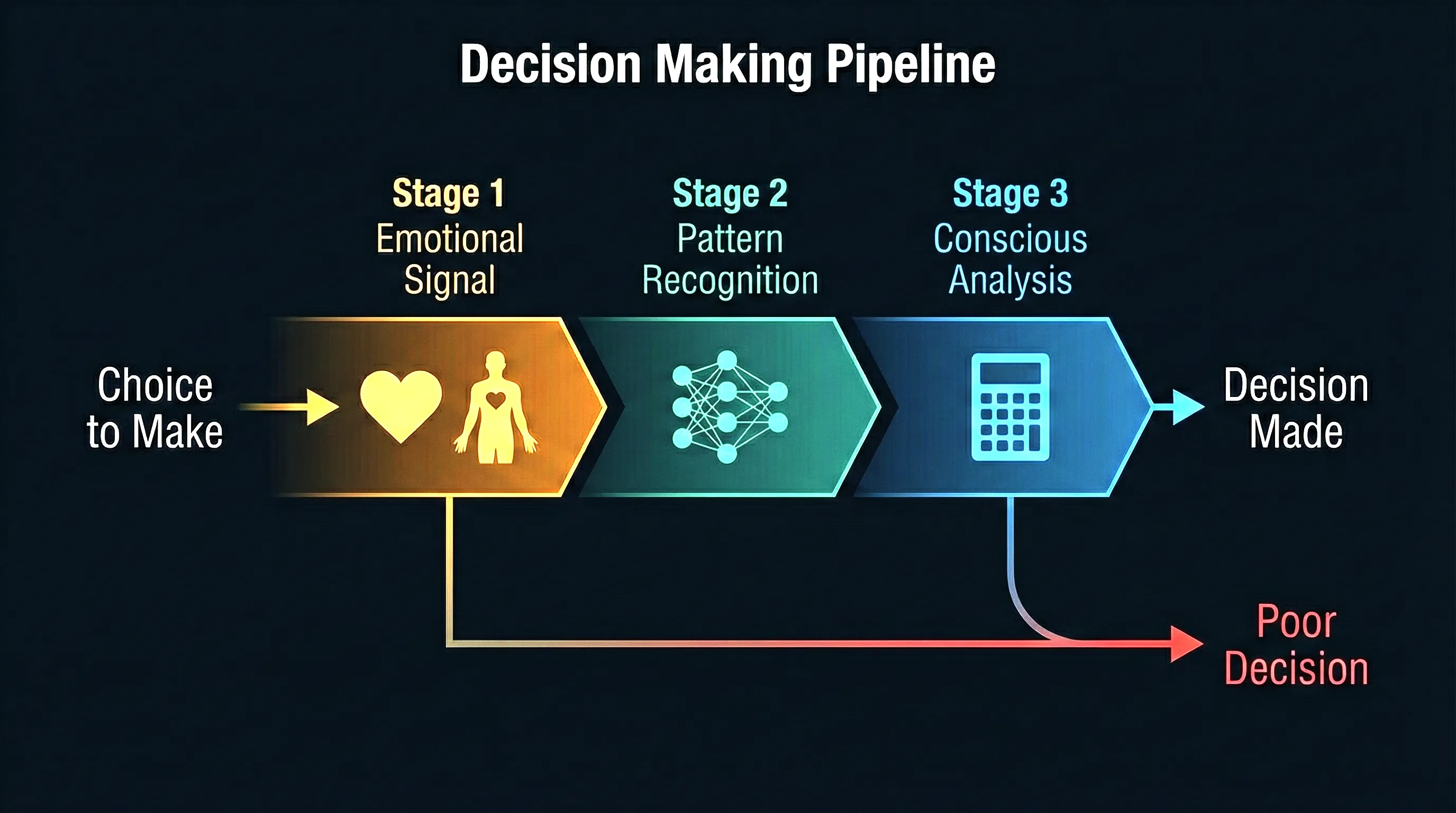
Neuroscientist Antonio Damasio studied patients with damage to the ventromedial prefrontal cortex. This brain region connects emotional processing to decision making. These patients could reason logically. They could analyze options. But they couldn’t make good choices.
The Iowa Gambling Task
Damasio tested these patients using the Iowa Gambling Task. Participants choose cards from four decks. Two decks give high rewards but devastating losses. Two give smaller rewards with manageable losses. Healthy participants gradually learn to avoid the bad decks. Their bodies start producing stress responses before their conscious minds even understand why.
Patients without emotional processing? They kept choosing from the losing decks. Over and over. Their logic was intact. Their decision making was broken.[4]
This research gave us the somatic marker hypothesis. Your emotions create body-based signals. Gut feelings. Anxiety before a bad choice. Excitement before a good one. These markers guide your decisions faster and often more accurately than pure analysis.[5]
- Your gut feelings are often based on real pattern recognition
- The brain’s emotional centers process threats faster than logical centers
- People who suppress emotions often make worse financial decisions
- “Trust your gut” has actual neuroscience behind it
“We are not thinking machines that feel. We are feeling machines that think.” - Antonio Damasio
Recommended read: The Art of Thinking Clearly by Rolf Dobelli - 99 short chapters on the thinking errors that trip up even the most logical minds.
Your prefrontal cortex handles rational analysis. But it works in partnership with emotional brain regions, not in isolation. The brain doesn’t have a “logic only” mode. Every decision you make carries emotional weight, whether you’re aware of it or not.
Smart Doesn’t Mean Rational
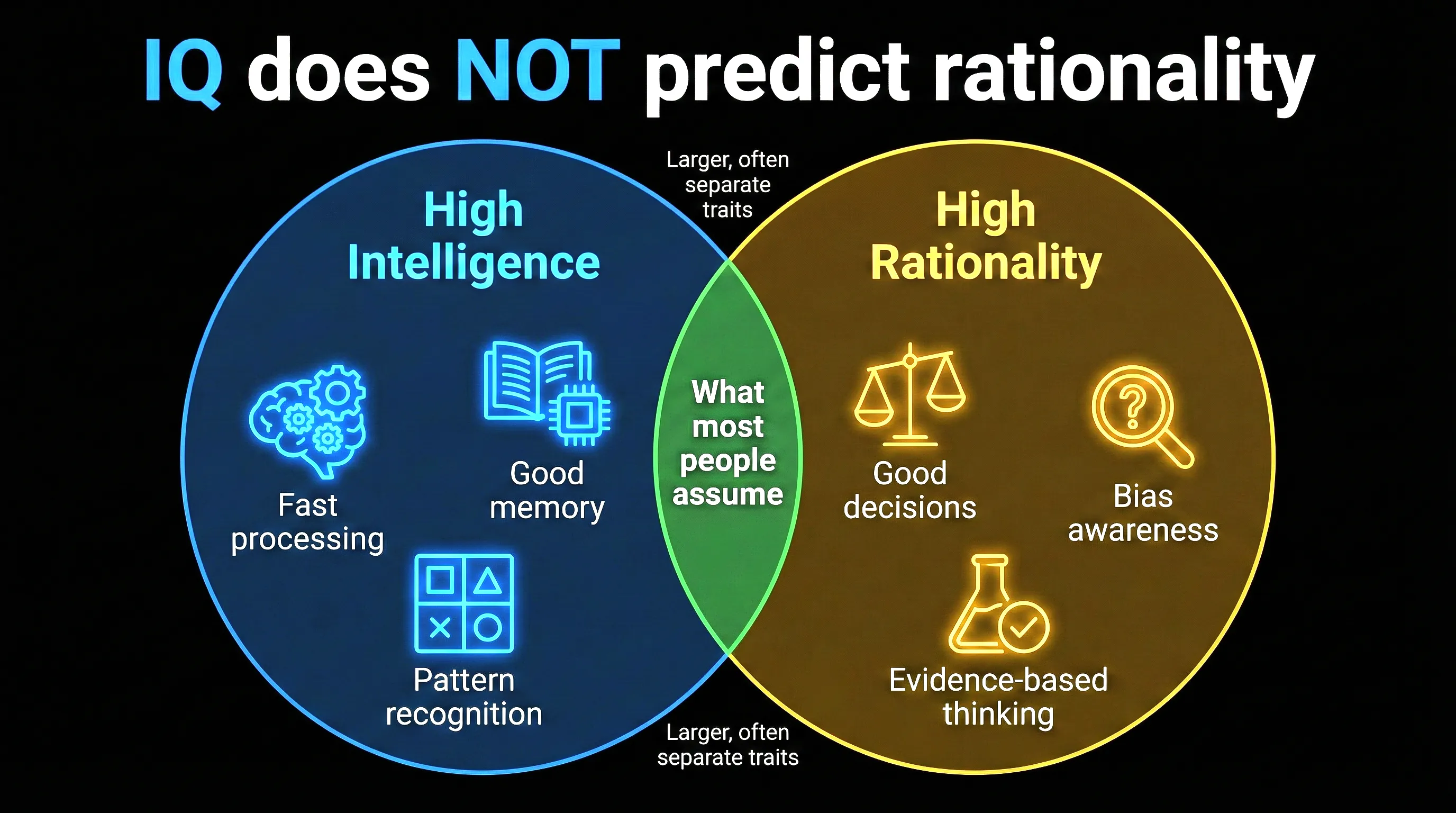
This might be the most counterintuitive finding in all of psychology. Higher IQ does not protect you from irrational thinking. In many cases, it makes things worse.
Psychologist Keith Stanovich coined the term dysrationalia to describe this phenomenon. It means the inability to think rationally despite having adequate intelligence.[6] Think of it like dyslexia, but for reasoning instead of reading.
The Intelligence Trap
Stanovich’s research shows that high-IQ individuals are no less likely to be cognitive misers than anyone else. A cognitive miser is someone who defaults to the easiest thinking strategy available. Smart people are just better at rationalizing their shortcuts after the fact.[7]
This creates a dangerous feedback loop. You’re intelligent enough to construct convincing arguments for whatever your gut already decided. You mistake elaborate justification for careful reasoning. And because you’re smart, other people believe you too. Even the world’s top scientists fall into this trap. When 19 researchers tried to build a consciousness test for AI, some of the same authors later argued their own framework was dangerously flawed.
| Trait | Intelligence | Rationality |
|---|---|---|
| Measures | Processing speed, pattern recognition | Quality of reasoning, decision making |
| Predicts | Academic performance, test scores | Real-world outcomes, fewer bad decisions |
| Teachable | Mostly fixed after development | Can improve with practice |
| Protects against bias | Barely | Significantly |
Your brain is also prone to irrational behavior in high-stakes situations. The smarter you are, the more sophisticated your rationalizations become. You don’t overcome the bias. You just dress it up in better language.
Recommended read: You Are Not So Smart by David McRaney - a witty guide to the many ways your brain lies to you every day.
In 2025, Stanovich and Toplak published new research connecting rational thinking to conspiratorial beliefs. Even highly educated people fall for conspiracy theories when their rational thinking skills are weak. Education fills your head with knowledge. It doesn’t automatically teach you how to use it well.[8]
How to Actually Think More Clearly
You can’t become perfectly rational. Your brain isn’t built for it. But you can learn to catch your System 1 before it runs away with a bad decision.
The good news from Stanovich’s research is that rational thinking is trainable. Unlike IQ, which stays mostly fixed, your ability to think clearly can improve with deliberate practice.
Five Steps to Better Thinking
-
Pause before deciding. When something feels obviously true, that’s exactly when you should slow down. Your System 1 is most confident when it’s most likely wrong.
-
Consider the opposite. Before committing to a belief, force yourself to argue the other side. Research shows this simple technique dramatically reduces confirmation bias.
-
Name your emotions. You can’t separate emotions from decisions. But you can notice them. Labeling what you feel activates your prefrontal cortex and gives System 2 a chance to engage.
-
Learn the common traps. Study the hidden rules that influence your thinking. Once you recognize a heuristic in action, you can choose whether to follow it.
-
Ask “what would change my mind?” If nothing could change your mind about something, you’re not thinking rationally. You’re just defending a conclusion you already reached.
- Track your predictions and check how often you’re right
- Surround yourself with people who disagree with you
- Sleep on major decisions to let System 2 catch up
- Read widely outside your comfort zone to challenge existing mental models
Recommended read: Clear Thinking by Shane Parrish - practical frameworks for making better decisions by understanding how your brain actually works.
Being rational doesn’t mean being cold or emotionless. It means being honest about how your mind works. Your brain will always take shortcuts. Your emotions will always influence your choices. The only question is whether you notice it happening.
The most rational thing you can do is accept that you’re not as rational as you think.

Sources
The Rationality Illusion, Why Your Brain Lies to You
Your Brain’s Shortcut Factory
2. Judgment Under Uncertainty: Heuristics and Biases (Science, 1974)
3. Cognitive Reflection and Decision Making (Journal of Economic Perspectives, 2005)
9. Dual-Process Theory and Decision-Making in Large Language Models (Nature Reviews Psychology, 2025)
10. Heuristics and Cognitive Biases: A Conceptual Analysis (Memory & Cognition, 2025)
Why Emotions Run the Show, Not Logic
4. Insensitivity to Future Consequences Following Damage to Human Prefrontal Cortex (Cognition, 1994)
Smart Doesn’t Mean Rational
6. What Intelligence Tests Miss: The Psychology of Rational Thought (Yale University Press, 2009)
7. Rational and Irrational Thought: The Thinking That IQ Tests Miss (Scientific American, 2009)