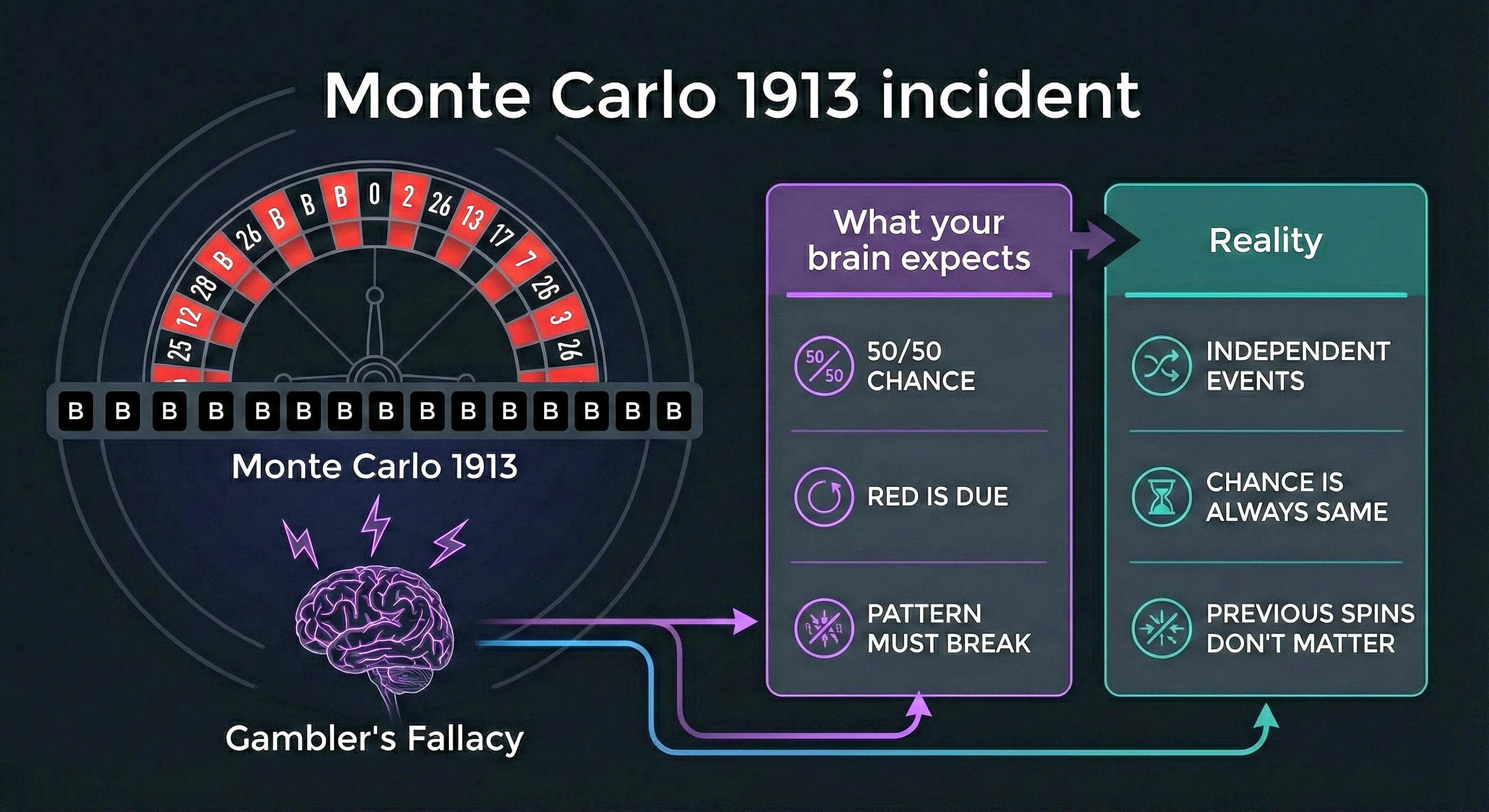
In 1913, at the Monte Carlo Casino, the roulette ball landed on black. Then it landed on black again. And again. By the fifteenth spin, gamblers were throwing money at red. Black was “due” to end. It had to.
Black came up twenty-six times in a row. The crowd lost millions.
The odds never changed. Every spin was 50/50. But the human brain simply can’t accept that. And casinos have been profiting from this glitch ever since.
The Gambler’s Fallacy, Why You Think Red Is “Due”
You’ve felt this before. Maybe not at a roulette table. Maybe it was flipping a coin or watching your sports team lose three games straight. You felt the next one had to go the other way.
This is the gambler’s fallacy. It’s the belief that past random events affect future ones. And it’s hardwired into your brain.
As David McRaney explains in You Are Not So Smart, your ancestors survived because they were brilliant at spotting patterns. Predators, prey, weather changes. Pattern recognition kept them alive for millions of years.
The problem? You can’t turn it off.
- You see faces in clouds
- You throw dice harder when you need high numbers and softly when you need low ones
- You blow on the dice before a craps throw
- You believe “the cards are about to turn” after a bad streak
- None of this has any real effect on the odds
Here’s the twist that makes this even stranger. Cognitive scientist Steven Pinker argues that the gambler’s fallacy isn’t actually a flaw in most real-world situations. Rain clouds have average sizes. A train’s hundredth car really does signal the caboose. In nature, patterns are useful predictions.
But gambling devices are specifically engineered to defeat your pattern recognition. Roulette wheels and slot machines are precision instruments built to produce random outcomes. As Pinker puts it, calling our intuitive predictions “fallacious” because they fail on gambling devices is backwards. A gambling device is, by definition, a machine designed to defeat your intuitions.
Your brain isn’t broken. It’s just playing a game that was built to exploit its greatest strength.
“Your brain is always looking for patterns and sending little squirts of happy throughout your body when it finds them. But like faces in clouds, you often see patterns where none exist.” - David McRaney
Recommended read: You Are Not So Smart by David McRaney. A fun, fast tour through 48 ways your brain tricks you every day, including the gambler’s fallacy and the illusion of control.
The Near-Miss Trap, How Almost Winning Feels Like Winning
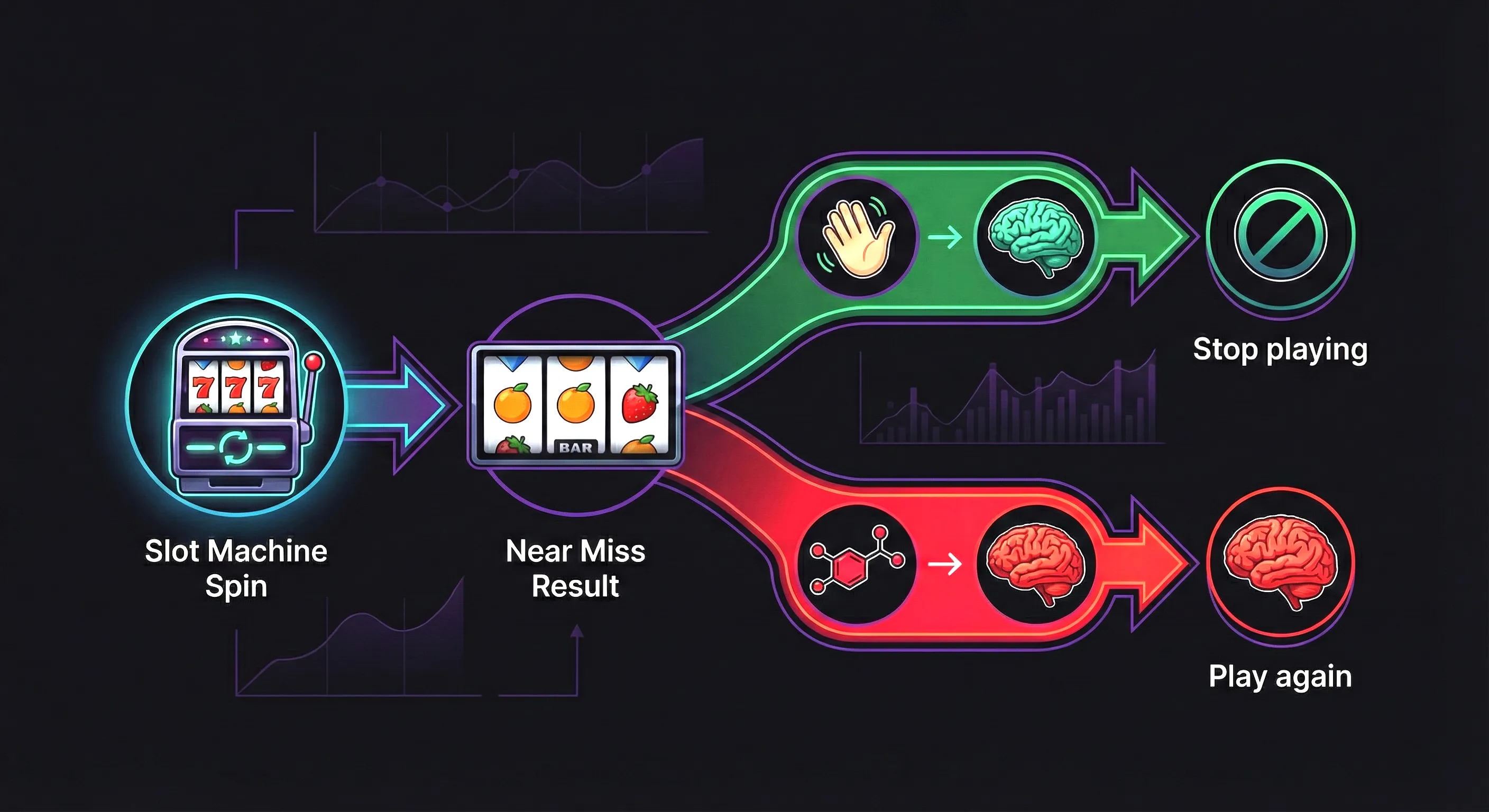
In 2010, neuroscientist Reza Habib put twenty-two people inside an MRI machine and showed them a slot machine spinning.[1] Half were pathological gamblers. Half were social gamblers.
The slot machine was rigged to show three outcomes. Wins, losses, and “near misses” where the symbols almost lined up but didn’t.
Here’s what happened in their brains:
- Both groups got excited when they won
- Non-pathological gamblers treated near misses like losses. Their brains sent a signal that said “quit while you’re ahead”
- Pathological gamblers treated near misses like wins. Their reward centers lit up almost identically to actual victories
Two groups watched the exact same event. Their brains interpreted it completely differently.
Research has since confirmed that the size of the dopamine response to a near-miss correlates with the severity of an individual’s gambling addiction.[2] And here’s the most counterintuitive finding. Almost winning triggers a more substantial urge to play than even winning itself. The near-miss creates a stronger motivational pull than actual success.[9]
Why This Matters More Than You Think
Casino companies know about this research. And they’ve used it. As Charles Duhigg reports in The Power of Habit, slot machines have been deliberately reprogrammed over the past few decades to deliver more near wins.
A state lottery consultant (who spoke anonymously) put it bluntly:
“Adding a near miss to a lottery is like pouring jet fuel on a fire. Every other scratch-off ticket is designed to make you feel like you almost won.”
Psychologist Mike Dixon found something even more alarming.[3] Modern slot machines like “Lobstermania” use what he calls losses disguised as wins. You bet on six lines, win on one, and lose on five. You actually lost money. But the machine plays victory music, flashes lights, and your brain sweats with excitement as if you won.
| What Happens | What Your Brain Thinks | Reality |
|---|---|---|
| Two oranges, one strawberry on slots | “Almost! I nearly won!” | You lost your stake |
| Horse finishes second | “I’m getting closer!” | You lost your stake |
| Win on 1 line, lose on 5 | “I won!” (lights, sounds) | Net loss of money |
| Near miss on scratch-off | “Next one will hit” | Same odds as always |
Dixon hooked novice gamblers to skin conductance monitors. They sweated just as much during losses disguised as wins as during genuine wins. Their bodies literally couldn’t tell the difference.
The House Money Effect, Why Winning Makes You Lose More
Behavioral economist Richard Thaler noticed something odd while playing poker with his colleagues. Players who were up for the night became reckless. They’d take wild bets they’d never normally make.
He called this the house money effect.[4] When you’re ahead, your winnings feel like “the casino’s money,” not yours. Easy come, easy go. It’s the same psychological shift that explains why rewards can actually destroy your motivation for things you used to enjoy.
You can watch this happen at any casino. A player wins $200 early in the evening. They put their original $300 in one pocket and the $200 in chips on the table, ready to bet. The money in either pocket spends exactly the same. But in their mind, the winnings are play money.
This is mental accounting at its worst. Money is money. But your brain puts it in separate mental buckets. The same brain quirk that makes happiness from a raise fade within weeks makes gambling winnings feel like play money.
When You’re Losing, It Gets Even Worse
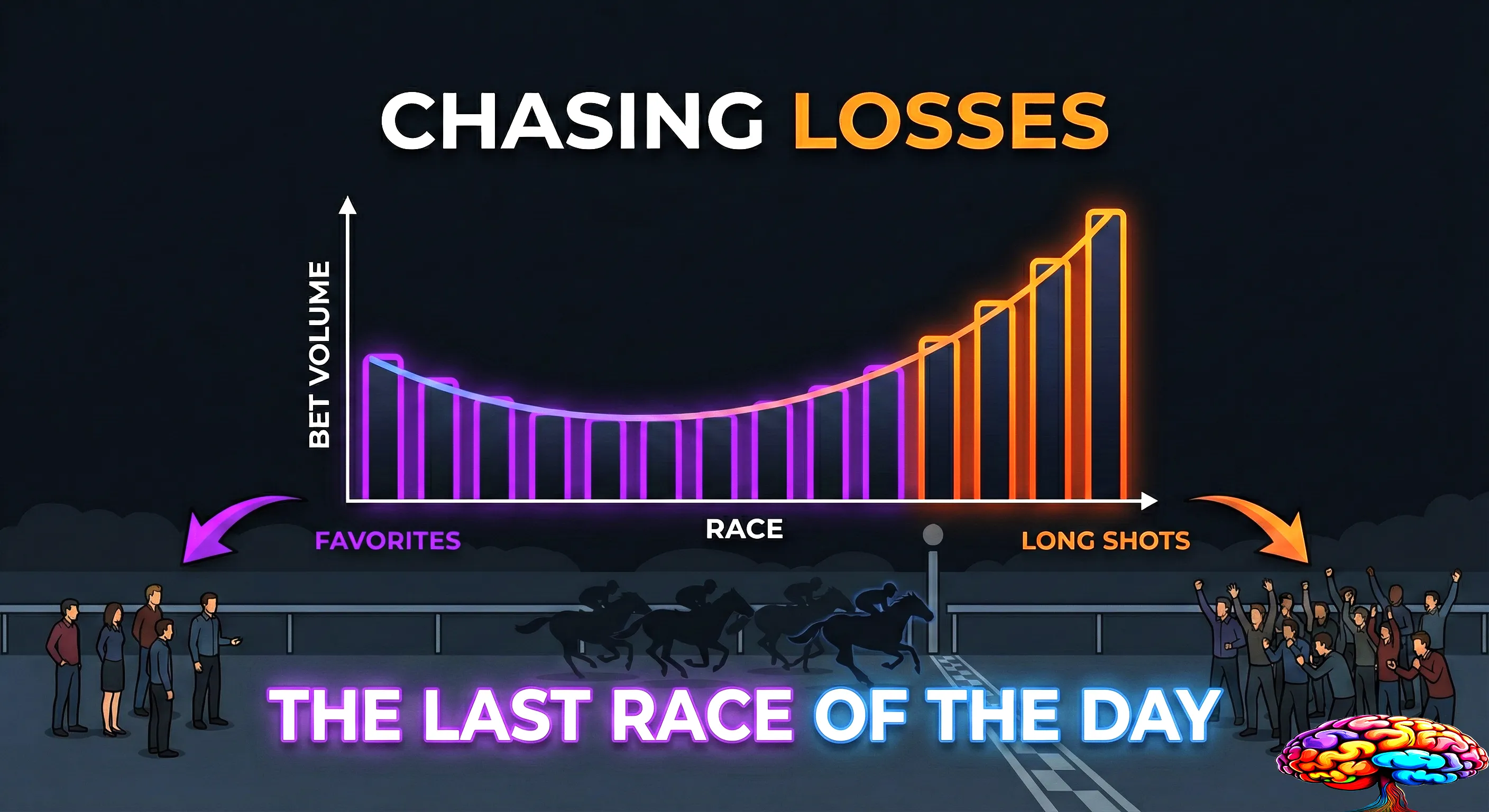
Thaler also studied what happens at the racetrack on the last race of the day. Most bettors have been losing all afternoon. They’re “in the red” in their racetrack mental account. So what do they do?
They bet on long shots. Horses with almost no chance of winning. Because a long-shot win is the only way to break even in one bet.
This behavior comes straight from prospect theory, discovered by Daniel Kahneman and Amos Tversky.[5] People who are losing become risk-seeking. They’d rather take a wild gamble for a chance to break even than accept a guaranteed smaller loss.
- Mutual fund managers take bigger risks in Q4 when their fund trails the benchmark
- Rogue traders who lost billions for their banks doubled down trying to recover
- Casino gamblers chase losses with increasingly desperate bets
The same cognitive biases that sabotage your everyday decisions become supercharged at the gambling table.
The Sports Betting Explosion
The gambling landscape has transformed dramatically since the Supreme Court struck down the federal ban on sports betting in 2018. Americans legally wagered less than $5 billion on sports that year. By 2024, they bet $150 billion.
About 22% of Americans and 48% of men ages 18 to 49 now have at least one online sportsbook account. And the numbers are alarming. The National Council on Problem Gambling reports that about 16% of online sports bettors meet criteria for disordered gambling, with another 13% showing signs of compulsive behavior.
Mobile betting apps have removed every friction point that once protected people from compulsive gambling. Push notifications, flash odds, “top bets,” and countdown timers are psychologically designed to nudge you toward action. You can now bet on micro-moments. A single free throw. A coin toss. How long the national anthem lasts. Since legalization, searches for help with gambling addiction have jumped 23% nationally, according to a 2025 study in JAMA Internal Medicine.[6]
Young men are particularly vulnerable. The prefrontal cortex, responsible for rational decision-making, isn’t fully developed until around age 26. Before that, the brain is easily influenced by outside stimuli. And sports betting apps are engineered to exploit exactly that vulnerability.
“Watch out!” - Richard Thaler
Recommended read: Misbehaving by Richard Thaler. The Nobel Prize winner explains how real humans make financial decisions, from poker tables to stock markets, and why “rational” economic theory gets it all wrong.
The Illusion of Control, Why You Blow on the Dice
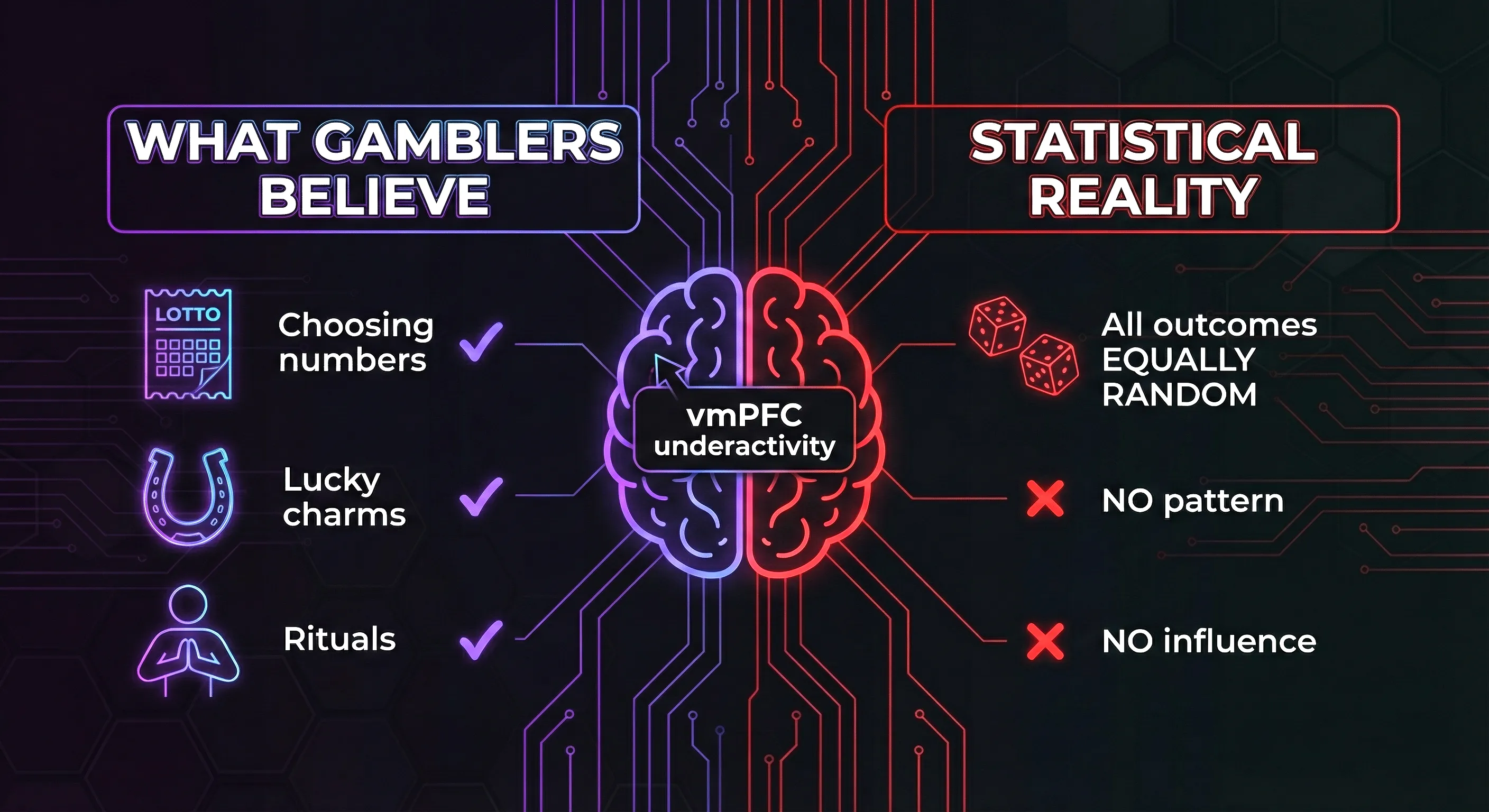
In 1975, psychologist Ellen Langer ran a series of experiments that revealed something uncomfortable about human nature.[7] She found that people bet more money when playing against a nervous opponent, even in games of pure chance. They paid more for lottery tickets they chose themselves versus randomly assigned ones.
She even had people predict coin flips. When subjects happened to guess correctly at the beginning, they believed they could practice to improve their performance on future runs.
They thought they could learn to predict coin flips.
Your Brain Confuses Familiarity With Skill
Langer concluded that any game with customizable features makes you feel like skill is involved:
- Choosing your own lottery numbers makes you overvalue the ticket
- Picking which roulette number to bet on feels different from random assignment
- Having options in how you play creates a false sense of expertise
- Seeing patterns early builds confidence that snowballs into overconfidence
This is the illusion of control. And it extends far beyond the casino. In 2008, researchers at Stanford found that simply writing an essay about a time you were a leader made people more likely to insist on rolling the dice themselves.[8] A full 100% of people primed with thoughts of power wanted personal control of the roll.
The dice don’t care who throws them. But your brain does.
Problem gamblers take this even further. Research at the UK’s National Problem Gambling Clinic found that gamblers are more likely than the general population to carry lucky charms, perform superstitious rituals, and explain losses as “bad luck” rather than normal statistical outcomes.
Over time, the brain’s reward system changes. In chronic gamblers, the dopamine system becomes less sensitive to rewards. This is tolerance. You need bigger bets and riskier gambles just to feel the same thrill. The ventromedial prefrontal cortex, which helps you foresee consequences and delay gratification, shows reduced activity in problem gamblers. It works just like the dopamine hijacking that makes your phone addictive, but at a gambling table instead of a screen.
Recommended read: Irresistible by Adam Alter. Explores how behavioral addiction works in casinos, apps, and games, and why near misses and escalation traps keep us hooked longer than we plan.
How to Protect Your Brain From the Gambling Trap
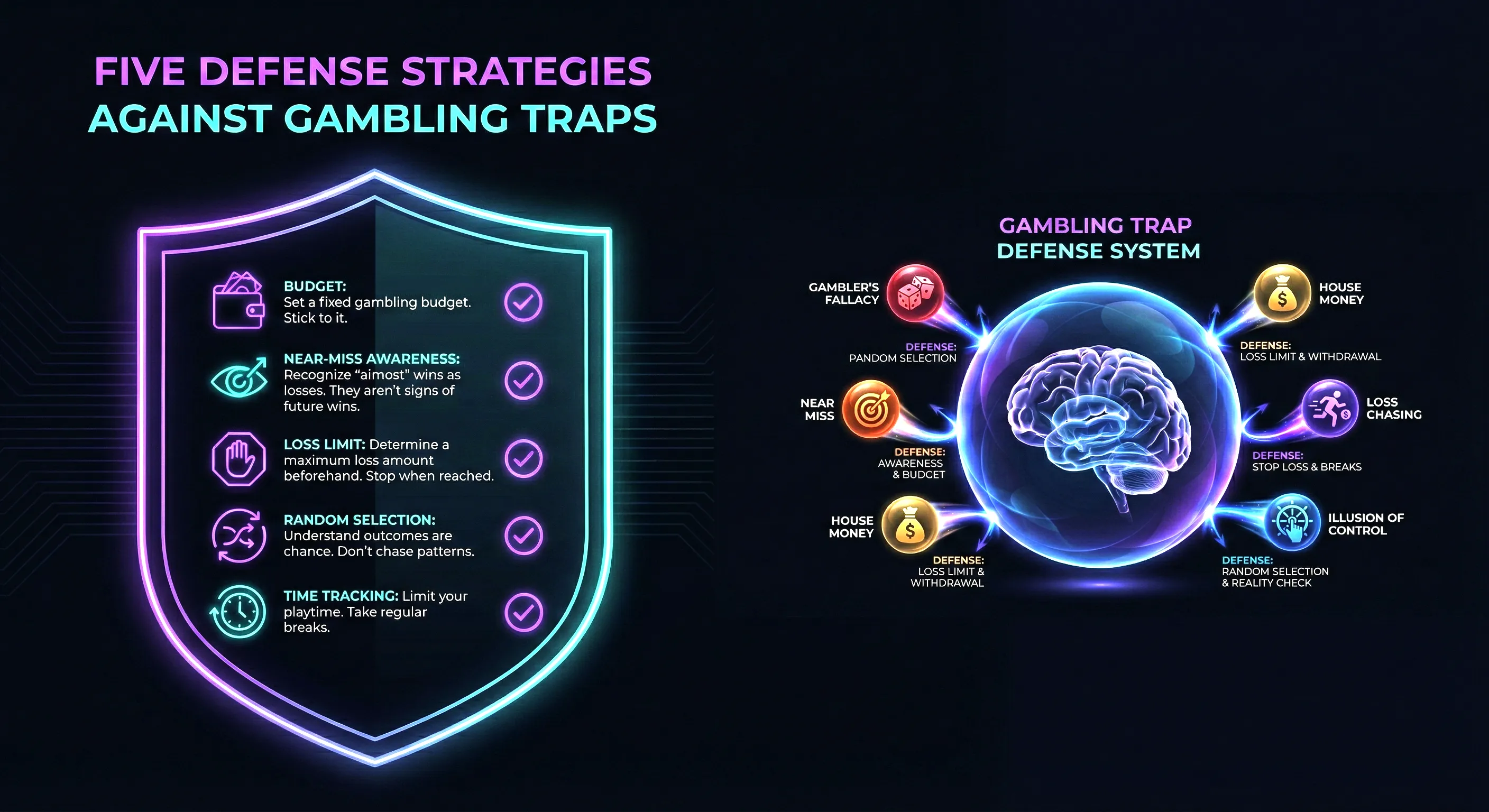
Understanding these tricks won’t make you immune. But awareness is the first line of defense. Here’s what the research says actually works:
-
Set a hard budget before you start. Claudia Hammond, author of Mind Over Money, recommends arriving at a casino with only a fixed amount of cash and no cards. Mental accounting can work in your favor here. Once your gambling budget is empty, you’re done.
-
Know the near-miss trick. When you “almost win,” remind yourself that a near miss is a loss. Period. The lights and sounds are designed to trick your body into feeling otherwise. If you can label the experience correctly, you break its power.
-
Watch for loss-chasing. The moment you start thinking “I need to win it back,” you’ve entered the most dangerous zone. Thaler’s research shows this is when people make their worst decisions. Set a loss limit before you play and walk away when you hit it.
-
Delete the betting apps. Mobile gambling is significantly more addictive than in-person gambling. 22% of mobile bettors report problem gambling versus 11% of land-based bettors. The push notifications, instant access, and micro-bets are designed to bypass your impulse control. Remove the temptation entirely.
-
Track time, not just money. Casinos remove clocks and windows for a reason. Set a timer on your phone. Casino consultant Natasha Dow Schüll found that “time on device” is the single best predictor of how much money a gambler loses.
The research from the National Problem Gambling Clinic shows that the dark patterns that trick your brain into bad online decisions use many of the same psychological levers as casino design. Recognizing one helps you resist the other.
| Gambling Trap | How It Works | Your Defense |
|---|---|---|
| Gambler’s fallacy | “Red is due after 5 blacks” | Each spin is independent. Period. |
| Near-miss effect | Almost winning feels like winning | A near miss is a loss. Label it. |
| House money effect | Winnings feel like free money | All money is your money. |
| Loss chasing | Desperation to break even | Set a loss limit before you start. |
| Illusion of control | Choosing numbers feels like skill | Randomness doesn’t care about your choices. |
| Mobile accessibility | Betting from your couch at 2am | Delete the apps. Add friction. |
For Paul, a problem gambler who lost hundreds of thousands of pounds, recovery came through cognitive behavioral therapy at London’s National Problem Gambling Clinic.[10] He learned to recognize his distorted thinking, avoid every gambling trigger, and replace the habit with healthier activities. His behavior shifted surprisingly fast once temptation was removed and replacement activities were found.
If gambling has gone from entertainment to compulsion, help exists. The key is recognizing that the problem isn’t willpower. It’s a brain that’s doing exactly what it evolved to do, in an environment specifically designed to exploit it.
Recommended read: Predictably Irrational by Dan Ariely. Reveals the systematic mistakes we all make when weighing risks and rewards, and why our irrational decisions are surprisingly predictable.
Sources
The Near-Miss Trap, How Almost Winning Feels Like Winning
2. Gambling Severity Predicts Midbrain Response to Near-Miss Outcomes (Journal of Neuroscience, 2010)
3. Losses Disguised as Wins in Modern Multi-Line Video Slot Machines (Addiction, 2010)
The House Money Effect, Why Winning Makes You Lose More
5. Prospect Theory: An Analysis of Decision under Risk (Econometrica, 1979)
The Illusion of Control, Why You Blow on the Dice
7. The Illusion of Control (Journal of Personality and Social Psychology, 1975)