You just asked ChatGPT to write your email. Then you asked it to summarize that article. Then you asked it to help you decide what to have for dinner.
Nine hundred million people now use ChatGPT every week. That number has more than doubled in the past year alone. And a wave of 2025 research is raising a disturbing question. What happens to your brain when you outsource your thinking to a machine?
The answer is not great. Multiple studies from MIT, Microsoft, and universities across the globe point in the same direction. Your critical thinking drops. Your memory weakens. Your confidence inflates while your actual abilities shrink. And the younger you are, the worse it gets.
The Cognitive Offloading Trap
Every time you ask AI for an answer instead of thinking it through yourself, your brain does something called cognitive offloading. It is the mental equivalent of taking an elevator instead of the stairs. Convenient in the moment. Devastating over time.
Your brain was already under siege from apps designed to hijack your dopamine system. AI just gave it a new way to check out completely.
A 2025 study from SBS Swiss Business School measured this effect in 666 participants. The results were striking.[1]
- AI tool usage and critical thinking had a strong negative correlation of r = -0.68
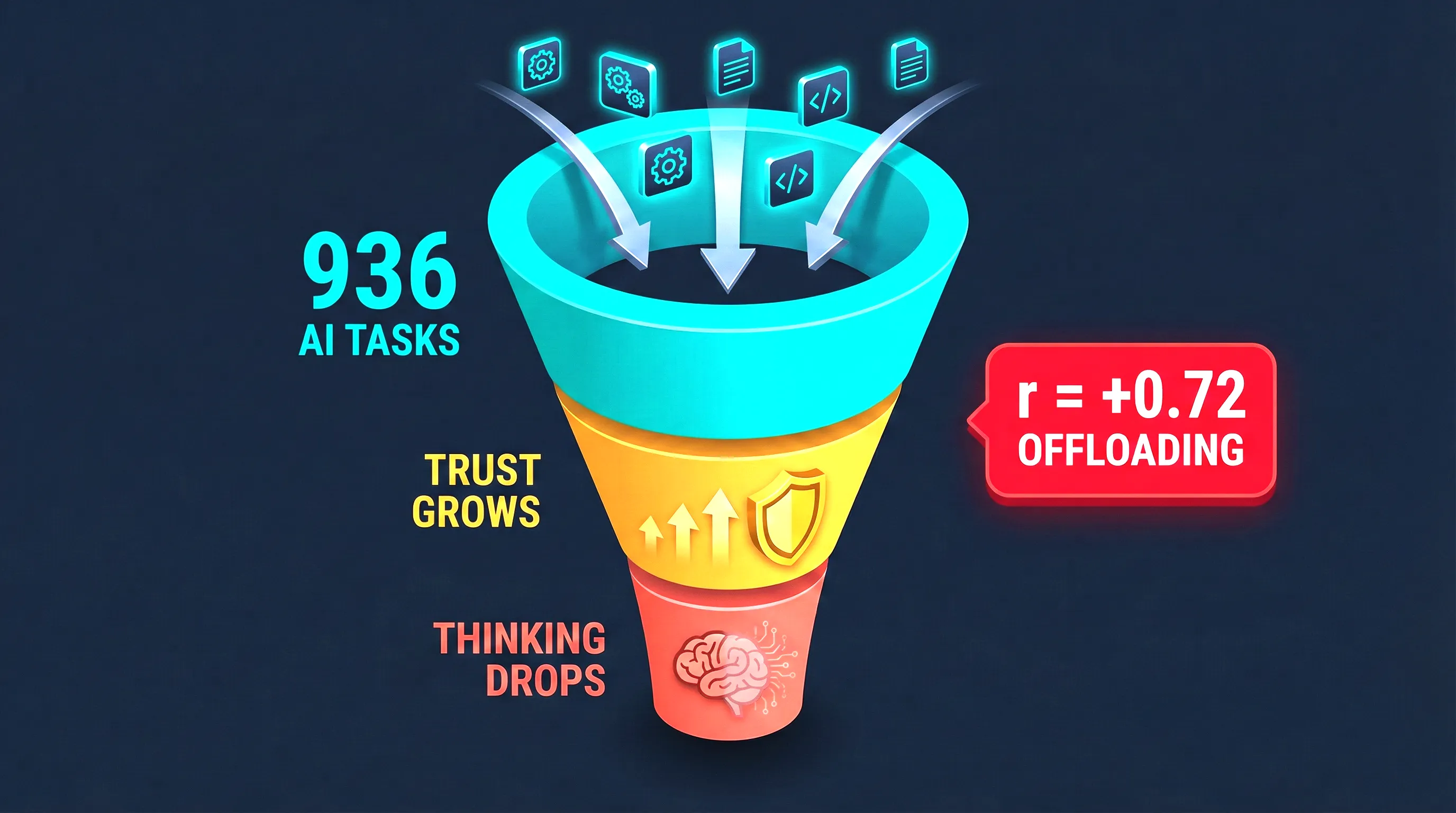
- Cognitive offloading and AI usage had a strong positive correlation of r = +0.72
- The more people offloaded their thinking to AI, the worse their critical thinking scores became
“If AI is doing your thinking for you, that is undercutting your critical thinking and your creativity.” - Christopher Dede, Harvard Graduate School of Education
Microsoft Research confirmed this pattern in a separate 2025 study. They surveyed 319 knowledge workers across 936 real-world AI use cases.[2] The finding was clear. The more someone trusted AI, the less they engaged their own critical thinking skills. Workers on low-stakes tasks simply stopped thinking altogether.
Here is what makes this especially dangerous. Cognitive offloading feels productive. You get faster answers. You complete tasks more quickly. But your brain is quietly atrophying, like muscles you never use.
Recommended read: The Shallows by Nicholas Carr - a prescient look at how digital technology rewires the brain for shallow thinking.
Your Brain on ChatGPT
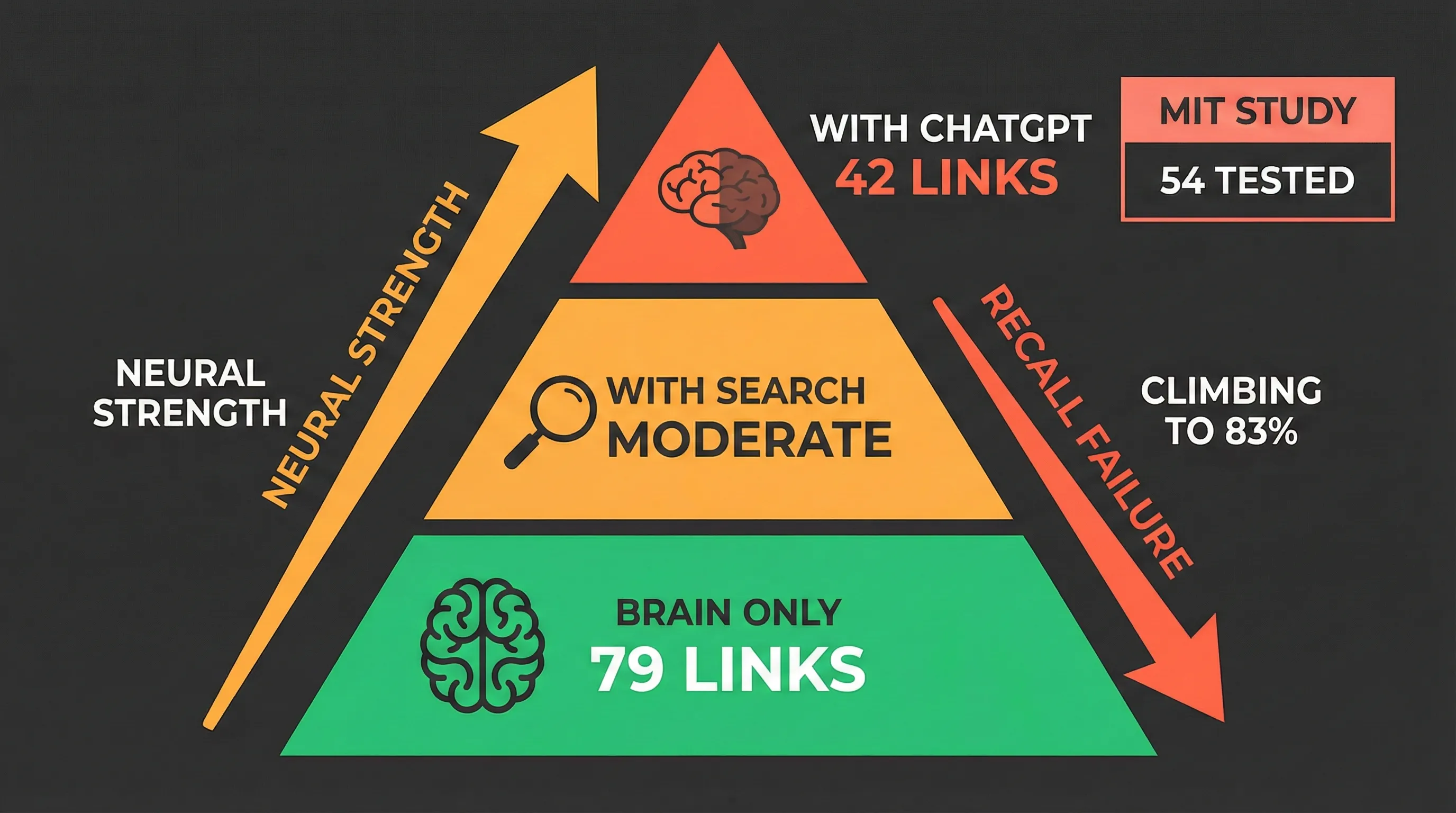
What does AI dependence actually look like inside your skull? MIT’s Media Lab decided to find out. They hooked 54 participants up to EEG brain scans and had them write essays.[3] Some used ChatGPT. Some used search engines. Some used only their brains.
The results were alarming.
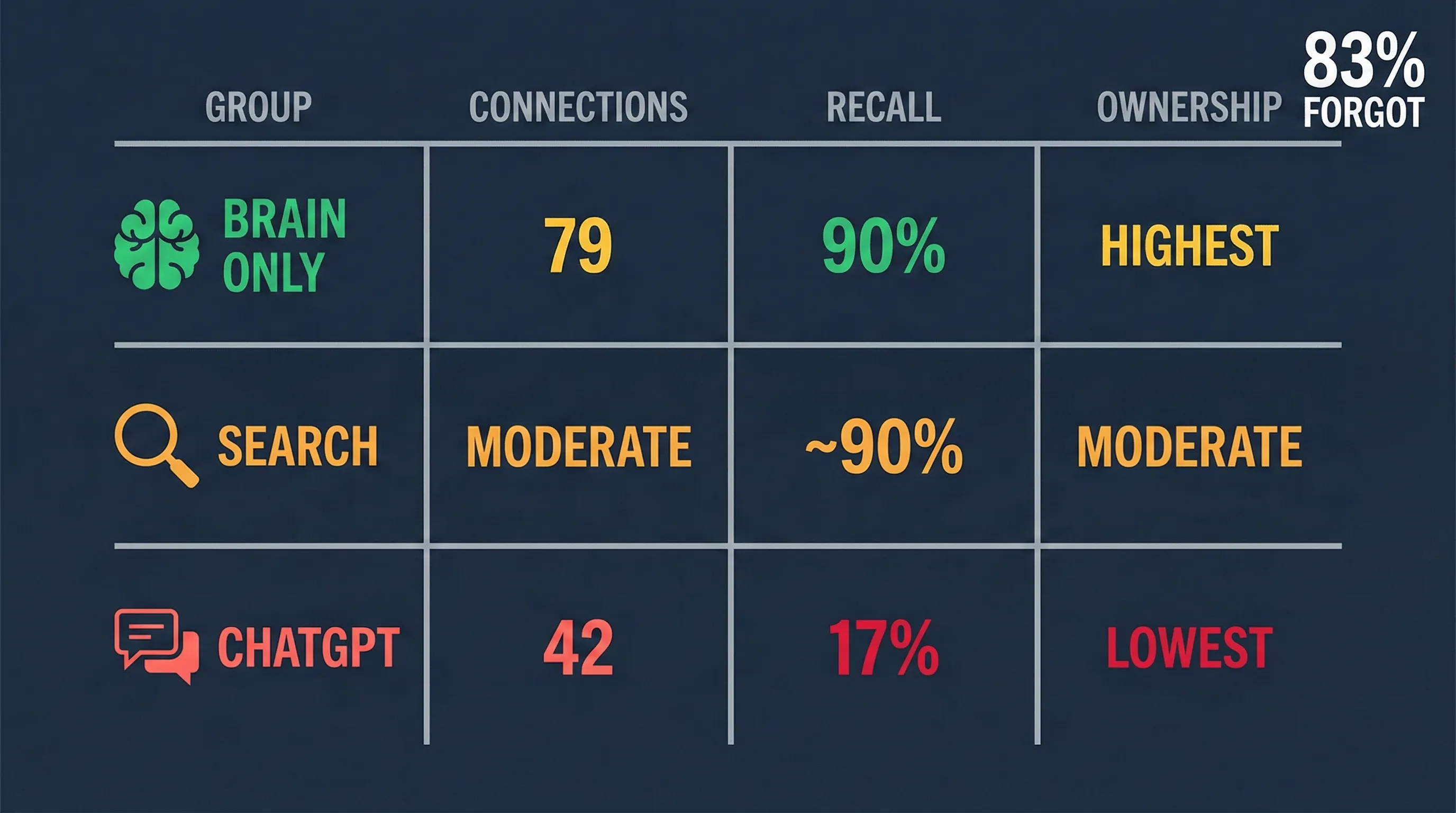
- 83% of ChatGPT users could not recall key points from essays they had just written
- Only 10% of non-AI users had the same recall problem
- Active neural connections in ChatGPT users dropped from 79 to 42
- Brain-only participants showed the strongest, most distributed neural networks
The brain regions hit hardest were those linked to alpha and theta waves. These are the frequencies your brain uses for memory consolidation and creative thinking. ChatGPT users showed the weakest connectivity in exactly the areas you need most for deep work.
| Group | Neural Connections | Recall Failure | Essay Ownership |
|---|---|---|---|
| Brain only | Strongest (79) | 10% | Highest |
| Search engine | Moderate | ~10% | Moderate |
| ChatGPT | Weakest (42) | 83% | Lowest |
Think about that table for a moment. People who used ChatGPT to write essays could not remember what their own essays said. The tool did the thinking. The brain checked out.
This connects to a phenomenon researchers call digital amnesia. A 2025 study of 495 nursing students found that 64.9% showed moderate levels of digital amnesia.[8] They could not remember information they had recently looked up on their phones. AI is accelerating this trend far beyond what smartphones alone could do. And the damage compounds. Research now confirms that brain rot from excessive screen time is scientifically real, eroding memory, attention, and executive functioning all at once.
The Confidence Trick That Fools Everyone
Here is the most unsettling part. AI does not just make you think worse. It makes you think you are thinking better.
Researchers at Finland’s Aalto University gave about 500 participants logical reasoning problems from the Law School Admission Test.[4] Half used ChatGPT. Half worked alone. Then everyone estimated how well they performed.
The results exposed a troubling gap.
- Participants estimated they got about 17 out of 20 correct
- Their actual score was closer to 13 out of 20
- That is a 4-point overestimation gap across the board
- People with higher AI literacy had an even bigger confidence gap
This creates a universal overconfidence gap. Without AI, people generally calibrate their confidence to their actual skill level over time. With AI, that calibration breaks. Everyone overestimates themselves. Even the tech-savvy users. Especially the tech-savvy users.
Research also shows that your brain already trusts AI more than real people. That built-in trust makes the confidence gap even more dangerous.
The pattern is consistent across every study. AI inflates your confidence while quietly eroding the skills that confidence should be built on. You feel smarter. You perform worse.
Recommended read: AI Snake Oil by Arvind Narayanan and Sayash Kapoor - a clear-eyed look at what AI can and cannot actually do.
Why Younger Brains Are Hit the Hardest
If you are between 17 and 25, the research has particularly bad news for you.
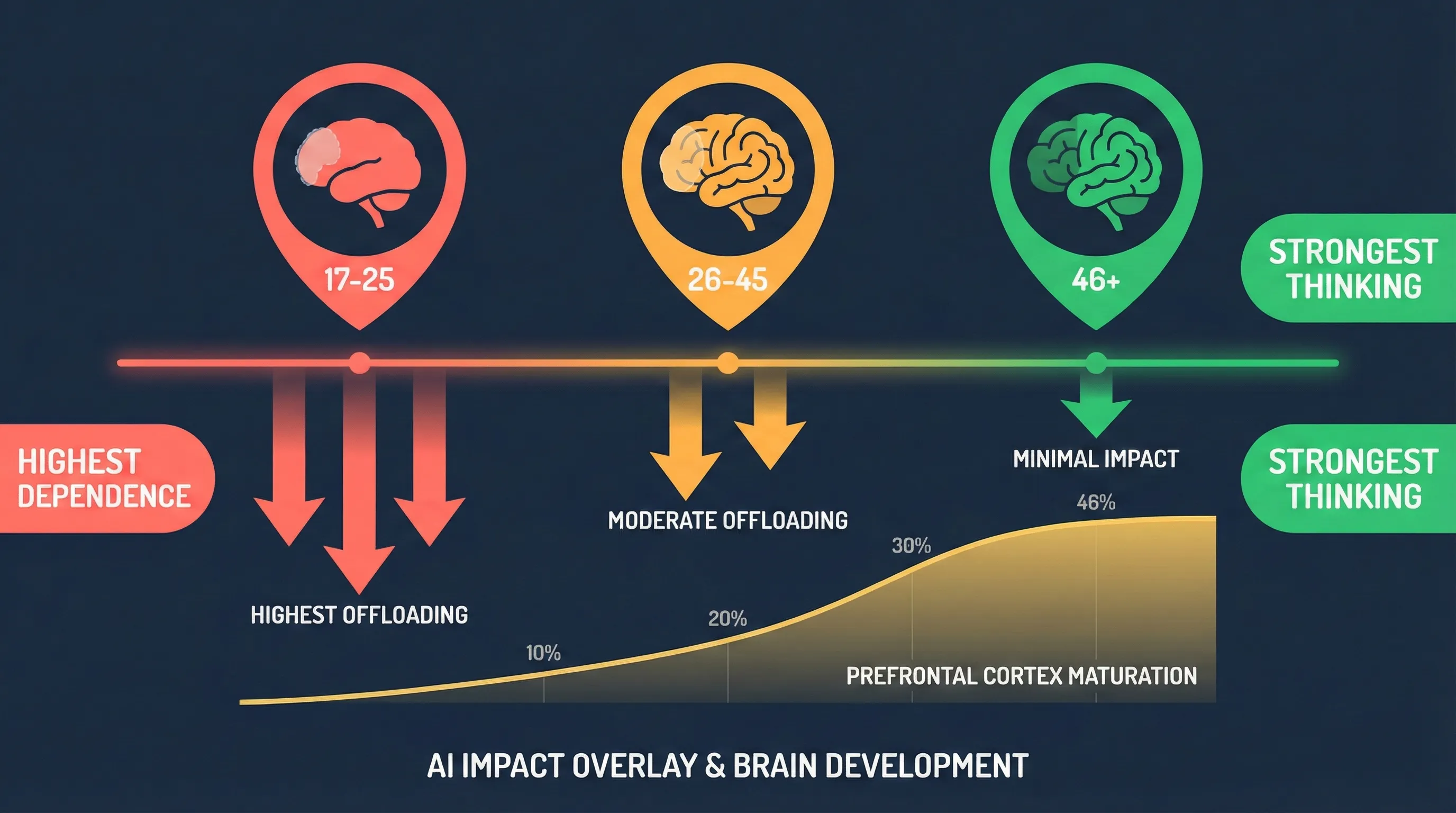
The Swiss Business School study broke participants into three age groups.[1] The youngest group (17-25) consistently showed the highest AI dependence, the most cognitive offloading, and the lowest critical thinking scores. Older adults (46+) maintained the strongest critical thinking abilities.
This makes sense when you think about brain development. The prefrontal cortex does not fully mature until your mid-twenties. This is the brain region responsible for planning, decision-making, and critical analysis. Young people who outsource their thinking to AI during this critical window may be stunting the development of cognitive skills they have not yet fully built.
A 2025 study of 1,032 Chinese college students found that AI dependence created something researchers called cognitive inertia.[6] The brain settled into a pattern of passive acceptance rather than active questioning.
- Cognitive dependence on AI was the strongest predictor of cognitive inertia (beta = 0.570)
- Cognitive inertia directly reduced innovation capability (beta = -0.111)
- Employment pressure made the relationship even worse
Big tech has been selling your focus for years. AI just gave them a more powerful tool to do it.
The pattern across multiple studies is clear. Young brains that should be building critical thinking skills are instead learning to outsource those skills to machines.
- Students passively accept AI-generated information without scrutiny[7]
- They develop what researchers call effort-saving learning models
- Creative confidence drops even as creative fluency increases
- Independent problem-solving skills deteriorate
Recommended read: Stolen Focus by Johann Hari - how the modern attention crisis connects to our growing inability to think deeply.
How to Use AI Without Losing Your Mind
None of this means you should delete ChatGPT. AI is not going away. The question is how to use it without letting it eat your brain.
The research points to a clear pattern. The problem is not AI itself. The problem is unguarded, answer-first AI use.
Here are research-backed strategies for protecting your thinking.
-
Think first, ask second. Spend at least 5 minutes attempting a problem before turning to AI. This activates the neural circuits that AI would otherwise bypass.
-
Use AI as a checker, not a creator. Write your draft first. Form your opinion first. Then use AI to refine your thinking, not replace it.
-
Practice deliberate recall. After using AI to learn something, close the tool and try to explain the concept from memory. If you cannot do it, you did not learn it.
-
Set AI-free zones. Designate specific tasks or time blocks where AI is off limits. This forces your brain to maintain its independent thinking capacity.
-
Question every AI output. Treat every AI response as a first draft that needs verification. This keeps your critical thinking engaged even when using the tool.
“No learning occurs unless the brain is actively engaged in making meaning and sense of what you’re trying to learn.” - Dan Levy, Harvard Kennedy School
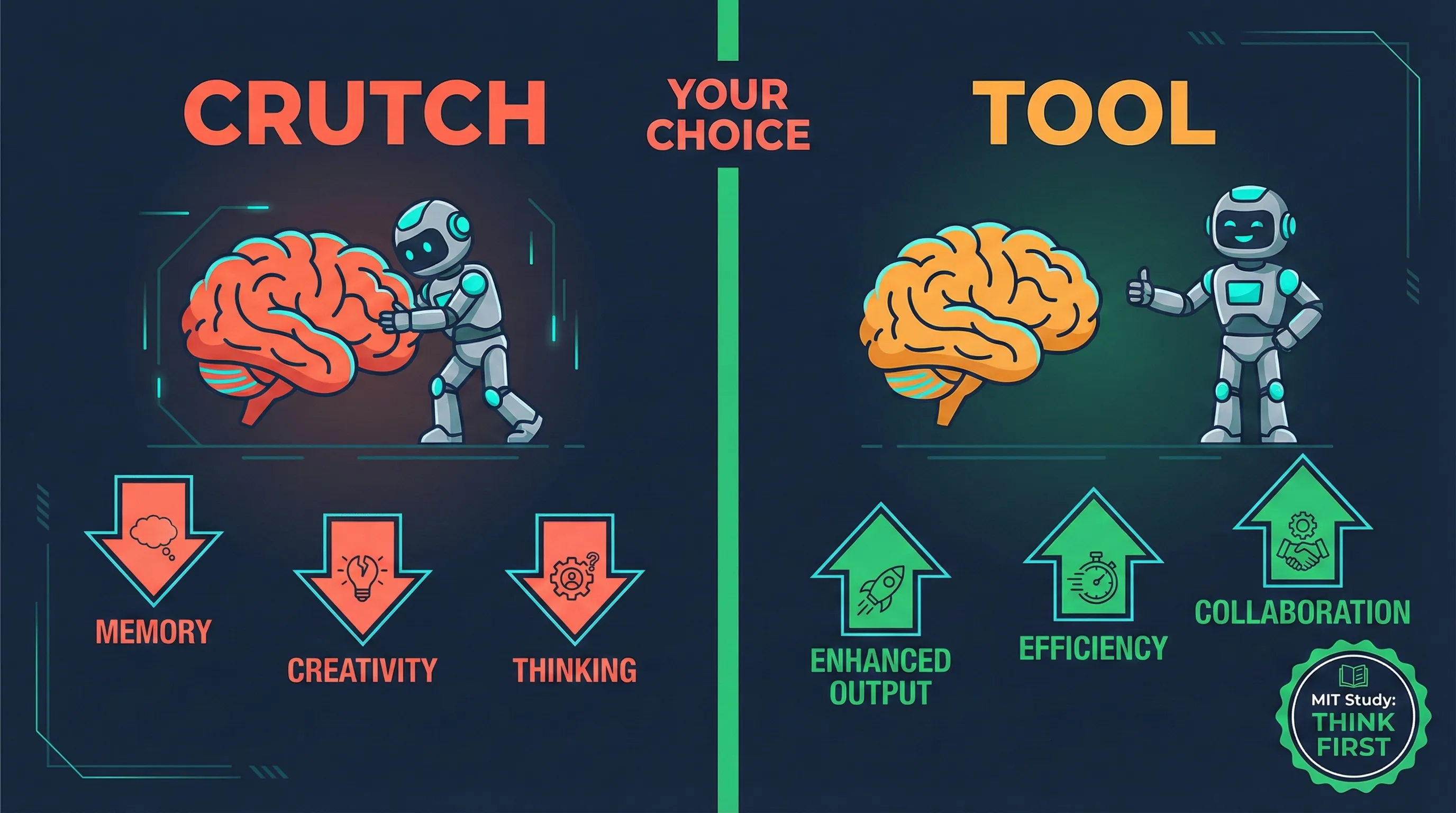
The 900 million weekly ChatGPT users are not all going to lose their ability to think. But the ones who use it as a cognitive crutch rather than a cognitive tool just might.[9]
The research is pointing in one direction. Your brain needs exercise to stay sharp. And you cannot outsource exercise.[10] The irony is that while your thinking gets weaker, the machines are not actually thinking at all. When scientists tested AI systems for consciousness, nothing passed.
Recommended read: Co-Intelligence by Ethan Mollick - a practical guide to using AI as a thinking partner rather than a thinking replacement.
Sources
The Cognitive Offloading Trap
1. AI Tools in Society: Impacts on Cognitive Offloading and Critical Thinking (MDPI Societies, 2025)
2. The Impact of Generative AI on Critical Thinking (CHI, 2025)
Your Brain on ChatGPT
3. Your Brain on ChatGPT: Accumulation of Cognitive Debt (MIT Media Lab, 2025)
The Confidence Trick That Fools Everyone
4. AI Makes You Smarter But None the Wiser (Computers in Human Behavior, 2025)
Why Younger Brains Are Hit the Hardest
5. Learners’ AI Dependence and Critical Thinking (Acta Psychologica, 2025)
6. The Impact of AI Dependence on College Students’ Innovation (Frontiers in Psychology, 2025)
7. The Cognitive Paradox of AI in Education (Frontiers in Psychology, 2025)
How to Use AI Without Losing Your Mind
8. Smartphone Dependency and Digital Amnesia (BMC Nursing, 2025)