At a Communist Party conference in Moscow in the late 1930s, someone called for a tribute to Stalin. The audience burst into applause. Five minutes passed. Then eight. Then ten.
Everyone’s palms were burning. Their arms ached. Older people were gasping for breath. But nobody stopped. Yuval Noah Harari recounts what happened next. NKVD agents stood in the hall, watching to see who would quit first. Eleven minutes of clapping passed before the director of a paper factory finally sat down. He was arrested that night.
The crowd wasn’t applauding because they loved Stalin. They were applauding because they knew they were being watched. And that single fact changed everything about how they behaved. It’s a vivid example of why people follow the crowd, even when every instinct tells them to stop.
Your brain does the same thing today. Just in quieter, less obvious ways.
Your Brain Knows You’re Being Watched
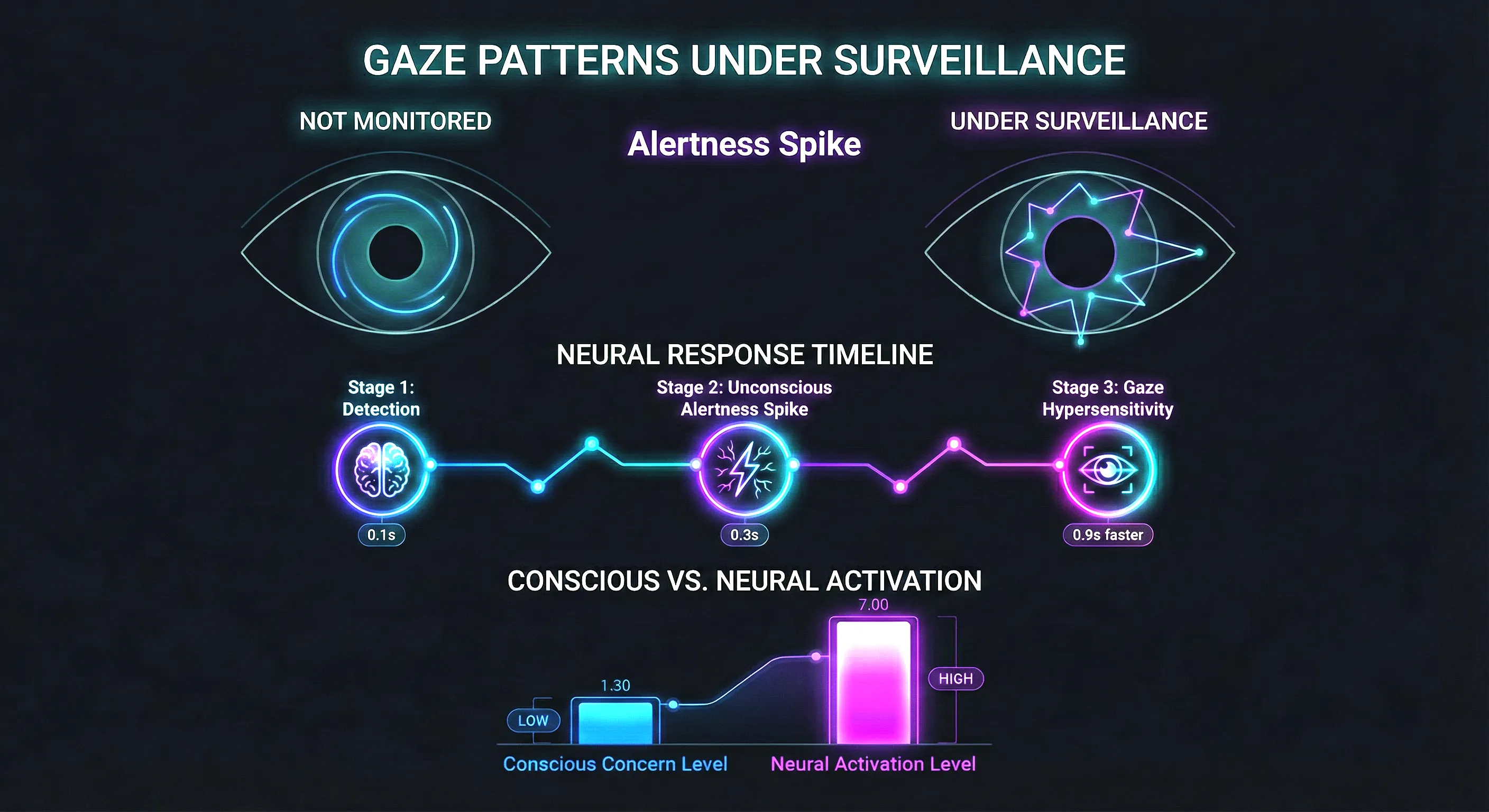
You might think surveillance only matters if you’re doing something wrong. But your brain doesn’t see it that way. Research from Oxford University found something surprising. Simply knowing you’re being monitored changes how your brain processes the world around you.[1]
The Neuroscience of Being Watched
Participants under surveillance became aware of faces almost a full second faster than those who weren’t being watched.[1] Their brains went into a heightened state of social alertness. They became hypersensitive to where other people were looking.
Here’s the strange part. Most participants said they felt “relatively unconcerned” about being monitored. But their brains told a different story. The neural response was automatic and unconscious.[1]
A 2025 study on surveillance as a socio-technical system confirmed this disconnect. Researchers found that individuals who perceive higher psychological pressure from surveillance modify their behavior and exhibit heightened self-awareness and restraint.[2] Belief in active monitoring of footage significantly amplified behavioral vigilance, even when no one was actually watching at that moment.[2]
This matters because hyper-awareness of gaze is a hallmark of several mental health conditions:
- Social anxiety disorder involves constant monitoring of other people’s attention
- Psychosis can include the persistent feeling of being watched
- Paranoia often starts with heightened sensitivity to perceived observation
Pervasive surveillance doesn’t create these conditions from scratch. But it can push vulnerable people closer to the edge. And it keeps everyone’s nervous system running a little hotter than it should.
Your Body Responds Even When Your Mind Doesn’t
Nicholas Carr’s research on how technology reshapes neural pathways helps explain why. Your brain is remarkably plastic. It physically adapts to the environments you spend time in. London taxi drivers grow larger hippocampi from memorizing routes. Your brain adapts to surveillance the same way.
When monitoring becomes constant, your brain starts treating “being watched” as the baseline. You stop noticing it consciously. But your nervous system never fully relaxes. It’s like living next to a highway. You stop hearing the traffic, but your cortisol levels stay elevated.
“Simply knowing we are being watched can unconsciously heighten our awareness of other people’s gaze.” - Oxford University neuroscience researchers
Recommended read: Nexus by Yuval Noah Harari. A sweeping look at how information networks from ancient empires to modern AI reshape human behavior and control.
The Chilling Effect Is Changing How You Act
The psychological effects of surveillance go beyond anxiety. They change what you say, what you do, and even what you think. Researchers call this the chilling effect. It’s one of the most well-documented consequences of being watched.
You’re Already Censoring Yourself
Shoshana Zuboff describes an extended chilling effect that now reaches beyond online behavior into real life. People censor and curate their real-world behavior because they know that information about their offline activities could end up online.
Participation in social media “is profoundly intertwined with the knowledge that information about our offline activities may be communicated online, and that the thought of displeasing ‘imagined audiences’ alters our ‘real-life’ behavior.”
You don’t need someone actually watching you. You just need to believe they might be.
A 2025 study published in Frontiers in Communication explored how this plays out in the UK. Researchers found that political orientation shapes perceptions of online speech regulation, which in turn influences self-censorship behaviors.[3] People who feel their views are more likely to draw negative attention censor themselves more heavily, regardless of whether anyone is actually monitoring them.[3]
The Workplace Panopticon
The chilling effect hits hardest at work. Recent data paints a stark picture of what constant monitoring does to employees:
- 38% of workers say their stress levels increased as a direct result of workplace surveillance[4]
- 37% directly link surveillance to declining mental well-being[4]
- 47% admit to self-censoring conversations and topics at work for fear of how they’d come across[4]
- 43% feel their employers distrust them because of monitoring practices[4]
Researchers describe monitored workers as feeling “like captives in Bentham’s panopticon prison.” The supervisor is always “looking,” even when not physically present. All worker actions and movements may be recorded and analyzed at any time.[4]
A study published in the American Sociological Review identified three specific mechanisms through which workplace surveillance damages well-being: increased job pressure, reduced autonomy, and privacy violations.[4] Each one independently raises stress. Together, they compound into chronic psychological strain.
The Milgram Subway Demonstration
Social psychologist Stanley Milgram illustrated how powerful social observation pressure feels through an informal classroom exercise. He asked his students to approach strangers on the New York subway and simply ask, “May I have your seat?” No justification. Just the request.
Milgram thought it would be easy. It wasn’t:
- The words “seemed lodged in my trachea and would simply not emerge”
- He stood frozen, then retreated in a wave of “paralyzing inhibition”
- When he finally asked and got the seat, he felt physically ill
- His head sank between his knees and his face went white
- The moment he left the subway car, all the tension disappeared
This was an informal demonstration, not a controlled study. But the personal experience resonated because most people recognize the feeling. The pressure of being observed and judged by strangers can be physically overwhelming. The only thing that made it bearable was the ability to exit.
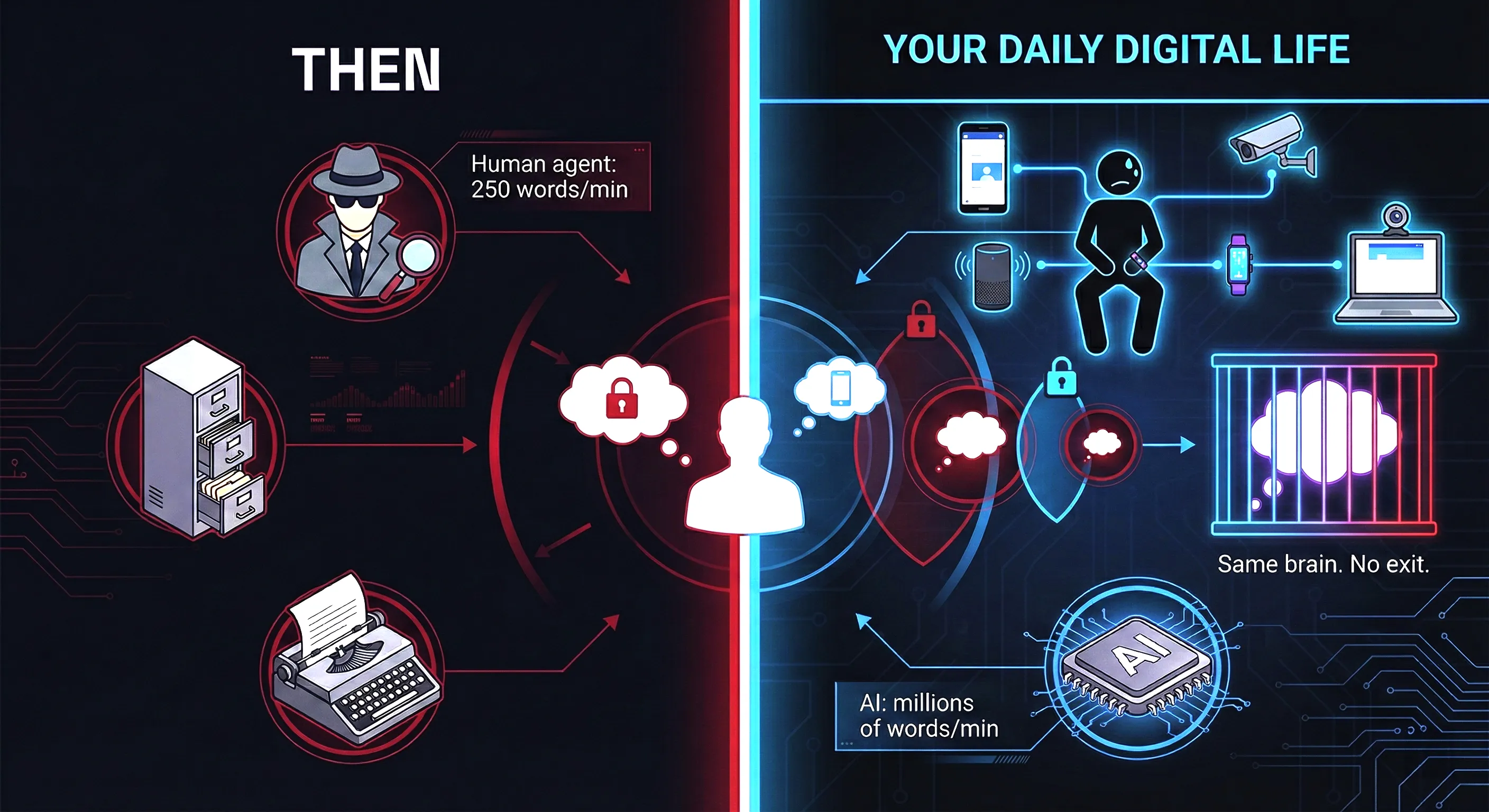
Today, there is no exit. Your phone follows you everywhere. Cameras line the streets. Algorithms track your clicks.
| Historical Surveillance | Modern Surveillance |
|---|---|
| Required human agents to follow you | Digital agents ride in your pocket |
| Agents couldn’t enter your bedroom | Your smartphone sits on your nightstand |
| Analysis took weeks or months | AI processes millions of words per minute |
| Coverage was incomplete by default | Coverage is nearly total by design |
| You could identify who was watching | You often can’t tell who collects your data |
Recommended read: The Age of Surveillance Capitalism by Shoshana Zuboff. The definitive account of how tech companies turned human experience into raw material for profit and prediction.
From Eye Scans to Brain Waves, Nothing Is Off Limits
Surveillance used to mean cameras on street corners. Now it means sensors that can read your eye movements, track your brain activity, and predict your personality. The technology has moved under your skin.
Your Eyes Give Away More Than You Think
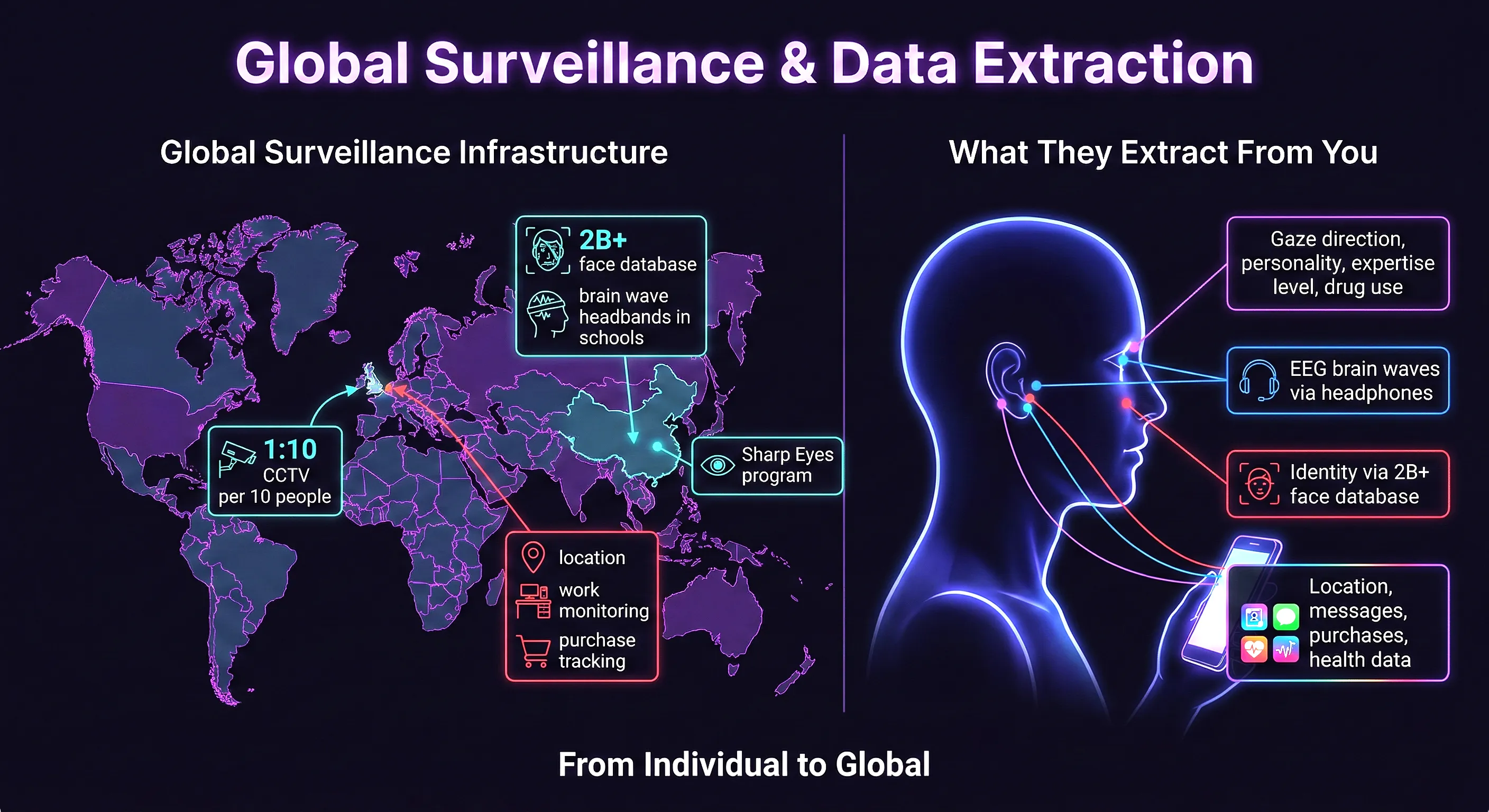
Harari describes how CCTV cameras and laptop webcams now routinely analyze eye movement data. Tiny changes in your pupils and irises lasting just milliseconds reveal:
- The direction of your gaze and what holds your attention
- Whether you’re focused, distracted, or zoning out
- Your personality traits, including openness to new experiences
- Your level of expertise in any given field
- Your preferences in everything from politics to personal interests
- Whether you’ve consumed alcohol or drugs, even at low doses
Experts display systematic gaze patterns. Novices let their eyes wander. A digital system watching your eyes can tell the difference in seconds. It’s one reason your brain may trust AI more than real people in certain contexts.
Brain Waves Are the New Frontier
Hilke Schellmann documents how electroencephalogram (EEG) technology has moved from hospitals into everyday workplaces. Companies are now reading their employees’ brain activity in real time.
- SmartCap in Australia built a hat that reads truck drivers’ brain waves and alerts them when fatigue sets in. Every worker’s data gets stored in the cloud.
- In China, “lightweight, wireless sensors” hidden in safety helmets “constantly monitor the wearer’s brainwaves.” AI algorithms detect “emotional spikes such as depression, anxiety or rage.”
- Chinese schoolchildren wear brain wave headbands during class. The data and a ranking of the kids are shared with teachers, parents, and researchers.
- MN8 headphones with EEG capabilities let companies track workers’ focus and stress levels. Managers get aggregated team data.
The South China Morning Post reported that this technology is already “in widespread use” in factories, transportation, state-owned companies, and the military.
The “Sharp Eyes” Program
Mustafa Suleyman describes China’s ambitions for total surveillance. The “Sharp Eyes” facial recognition program aims to cover 100 percent of public space. It builds on a database of over two billion faces. And it’s just one piece of a larger system that tracks purchases, messages, location, health data, and social connections.
Think that can’t happen where you live? Suleyman points out that a typical day in London already involves CCTV capture hundreds of times, work computer monitoring, purchase tracking, and phone location logging. The only missing step is bringing all those databases together.
Recommended read: The Algorithm by Hilke Schellmann. How AI secretly decides who gets hired, monitored, and fired, and why we need to push back now.
How Surveillance Slowly Erodes Your Sense of Self
The deepest damage from constant surveillance isn’t what it sees. It’s what it does to the person being watched. Over time, surveillance doesn’t just observe your behavior. It reshapes it.
The Shift from “I Will” to “You Will”
Zuboff identifies a fundamental change in human autonomy. The word autonomy comes from Greek, literally meaning “regulation by the self.” Its opposite is heteronomy, meaning “regulation by others.”
Surveillance capitalism shifts the locus of control from your choices to their predictions. “Each one of us may follow a distinct path,” Zuboff writes, “but economies of action ensure that the path is already shaped by surveillance capitalism’s economic imperatives.”
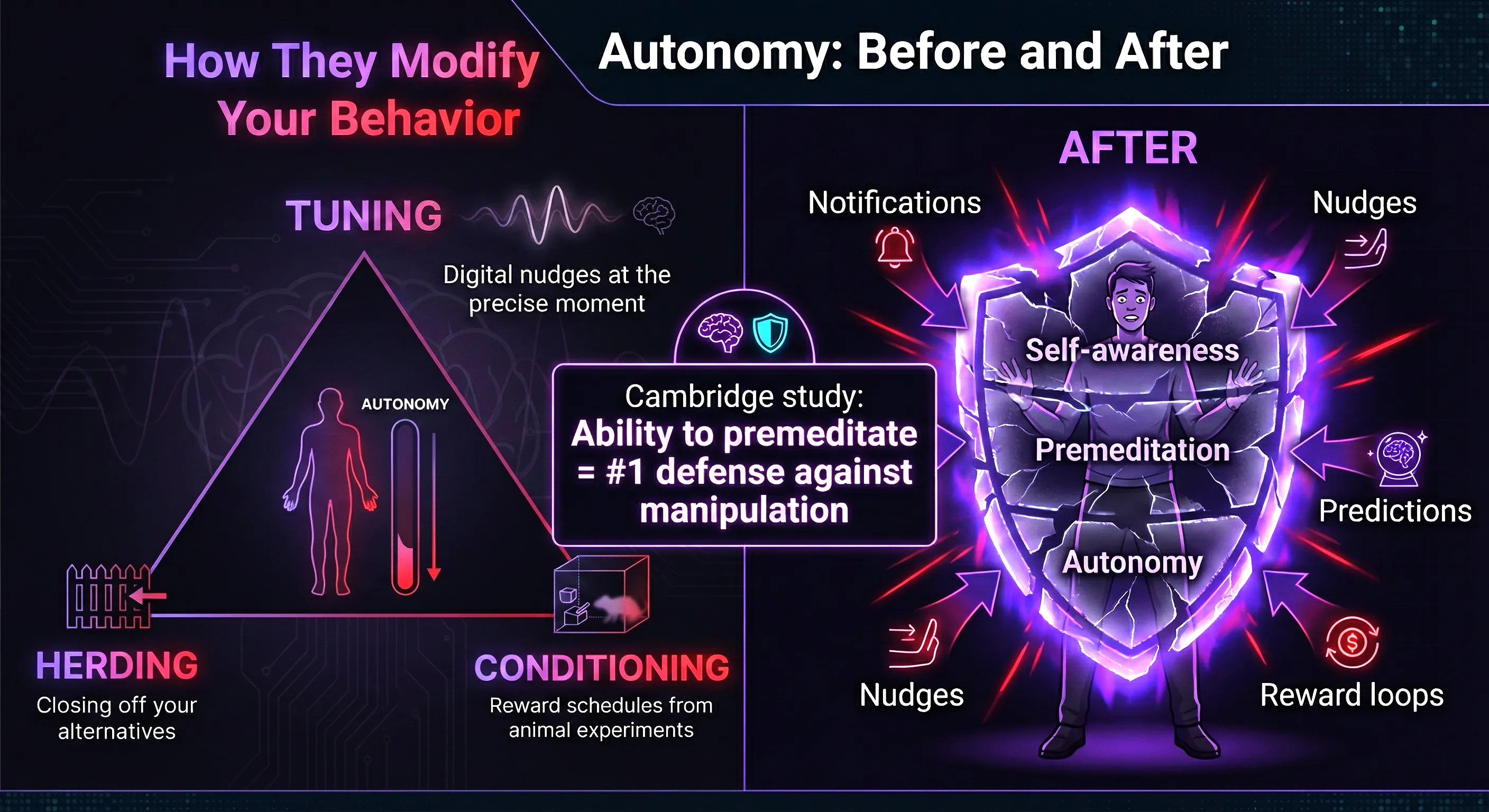
This happens through three mechanisms:
- Tuning. Subliminal cues and digital nudges that subtly shape your behavior at the precise moment for maximum influence
- Herding. Controlling your immediate environment to foreclose alternatives. Like a smart car shutting down its engine or a fridge locking you out
- Conditioning. Reinforcement schedules borrowed directly from B.F. Skinner’s animal experiments, now applied to humans at massive scale through apps, notifications, and reward systems. This is the same mechanism that apps use to hijack your dopamine system.
Research on digital dataveillance confirms the broader pattern. People’s sense of being subject to digital monitoring causes them to restrict their communication behavior. This is self-censorship in everyday digital media use, with attendant risks of undermining individual autonomy and well-being.
The “Nothing to Hide” Trap
Sandra Matz, a Columbia professor who studies psychological targeting, encounters people all the time who say they don’t care about privacy. She identifies two fallacies behind this thinking:
- The “It’s worth it” fallacy. Believing the trade (free apps for your data) is fair. It isn’t. You don’t know what you’re giving up.
- The “I have nothing to hide” fallacy. Believing privacy only matters if you’re doing something wrong.
As philosopher Carissa Veliz puts it: “Privacy is power.” When others have unrestricted access to your psychological needs, they gain the power to control what you do. And eventually who you are.
“The moment others have unrestricted access to your deepest psychological needs, they gain the power to control what you do, and eventually who you are.” - Sandra Matz
How to Protect Your Mind in a Watched World
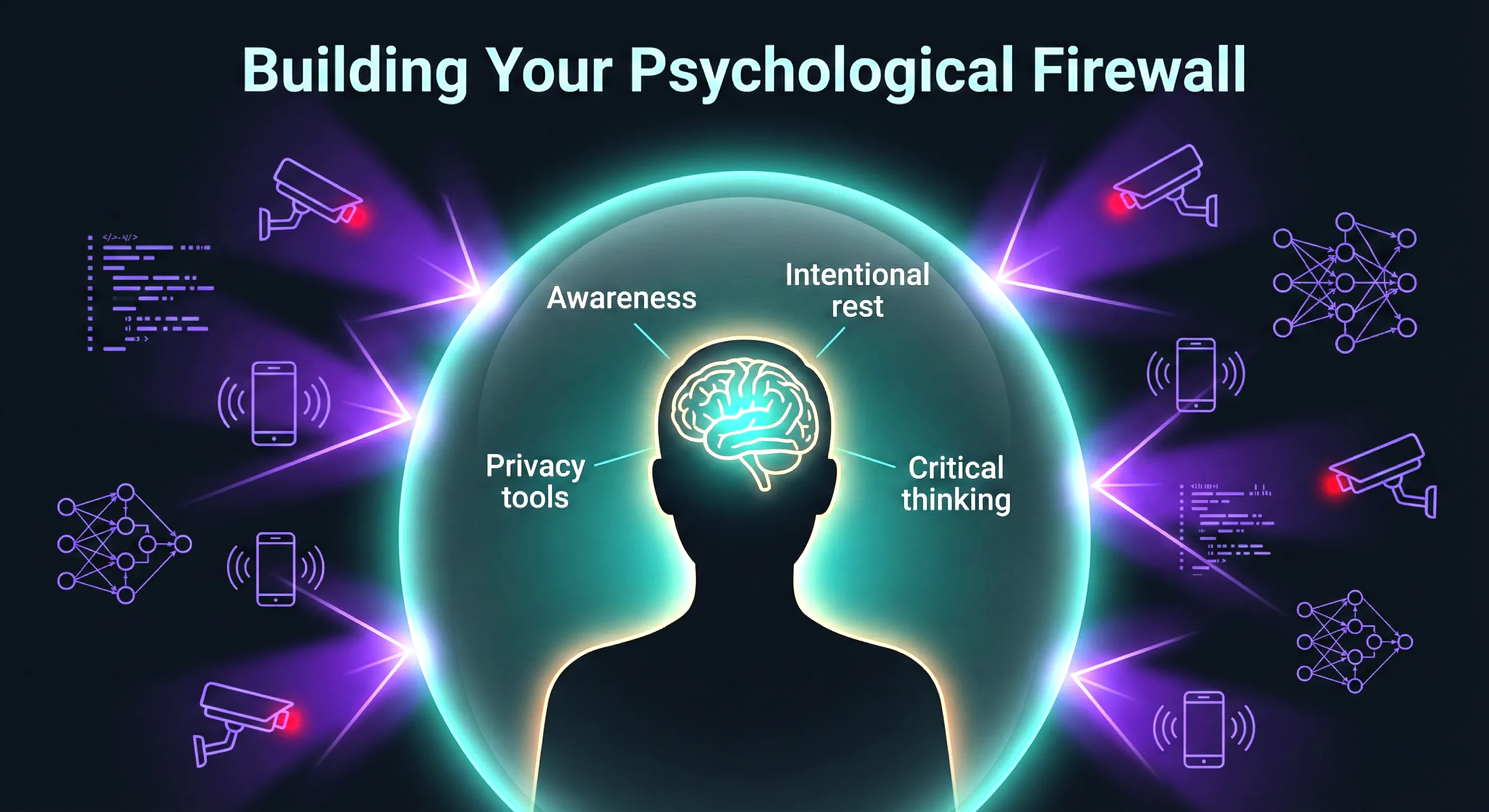
You can’t escape surveillance entirely. But you can reduce its psychological grip on you. Awareness is the first and most important step. The system works best when you don’t think about it.
-
Create intentional offline time. Harari points out that humans are organic beings who need cycles of rest. Computers are always on. You don’t have to be. Put your phone in another room for an hour each day. Let your nervous system downshift.
-
Audit your digital footprint. Check which apps have access to your camera, microphone, location, and contacts. Revoke anything that isn’t essential. Pay special attention to health and fitness apps, which often collect far more data than they need.
-
Use privacy-focused tools. Switch to browsers like Firefox or Brave. Use DuckDuckGo instead of Google. Choose encrypted messaging apps. Every switch reduces the behavioral data you generate for prediction machines.
-
Practice noticing self-censorship. Pay attention to moments when you change what you say or do because you’re thinking about who might see it. The chilling effect works best when it’s invisible. Making it visible weakens its power. The 2025 research on online self-censorship confirms that simply being aware of surveillance pressure is the first step to resisting it.[3]
-
Support structural change. Individual action matters, but the system needs new rules. Support privacy legislation. The Illinois Biometric Privacy Act is one model. It requires written consent before companies can collect biometric data and lets individuals sue for violations.
-
Protect your ability to premeditate. Research found that the single most important factor in resisting persuasion is self-awareness. The ability to think through consequences before acting. That’s exactly why surveillance capitalism targets awareness itself. Your attention is a product that companies trade on. The more aware you are, the harder you are to nudge, herd, or condition.
The Romanian Securitate didn’t have the technology to watch everyone all the time. Their real power, Harari explains, was “their ability to inspire the fear that they might be watching, which made everyone extremely careful about what they said and did.”
Today, the technology exists to actually watch everyone. All the time. The business model behind it, known as surveillance capitalism, has turned your personal data into a trillion-dollar commodity. But the psychological mechanism is the same. You change your behavior not because someone is watching, but because someone might be. And your brain can’t tell the difference.
Recommended read: Means of Control by Byron Tau. The hidden alliance between tech companies and government that built America’s modern surveillance state.